Before 1984, There Was THIS Book. And Almost Nobody Has Read It
Quick test. Without checking, name the first great dystopian novel of the twentieth century.
Most readers, if they’re being honest, will say 1984. Some will say Brave New World. A few clever ones will reach back to Jack London’s The Iron Heel or H.G. Wells’s When the Sleeper Wakes.
Almost none will say We.
Which is a problem. Because We is the book that invented most of what we now think of as dystopian fiction. It came out in 1921. Orwell admitted, on the record, that it influenced 1984.
Huxley denied being influenced by it, and the denial has not aged well — the book sits in plain sight, two decades ahead of Brave New World, doing many of the same things first. We is the missing ancestor sitting at the head of the table. Everyone is eating the meal it cooked, and nobody is saying its name.
This post is about that book, the man who wrote it, why it disappeared, and why you should read it before you read 1984 again.
The Book Russia Couldn’t Publish
We was written by Yevgeny Zamyatin between 1920 and 1921, in the middle of the Russian civil war, by a man who had been a committed Bolshevik for most of his adult life. That last detail matters.
Zamyatin wasn’t a Tsarist reactionary writing against the revolution. He was a revolutionary writing against what the revolution was already becoming. He had been arrested by the Tsarist secret police for being a Bolshevik in 1905. He was about to be arrested by the Bolshevik secret police for being a Zamyatin in 1922.

The novel he wrote in that gap was so politically dangerous that Soviet censors blocked its publication. It was the first book ever banned by the Soviet censorship board. It would not appear in Russian, in Russia, until 1988 — sixty-seven years after it was written.
Read that again. The most important Russian novel of the twentieth century could not be legally published in its own language, in its own country, for sixty-seven years.
In the meantime, the manuscript was smuggled out, translated into English in 1924, and read — quietly, in literary circles, in the original samizdat sense of quietly — by precisely the kind of people who would go on to write Brave New World and 1984.
Orwell got his hands on a French translation in 1946. He wrote a review of it that reads, on a reread, less like a review and more like a confession. Here, you can almost hear him thinking, is the book I have been trying to write.
Three years later, he published 1984.
What Zamyatin Actually Wrote
Set the dates aside for a second and look at what’s actually in the book.
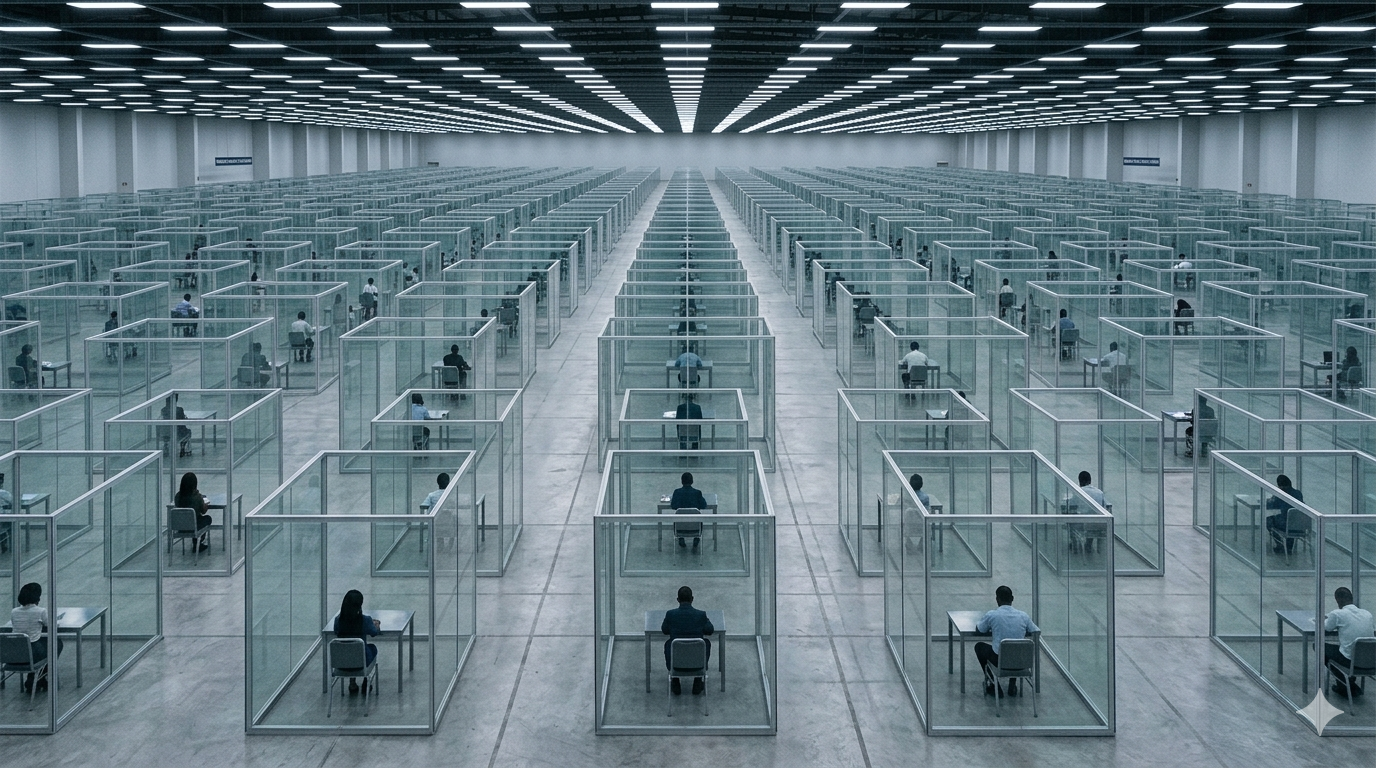
We is set in a far-future society called the One State, walled off from the rest of the planet by a great green glass barrier. Inside the wall, every aspect of life has been rationalised to mathematical perfection. People don’t have names — they have numbers.
They live in apartments made entirely of glass, so that nothing they do is hidden from their neighbours or from the state. The day is divided into precisely scheduled hours, including the two daily Personal Hours during which citizens may pull a small curtain for privacy. Sex is permitted, but only by appointment, with a pink ticket issued by the state for each encounter.
Above all of this presides the Benefactor — an elected figure who is always re-elected unanimously, year after year, in a ceremony called the Day of One Vote.
The narrator is a man called D-503. He is a mathematician and engineer. He is building a spaceship called the Integral, which the One State plans to launch in order to bring its mathematical happiness to the unenlightened populations of other planets — by force, if necessary.
D-503 is not a rebel. D-503 is, at the start of the book, the One State’s most ideal citizen. He genuinely believes the One State has solved the problem of human existence. He genuinely pities the wild and chaotic societies of the pre-revolutionary past, who lived in the catastrophe of personal choice.
And then he meets a woman called I-330, and the novel begins to come apart, the way D-503 begins to come apart.
If this sounds familiar, it should. Almost every structural beat of 1984 is here first. The total surveillance state. The protagonist who starts as a loyal cog and slowly cracks. The forbidden affair with a woman who introduces him to the appalling concept of interior life. The interrogation. The breaking. The final, devastating return to loyalty.
But Zamyatin’s version isn’t a copy of 1984. 1984 is a copy of Zamyatin. And the original is, in several important ways, more disturbing than its more famous descendant.
What We Does That 1984 Doesn’t
Three things make We genuinely strange and original, even after a century of imitators.
First: the dystopia of happiness. Orwell’s Oceania is held together by fear. Big Brother runs on terror, on torture, on the constant low-grade misery of a population that knows it is being watched. Zamyatin’s One State is held together by contentment. The citizens of the One State are not afraid.
They are not oppressed in any way they can perceive. They are happy. They love their glass apartments, their pink tickets, their scheduled hours, their unanimous votes. They look upon the chaotic freedom of pre-revolutionary humanity with the same horror that you or I might feel looking at footage of a famine. Imagine living like that. How did they bear it?
This is a more difficult dystopia than Orwell’s, because it forecloses the easy reader-response. In 1984 you can comfort yourself with the thought that you would resist. In We the question is uglier: what if you had been raised here, and were perfectly happy, and never knew anything was wrong, because nothing in your interior life had ever told you anything was wrong?
Zamyatin asked this in 1921. The question hasn’t aged a day.
Second: the dystopia of reason. The One State is not a tyranny of ignorance. It is a tyranny of logic. The Benefactor’s regime presents itself, with complete sincerity, as the rational endpoint of human progress — the moment at which mathematics finally solved the problem of human life. Every cruelty is justified with an equation. Every restriction is justified with a proof. The book’s deepest argument is not that totalitarianism is irrational, but that rationality itself, taken to its absolute, becomes totalitarian. The horror is not the loss of reason. The horror is reason fully achieved.
This is a critique you cannot find anywhere in Orwell, and frankly cannot find in most twentieth-century political writing. It is far closer to Dostoevsky than to Hayek. Zamyatin had read his Dostoevsky carefully — he was, after all, writing in Russian, and the underground man was still warm in the room. We is, in many ways, Notes from Underground with a spaceship.
Third: the dystopia of the smile. Orwell’s Party hates you. The Benefactor loves you. The One State does not need to torture its citizens, because it has already convinced them that any unhappiness they feel must be a kind of illness — a sickness called imagination, which can be cured by a simple surgical procedure that removes the offending tissue from the brain. By the end of the book, D-503 himself undergoes this surgery. He is restored to perfect happiness. He watches his lover being executed with serene mathematical satisfaction.
That ending is the moment Orwell, twenty-eight years later, will quietly steal — and soften. Winston, broken in Room 101, returns to loving Big Brother. D-503, in the closing pages of We, returns to loving the Benefactor and cannot remember why he ever stopped. Orwell’s ending is tragic. Zamyatin’s is something worse than tragic. Zamyatin’s is peaceful.
If you have ever wondered why 1984, for all its horror, feels survivable as a novel — why you can close the book and put it down — it is partly because Orwell let Winston retain enough self-awareness to suffer. Zamyatin doesn’t grant that. The book ends inside a mind that has been smoothed entirely flat, and is delighted about it.
Why Almost Nobody Has Read It
So why isn’t We on every dystopia shelf in every bookshop in the world?
A few reasons, none of them flattering to the literary establishment.
The first reason is simply that it was suppressed. A book that cannot be legally published in its original language for sixty-seven years loses generations of native readers. By the time We could be read in Russian in Russia, 1984 and Brave New World had occupied the cultural slot it should have held for half a century. The descendants had eaten the ancestor.
The second reason is Cold War politics. During the long ideological standoff of the twentieth century, Western readers were taught a clean, comforting story about dystopian fiction: we wrote it, they lived it. 1984 fit that story perfectly — an Englishman warning about Stalin from the safety of England. We did not fit. We was written by a Bolshevik warning about the future of the Bolshevik project from inside it. That isn’t a story the Cold War wanted on its bookshelves. A Soviet writer who had seen the inside of his own revolution and called it a glass cage was more useful as a footnote than as a major figure.
The third reason is translation. Early English translations of We were not good. The prose is angular, mathematical, deliberately strange — a kind of engineered Russian that mimics the engineered society it describes. Most translators, for decades, smoothed it out. They lost the very texture that makes the novel feel like a transmission from inside a totalitarian mind. The better translations have only appeared in recent years. Most readers who tried We in the 1960s or 70s bounced off prose that had been ironed flat in transit.
The fourth reason is that 1984 is, frankly, a more accessible novel. Orwell wrote in a tradition of plain English realism. Zamyatin wrote in a tradition of Russian symbolist modernism. Orwell’s narrator is a recognisable man with a stomach ulcer and a love life. Zamyatin’s narrator is a number who thinks in equations. The barrier to entry is real.
But none of these reasons amount to a literary judgment. None of them mean We isn’t the better book, or the more daring book, or the more original book. They mean only that history was unfair to it.
What You Should Do With This
Read it.
It’s short. It’s strange. It will rewire how you read 1984 afterwards. You will recognise scenes. You will recognise sentences. You will recognise the entire emotional shape of Winston Smith’s collapse, except experienced inside a mind that is even less prepared for what is happening to it.
And you will see, in a way that is hard to see from inside the more familiar book, what kind of warning dystopian fiction is supposed to be. Not a warning about one totalitarianism. A warning about the human longing for total clarity, total order, total rational happiness — the longing that the twentieth century learned, again and again, to be the most dangerous longing of all.
Zamyatin understood that longing from inside. He had felt it himself, as a young Bolshevik. He had watched it become a regime. He wrote We not as an outside critic but as someone reporting back from inside his own former dream.
That voice — the voice of someone who has loved the wrong thing and is now warning you about it — is part of what makes We something even 1984 cannot quite be. Orwell never loved Big Brother. He was always outside the dream. Zamyatin had loved his Benefactor once. That love had taught him exactly how the trick was done.
It is not an accident that the man who saw all of this first was the man who had believed in it first.
Reading Between the Lines
Here is the part that makes this post genuinely difficult to end. We is not just a forgotten book. We is, specifically, a book the twentieth century forgot in order to remember a more comfortable one. We kept the version of dystopia we could blame on other people. We lost the version that implicated everyone — every revolutionary, every reformer, every engineer of better worlds, every reader who has ever wished the human race would just get itself sorted out.
That second version is the one Zamyatin wrote. That is why he was banned in Russia, and why he is still under-read in the West, and why his name will not be on any list of major modern novelists you will encounter at school.
But the book is there. It has been there for over a hundred years now. It is waiting for the reader who is willing to be implicated.
If you have read 1984 and felt that something was missing — if you have ever closed the book and wondered why the warning, for all its terror, felt almost too clean — you have already sensed the gap We was written to fill. Read it. Then read 1984 again.
You will not read either book the same way.
And you will understand, for the first time, that the most dangerous dystopia is not the one that hates you.
It is the one that has been quietly delighted with you all along.