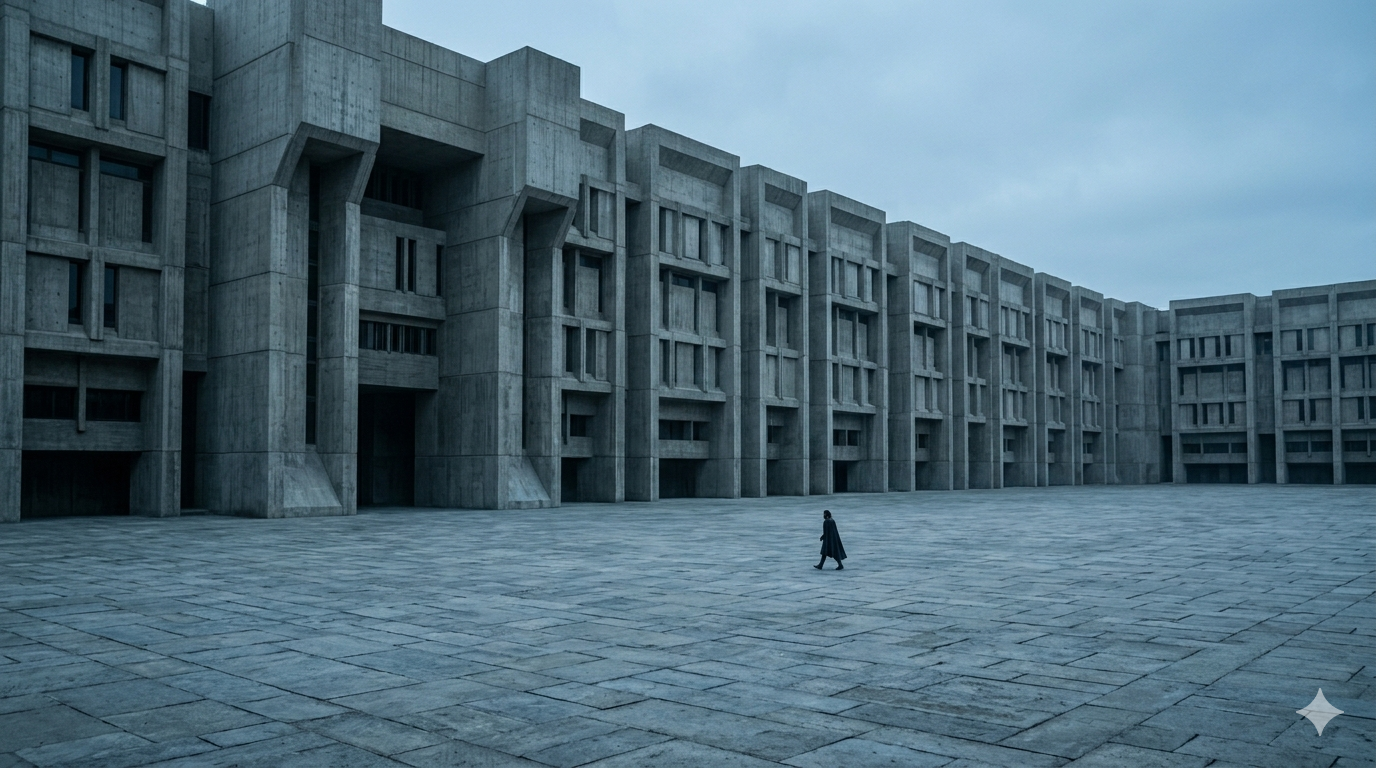
Why Totalitarian Regimes Build Massive Monuments While People Starve
In 1971, Romanian dictator Nicolae Ceaușescu visited Pyongyang. He came home transformed. He had seen the boulevards, the parade squares, the colossal statues, the entire choreographed city of Kim Il-sung, and he had decided that Bucharest needed to look like that too.
Within a decade, Romania would tear down a fifth of its capital’s historic centre — tens of thousands of houses, schools, monasteries, hospitals — and begin construction on what would become the largest building in Europe, the heaviest building in the world: the Palace of the Parliament. Rick Steves’ Travel Blog
The construction ran from 1983 to 1989. The cost, by most estimates, ran into the billions. By one accounting, the project consumed a third of Romania’s budget over five years.
During exactly those years, ordinary Romanians lived through food shortages, blackouts, and gas cuts, and rations were so deep that by the end of the decade Romania was the only country in Europe where hunger was widespread and malnutrition was on the rise. amusingplanet + 2
In 1995, in Pyongyang itself — the city Ceaușescu had so admired — a different monument went up. The Monument to Party Founding was completed in October of that year, to mark the fiftieth anniversary of the Workers’ Party of Korea. Its construction accelerated through 1994 and 1995, ensuring completion for the anniversary celebrations, even as the country slid into the catastrophe it would later officially rename.
The Arduous March, North Korea’s great famine, was already beginning. Between 240,000 and 3.5 million people would die of starvation or hunger-related illness over the next four years. The regime, meanwhile, finished its monument and unveiled it to mass rallies. It banned the words “famine” and “hunger” from official use, because those words implied government failure. Grokipedia + 2
This is not a story about two unusual men with unusual appetites. This is a pattern. The pattern is consistent enough across regimes, decades, and ideologies that it is fair to call it a rule. The deeper the famine, the bigger the monument. The longer the queues for bread, the more marble is poured into the public square.
The question is why. And the honest answer is not the one most people reach for first.
The Explanations That Don’t Quite Work
The standard explanations are all true and all insufficient.
Vanity. The dictator is a megalomaniac. He wants his name on something enormous. He cannot bear to be ordinary. This is true — Ceaușescu had a documented obsession with his own legacy, and the Kim dynasty has built a personality cult of unprecedented elaboration. But vanity by itself cannot explain why these projects are continued at such cost when continuing them is actively destabilising the regime.
By the late 1980s, the Palace of the Parliament was visibly hated by Romanians. It contributed materially to Ceaușescu’s downfall. He pressed on. Vanity does not adequately explain a man dying for a building.
Propaganda. The monument advertises the regime’s power. It impresses foreign visitors. It awes the citizenry into compliance. This too is true — and also insufficient. Propaganda can be done cheaper.
A film, a billboard, a parade, a poster. None of these require leveling a third of a capital city. If the monument were only propaganda, it would be enormously inefficient propaganda. There has to be a reason a regime chooses the most expensive available method of impressing its own population at exactly the moment that population is starving.
Corruption. Construction projects move money. Contracts are awarded to insiders, kickbacks are paid, the elite extract their share. Also true. Also insufficient.
The actual money flowing through these projects is dwarfed by what could be embezzled more quietly through ordinary state procurement. The monument is not where a sensible kleptocrat moves his money. The monument is where a regime spends money it cannot afford on something it cannot eat.
None of these explanations is wrong. All of them are surface. Underneath them is a different logic — a logic that explains why a regime would press on with a building project as its citizens collapsed in queues outside bakeries. A logic in which the building project and the empty bakeries are not in tension. They are the same operation.
What the Monument Is Actually Doing
A monument under a totalitarian regime is not a gift to the people. It is not an ornament on the state. It is a political technology — a tool the regime uses to do three specific things that no other tool can do as well.
First, the monument produces visible permanence. Totalitarian regimes have a peculiar problem that liberal democracies do not. They cannot point to elections, to constitutional continuity, to peaceful transfers of power, to any of the boring mechanisms by which ordinary governments demonstrate that they will still be here next year.
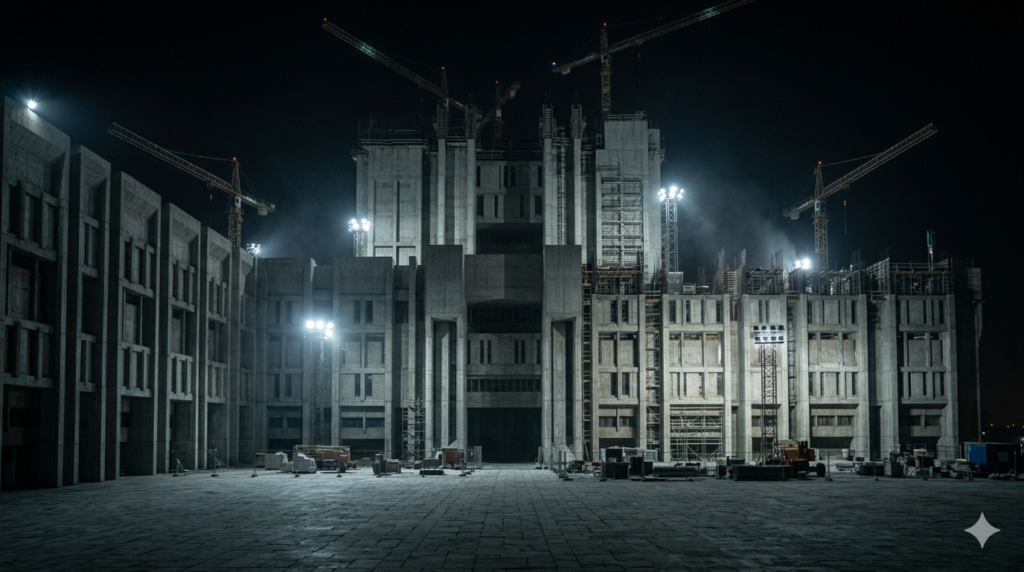
They have to manufacture their permanence from raw materials. Stone is the most durable material humans have ever worked with. To build something massive in stone is to make a claim about time itself: we will be here when you are gone.
Every citizen who passes the monument is reminded, without a word being spoken, that the regime outlasts the individual. This is not a metaphor. The Palace of the Parliament weighs 1.5 billion pounds of steel and bronze. That weight is the message. The regime is heavier than you. Atlas Obscura
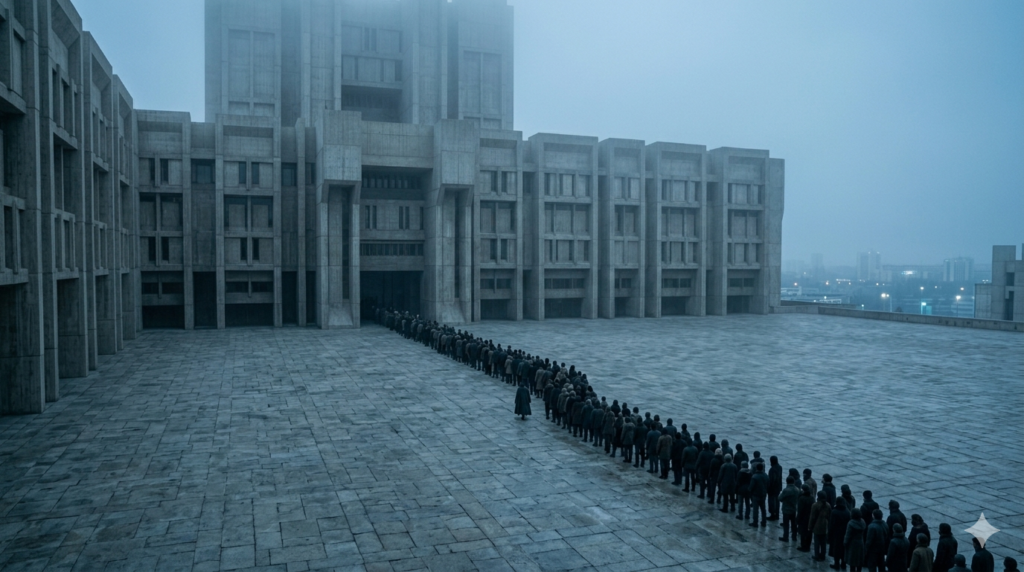
Second, the monument makes individual suffering feel small. This is the cruelest function and the most effective. A person standing in a bread queue at six in the morning, having stood there since four, with the queue not visibly moving, is in a state of profound private despair.
The despair is local, immediate, embodied. Their feet hurt. Their child is at home. Their stomach is empty. The monument, looming at the end of the boulevard, says to that person: your hunger is temporary. This is forever. Your suffering is small. This is large. Your individual life is one of many. This is one of one.
The scale of the building is calibrated, with terrible precision, to reduce the perceptual weight of personal misery. To make the citizen’s own hunger feel embarrassing, parochial, almost rude. Look how grand we are. How petty of you to be hungry inside something this large.
Third — and this is the part that surprises most readers — the consumption itself is the message. The point of the monument is not only what it is when finished. The point is also that it consumed what it consumed. The food not eaten. The medicine not bought. The hospitals not built. The houses not heated. These are not bugs of the project. They are part of its meaning.
The regime is announcing, through the act of construction itself, that it chose this. That given a choice between feeding the people and building the monument, it chose the monument.
That there was no genuine choice, because to the regime feeding the people and building the monument are the same act — the monument is what the regime feeds, the way other states feed their citizens.
The monument, in this reading, is not built despite the famine. The monument is built with the famine, the way other buildings are built with steel and concrete. The hunger is part of the construction material.
The Deepest Layer: The Regime Is the Monument
Here is where the logic gets genuinely strange, and where most analyses do not go.
A liberal-democratic government can exist without monumental architecture. Britain has had a continuous parliamentary tradition for centuries without producing a single building of the scale of the Palace of the Parliament.
The state does not require a stone embodiment in order to be real. The state is constituted by its laws, its institutions, its elections, its civil service. The buildings are incidental.
Totalitarian regimes do not work this way. A totalitarian regime is, by definition, a state in which the institutions have been hollowed out — parties merged into the leader, courts subordinated to the leader, parliaments turned into applause machines, civil society dissolved. What’s left is not an institutional state. What’s left is a will.
The will of the regime, expressed through fear, ideology, ceremony, and image. And a will, unlike an institution, cannot be inherited. Cannot be checked. Cannot be reproduced. A will dies with the body that holds it.
The monument is how the will makes itself look like an institution.
Once you see this, you can see why dying regimes build harder, not softer. Why Ceaușescu accelerated construction in his final years even as the economy collapsed. Why the North Korean regime, at the beginning of its worst humanitarian catastrophe, was finishing a monument rather than diverting concrete to anything else. Because to stop building is to stop existing.
The monument is not what the regime makes. The monument is what makes the regime. Stone is the only language in which a totalitarian state can plausibly say I will still be here tomorrow. And it must say that constantly, because nothing else about it is saying it.
This is the part the easy explanations miss. The monument is not a luxury. The monument is a life-support system. The day the cranes stop is the day the regime begins to die. Ceaușescu’s regime fell, in part, because Romanians stopped believing the cranes meant the future.
The cranes had been claiming permanence for six years, and now the queues outside the bakeries were claiming something else, and the queues won. They always do, eventually. But the regime fights the queues with stone, because stone is the only thing it has that can fight time.
Why the Dictator Looks at the Monument and Feels Calm
There is a private dimension to this that is rarely discussed. Pictures from inside the Palace of the Parliament show endless corridors of marble. Imagine being the man who built it. Imagine walking those corridors at night. The weight of the building, around you, in every direction. Marble overhead, marble underfoot, marble at every wall.
What you are walking through, if you are Ceaușescu, is the visible proof of your reign. The Palace says, every minute, you are real, you are real, you are real. Outside the palace, beyond the boulevards, in the dark Bucharest of the late 1980s, there are people whose stories are not real to you, whose hunger is a statistic and a number and a problem of distribution, and there is a population that may or may not love you, and there are foreign powers whispering about your downfall.
Inside the palace, the marble does not whisper. The marble is. It cannot lie to you. It cannot stop existing. It is the only honest thing in your kingdom.
This is why dictators love their monuments in a way that goes beyond pride. They depend on them privately, the way an insomniac depends on a particular lamp. The monument is what allows them to sleep. To stop building is to face the night without the lamp, and the night, for a man in that position, is unfaceable.
This is part of why these projects almost never get finished cleanly. The Palace of the Parliament was started in 1984; construction lasted thirteen years, finishing long after its commissioner had been executed. Parts of it are still being finished today. The monument outlives the man. It was, all along, the only thing that could. The Little House of HorrorsAtlas Obscura
Reading Between the Lines
The world has fewer Ceaușescus today than it had in the twentieth century. But the logic of the monument has not retired. It has migrated.
Look at any authoritarian-adjacent regime in the present moment and you will find a building project that does not make economic sense. Look at any state whose internal legitimacy is fraying and you will find a sudden enthusiasm for capitals, megaprojects, world’s-largest-something. The logic is the same.
The stone is the same answer to the same problem — the problem of being a will that needs to look like an institution, the problem of a power that has run out of softer ways to make itself look permanent.
This is also why dystopian fiction has always understood architecture better than most political writing does. Orwell’s Ministry of Truth is described as a vast white pyramid rising over the rooftops of London — monolithic, dominating, visible from everywhere. Huxley’s World State is built around hatcheries.
Zamyatin’s One State is enclosed in glass. Atwood’s Gilead remakes a university campus into a parade ground. Every serious dystopian novelist has understood that totalitarianism is, finally, a building problem. The regime has to be made physical. The citizens have to look up and see it. The hunger has to feel small next to it. HISTORY
And the cruel irony, the one that closes the loop, is that all of these regimes — the real ones and the fictional ones — fall in essentially the same way. The monument survives them. The Palace of the Parliament still stands in Bucharest, used now by the parliament of a country that executed the man who built it.
The Monument to Party Founding still stands in Pyongyang, currently outlasting the famine it watched arrive. The stone always wins. But it wins for whoever holds it next.
The dictator looks at his marble and thinks it will save him. The marble is not his friend. The marble is its own thing. It has its own time. It will be there when his face is removed from the wall and replaced with someone else’s.
So the next time you see a regime build something enormous while its people line up for flour, do not be confused. You are not looking at vanity. You are not looking at corruption.
You are looking at the regime keeping itself alive in the only way it knows how — by pressing more weight into the ground, by claiming more permanence than it has, by hoping the citizens will look up at the stone and forget, for a moment, what their hands are empty of.
The marble is heavy because the regime is light. That is the whole secret. That is what the monument is for.


