
Winston Smith Would Not Have Lasted A Week – Here’s Why
Let’s say the unsayable thing about 1984.
Winston Smith is a terrible rebel.
Not in the brave, tragic, doomed-from-the-start way the book is usually read. In a much more ordinary way. The man is, by any reasonable spy-craft standard, an absolute disaster.
If you handed his behaviour to anyone who’d lived through an actual police state — a Stasi defector, a Soviet dissident, a Romanian under Ceaușescu — they would close the book in the first fifty pages and tell you Winston is already dead, he just hasn’t been informed yet.
This isn’t a knock on Orwell. It’s the whole point. 1984 isn’t really about a clever man outwitting a totalitarian state. It’s about a fundamentally average man who is constantly broadcasting his rebellion and being slowly, lovingly walked toward his own destruction. The horror of the book lives in that gap — between how careful Winston thinks he’s being, and how obvious he actually is.
Let’s count the ways.
1. He Buys a Diary in a Shop the Party Almost Certainly Watches
The opening act of rebellion in the entire novel is Winston going to a junk shop in the prole quarter and buying a beautiful, conspicuous, cream-papered notebook. He’s a Party member walking into a part of the city Party members are not supposed to frequent, buying an object whose only realistic use is writing things you shouldn’t be writing.

This is, generously, the equivalent of buying a balaclava and a crowbar from a shop across the street from a police station and waving at the camera on the way out. The shop turns out to be a Thought Police front. Of course it does. The wonder isn’t that the Party catches him. The wonder is that he thought a junk shop in a regime that monitors junk shops was somehow off the grid.
Week one. Strike one.
2. He Writes in the Diary While Sitting in Front of His Telescreen
Winston spends a lot of mental energy on his clever little alcove — the one corner of his flat where the telescreen can’t quite see him if he tucks himself in just right.
Reread that. He has identified the exact spot in his own home where he believes he is invisible to a device that watches him for every other hour of his life. He then goes to that spot, repeatedly, at predictable times, holding a forbidden object, performing a forbidden activity, with a facial expression that he himself describes as suspicious.
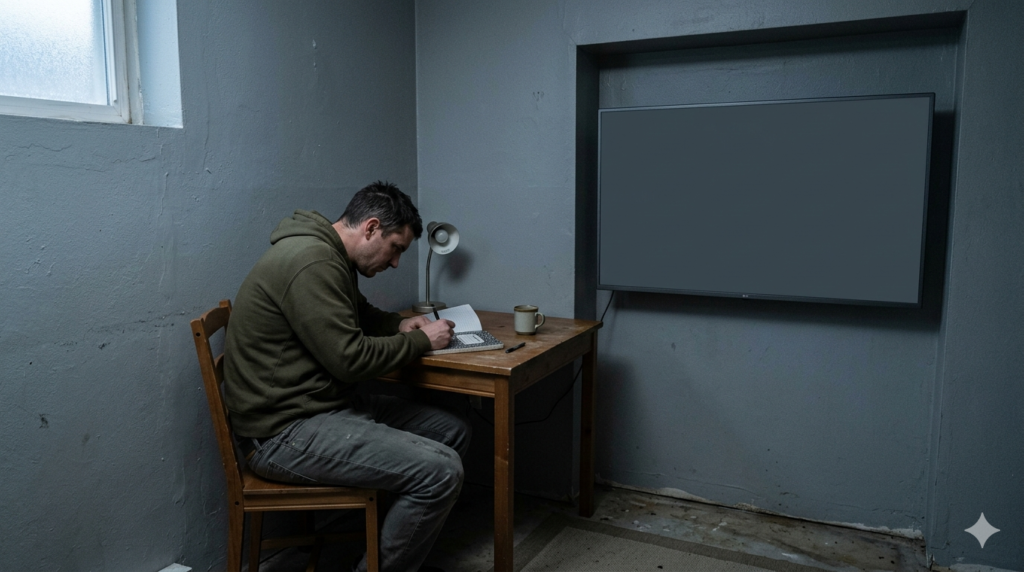
If you were the Thought Police and you had even a junior officer assigned to Winston’s flat, what would tip you off faster than a man who always sits in the same blind spot at the same time of evening?
Behavioural pattern recognition was not invented by Big Brother. It was invented by every uncle who has ever noticed his nephew sneaking out the back door at the same hour every Friday.
The alcove isn’t a hiding place. It’s a flashing neon sign.
3. His Facial Expression Is, by His Own Admission, a Confession
Orwell tells us early and often that facecrime is a thing — having the wrong expression in public is itself an offence. Winston knows this. Winston thinks about it constantly. And Winston spends most of the novel walking around London with what he himself describes as a face that could betray him at any moment. A twitch. A grimace. A flicker of contempt during the Two Minutes Hate.

A genuinely careful man in a regime that polices micro-expressions would have spent years training his face into a default mask of mild, slightly stupid enthusiasm. That’s what real survivors of police states learned to do. You become boring. You become unmemorable. You learn to look like you agree even when your insides are screaming.
Winston, on the other hand, walks around looking like a man who is about to commit a crime and feels bad about it. That isn’t rebellion. That’s a tell.
4. He Falls for the Most Obvious Trap in the Building
Let’s talk about O’Brien.
O’Brien is a senior Inner Party official. He has the kind of access, status, and intelligence that doesn’t get handed out by mistake in a regime built on paranoia. He doesn’t just survive the system — he runs parts of it. And Winston, on the basis of a single ambiguous look across a corridor, decides this man is secretly part of the resistance.
Stop and think about how absurd that is. In a society where everyone is taught from childhood to perform loyalty perfectly, Winston sees one Inner Party member glance at him meaningfully and concludes: that one’s on my team. It’s the logic of a man who desperately wants to be saved, not the logic of someone who has any idea how power actually works.

A real dissident in a real totalitarian state would not have looked at O’Brien and seen an ally. A real dissident would have looked at O’Brien and seen exactly what he was — a senior officer of the system, smiling, watching, waiting. Winston walks into O’Brien’s apartment essentially holding a confession in both hands.
The shocking thing isn’t the betrayal. The shocking thing is that Winston was ever surprised by it.
5. He Trusts Julia Within a Week
Julia hands him a note that says I love you in the middle of a workplace surrounded by surveillance. He reads it. He keeps it. They start meeting. He tells her, almost immediately, that he hates the Party, that he wants the Party destroyed, that he is willing to do anything to bring it down.
He has known her for a matter of days.
There’s a version of 1984 where Julia turns out to be Thought Police herself, and it would have changed almost nothing about the plot, because the speed at which Winston confides in her is reckless beyond belief.
The fact that she isn’t an agent is, in a way, the only piece of genuine good luck Winston gets in the entire novel. And he wastes it, because he treats luck like vindication. She loved me back. I was right to trust her. No, Winston. You weren’t right. You were lucky. There is a difference, and learning it is the first skill of anyone trying to survive a regime that has eyes everywhere.
6. He Rents a Room. Above the Shop. From the Man Who Sold Him the Diary.
This one is so bad it’s almost comic.
Having already bought a forbidden notebook from Mr. Charrington’s shop, Winston returns to that same shop, run by that same man, and rents a private room above it for secret meetings with his lover. He congratulates himself on how clever this is. A room with no telescreen. A landlord who seems sweet. A little nest above the city where the Party can’t reach.
The room has a picture on the wall. The picture, of course, hides a telescreen. Mr. Charrington, of course, is Thought Police. The whole arrangement, of course, has been a stage set for months.
What’s striking on a reread isn’t the betrayal. It’s how absolutely predictable the betrayal is in retrospect. Winston has essentially designed his own cage and paid rent on it.
Any halfway-suspicious mind would have asked: why is this so easy? Why is this old man so accommodating? Why is there a convenient room with a convenient view and a convenient landlord who conveniently dislikes the Party? Winston asks none of these questions, because Winston wants to believe.
That’s the deepest flaw in him. He doesn’t see what’s in front of him because he’s desperate for it to be what he hopes.
So Why Does Orwell Write Him This Way?
Because Winston isn’t supposed to be a hero. Winston is supposed to be you.
This is the part most readings of 1984 miss. Winston is not a trained operative. He’s not a revolutionary. He’s not even particularly courageous. He’s a clerk.
A small, ordinary, slightly sickly man with a varicose ulcer and a complicated relationship with his ex-wife. His “rebellion” is exactly the kind of rebellion most of us would manage — sloppy, emotional, desperate, hungry for connection, terrible at security, and far too quick to trust the first person who seems to be on our side.
Orwell isn’t writing about a man who almost outwits the Party. He’s writing about a man whose every move betrays him, and a Party so total that it doesn’t even need to be clever — it just has to wait.
The novel’s most chilling argument is hidden in Winston’s clumsiness: this is what all of us would look like, trying to resist. Not the romantic dissident with the false papers and the safehouse. The shaking man in the alcove, writing in his diary, certain he’s invisible.
A real spy would have lasted longer than Winston. A real revolutionary would have known better than to trust O’Brien on a glance. But Orwell isn’t writing about real spies. He’s writing about the human nervous system under a regime built to break it. And what he’s quietly telling us is that ordinary courage — the only kind most of us have — is not nearly enough.
Reading Between the Lines
If you reread 1984 and treat Winston’s mistakes as plot holes, you’ll feel let down. The book seems clumsy. Why doesn’t he hide better? Why does he trust so fast? Why does he never stop to wonder if O’Brien is exactly what he appears to be?
But read those same mistakes as the point, and the book becomes something far more frightening. Orwell isn’t testing whether a clever man can defeat the Party. He’s showing that ordinary humans — soft, lonely, hopeful, eager to be loved — cannot survive a system built on the assumption that we will betray ourselves out of sheer emotional need.
Winston wouldn’t have lasted a week against the Stasi. He wouldn’t have lasted a weekend against the KGB. He doesn’t last in Oceania either. He was never meant to.
That’s not the failure of the character. That’s the warning of the book.
The Party wins not because it’s stronger than us. It wins because it understands us better than we understand ourselves — and because most of us, in Winston’s shoes, would also rent the room above the shop, sit in the alcove with the diary, and walk smiling into the office of the kind man with the meaningful look.
We would tell ourselves we were being careful.
And we would be wrong in exactly the same way.


