Why Winston Smith Was Always Going to Fail
There is a particular kind of reader who finishes 1984 feeling that Winston Smith was unlucky.
If he had been more careful. If he had not trusted O’Brien. If he had found a better hiding place for the diary. If Julia had not broken first, or if the Brotherhood had been real, or if the Thought Police had given him a little more time. This reader closes the book with the sense that the story might have gone differently, that failure was contingent, that some adjustment to the plot could have produced a different ending.
This reading is wrong. Not because it misreads the plot but because it misunderstands what the novel is arguing.
Winston Smith was never going to succeed. Not because Orwell was a pessimist, and not because the Party is simply too powerful to be defeated in narrative terms. Winston was going to fail because the novel is constructed to demonstrate that the particular kind of resistance Winston attempts is the kind the Party has already accounted for. His failure is not a tragedy of circumstance. It is a tragedy of structure. The Party does not defeat Winston Smith. Winston Smith defeats himself, and the novel shows you exactly how, from the first pages.
I want to trace the argument here. Not the plot, which is well known, but the argument the plot is making about the nature of resistance, the nature of selfhood, and the nature of what it means to try to remain human inside a system designed to eliminate the possibility.
The Diary and What It Reveals
Winston’s first act of resistance is keeping a diary. He buys a notebook, finds a corner of his flat outside the telescreen’s angle of vision, and begins to write.
The act feels heroic. It is the act the reader is meant to identify with, because the reader is also someone who reads and writes, someone for whom the recording of private thought seems like a fundamental human right. When Winston opens the diary, we are on his side. The diary is resistance.
But the novel immediately complicates this.
Winston writes the date at the top of the first entry and then finds he cannot think of anything to say. He sits with the pen in his hand, watching the ink dry, and eventually begins writing about a film he saw the night before, a film in which a helicopter bombed a lifeboat full of refugees while the audience cheered. He writes rapidly and feverishly, and when he stops he discovers that what he has written, over and over, is DOWN WITH BIG BROTHER.
He does not remember deciding to write this. The phrase simply appeared on the page.
This is the first signal the novel sends about the nature of Winston’s resistance. His rebellion is not reasoned. It is not strategic. It is not the product of a careful analysis of the regime and a considered decision to oppose it. It is an eruption. DOWN WITH BIG BROTHER surfaces from Winston’s unconscious the way a symptom surfaces in a body that is trying to expel something it cannot digest.
The Party, as O’Brien will explain much later in the Ministry of Love, has always known about this kind of resistance. They call it thoughtcrime. They have built an entire apparatus to detect and manage it. Winston’s diary is not a threat to the Party. It is a data point. It confirms what the Thought Police already suspected, which is that Winston Smith is the kind of person who writes DOWN WITH BIG BROTHER in the margins of his own consciousness.

The diary does not endanger the Party. It endangers Winston.
The Problem of the Past
Winston’s central obsession, which the novel tracks with great care, is the past.
He believes, with a conviction he cannot fully justify, that the past was different from what the Party says it was. He believes that there was a time before Big Brother, a time when clocks struck twelve and people were not watched and the facts of history were stable. He cannot prove this. The Ministry of Truth, where he works, has destroyed the evidence. The old newspapers have been revised. The photographs have been altered. The memories of the people who lived through the period before the Revolution have been worn down by decades of contradictory information until they can no longer distinguish what they actually remember from what they have been told to remember.
Winston has scraps. A glass paperweight. A half-remembered rhyme about churches. A photograph he once held in his hands for thirty seconds before dropping it into a memory hole. A feeling, more than a memory, that things were different.
He wants to recover the past because he believes that if the past can be established as real and stable, it provides a ground on which to stand against the Party’s version of the present. If he can prove that the past was different, he can prove that the Party is lying about the present. If the Party is lying, its authority is illegitimate. If its authority is illegitimate, resistance is justified.
This is a coherent argument. It is also, as the novel demonstrates, exactly the wrong argument to make against the Party.
The Party’s power does not rest on being believed. It rests on being obeyed. O’Brien makes this explicit in the conversations in the Ministry of Love. The Party does not claim to represent truth. It claims to constitute truth. The Party says two plus two equals five, and it does not need Winston to believe that two plus two equals five. It needs Winston to say it. The distinction is everything.
Winston spends the novel trying to find evidence that the Party is wrong. O’Brien spends the last third of the novel explaining to Winston that evidence is irrelevant. The past is not something that exists independently and can be recovered. The past is what the Party says it is, because the Party controls every mechanism by which the past is recorded, transmitted, and remembered.
Winston cannot win this argument. He is trying to fight a war over facts in a world where facts are produced rather than discovered. The weapon he is trying to use does not work against the enemy he is fighting.
The Question of Julia
Winston’s relationship with Julia is the emotional centre of the novel, and it is also, on careful reading, one of the clearest demonstrations of why his resistance cannot succeed.
Julia is a more effective resister than Winston in every practical sense. She is not interested in the grand political questions that obsess Winston. She does not care about the Brotherhood or the theory of oligarchical collectivism or the nature of the past. She cares about pleasure. She smuggles real coffee and real sugar and real chocolate. She sleeps with Party members she despises and feels no guilt about it because she has learned to separate her inner life from her outer performance completely. She rebels from the waist downwards, as Winston observes, and what he means is that her rebellion is bodily and immediate rather than ideological and abstract.
In the world of the Party, Julia’s approach is considerably more survivable than Winston’s.
Winston cannot do what Julia does, because Winston cannot separate his inner life from his outer performance. He is constitutionally unable to say two plus two equals five without caring whether it is true. He is unable to participate in the Two Minutes Hate without some part of him standing outside the performance and watching himself perform. He is unable to live inside the contradiction that Julia inhabits without difficulty.
This is what makes Winston sympathetic to the reader. It is also what makes him legible to the Thought Police. O’Brien identifies him at a glance, across a room, during the Two Minutes Hate. Winston cannot hide what he is, not because he is careless but because what he is cannot be hidden. He is a person for whom the relationship between interior and exterior matters. He cannot perform a self that is not connected to an interior.
The Party has built its system to destroy exactly this kind of person.
O’Brien and the Trap
The relationship between Winston and O’Brien is the novel’s most carefully constructed argument about the nature of resistance and its limits.
Winston has believed for years that O’Brien is a secret rebel. He has no real evidence for this. He has a feeling, an impression, a sense communicated in a single glance during the Two Minutes Hate that O’Brien shares his understanding of the world. This feeling is enough for Winston to trust O’Brien completely when the opportunity presents itself.
What Winston is doing, without knowing it, is projection. He sees in O’Brien the thing he most needs to believe exists: another consciousness like his own, another person who stands outside the Party’s version of reality and sees it for what it is. O’Brien is intelligent, authoritative, physically impressive. He represents, to Winston, the possibility that the kind of person Winston is can also be the kind of person who survives.
O’Brien is not that person. O’Brien is the Party’s most sophisticated product: a man who has so thoroughly internalised the Party’s logic that he can simulate the consciousness of a dissident perfectly enough to draw out a real dissident and destroy him. Whether O’Brien believes what he says in the Ministry of Love, whether he ever had doubts of his own that he suppressed, is a question the novel deliberately leaves open. What the novel does not leave open is the use to which he has been put.
Winston’s trust in O’Brien is not a mistake he could have avoided by being more careful. It is a structural consequence of what Winston is. A person who believes in the value of consciousness, of the interior self, of the reality of human connection, will seek out other such people. In Oceania, that search leads directly to the Ministry of Love, because the Ministry of Love has positioned O’Brien precisely there to intercept it.
The trap is not a trap that a smarter or more cautious Winston could avoid. It is a trap built out of the materials of Winston’s own humanity.
Room 101 and What It Proves
The final stage of Winston’s destruction is Room 101, where each prisoner faces the thing they fear most, and where Winston, confronted with the cage of rats, betrays Julia completely.
The betrayal is not a failure of love. Winston loves Julia. He betrays her not because the love was insufficient but because there is a level of suffering at which the self dissolves and there is nothing left to love with. Room 101 is the Party’s proof that there is no self that cannot be unmade, no loyalty that cannot be broken, no interior that cannot be reached and emptied.
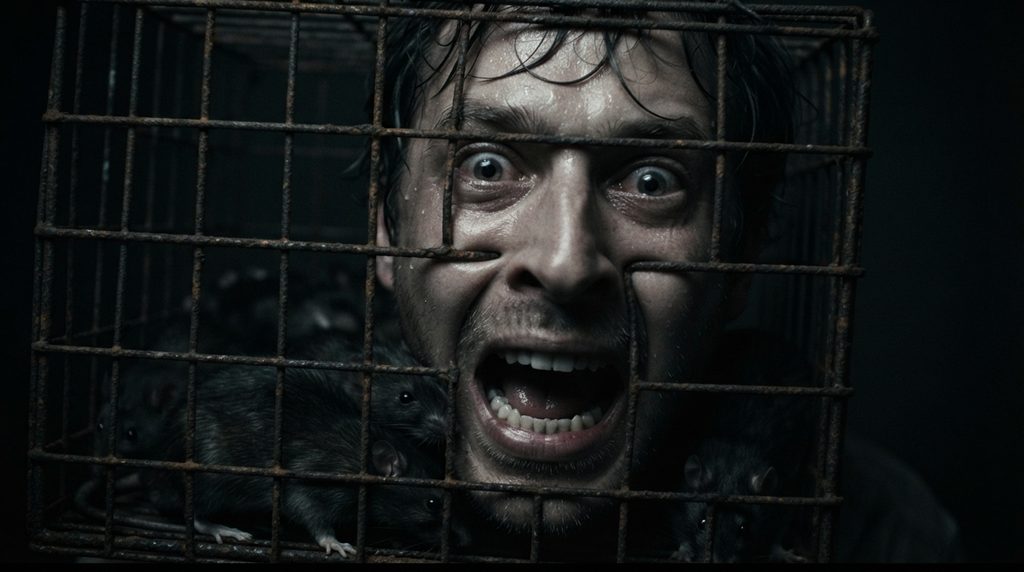
Winston enters Room 101 believing, at some level, that there is something inside him that the Party cannot touch. This is the residue of his faith in the individual self, in the interior consciousness that he has been trying to defend throughout the novel. Room 101 is designed to prove that this faith is wrong. There is no inviolable self. There is only behaviour, and behaviour can always be modified if you apply sufficient pressure in the right place.
After Room 101, Winston is not defeated. He is remade. The novel’s final image of Winston sitting in the Chestnut Tree Cafe, drinking Victory Gin, with tears running down his face as he gazes at the portrait of Big Brother, is not an image of a man who has given up. It is an image of a man who no longer exists in any meaningful sense. The thing that would have needed to give up is gone.
He loves Big Brother.
The novel does not say he pretends to love Big Brother. It does not say he performs love for Big Brother while secretly retaining his rebellion in some protected interior. It says he loves him. The interior has been reached. The self has been unmade.
What the Novel Is Arguing
The question the novel is genuinely asking is not whether Winston could have succeeded. It is whether the kind of person Winston is can survive inside the kind of system the Party has built.
The answer is no. Not because the Party is all-powerful in some abstract sense, but because the Party has been built specifically to destroy the kind of selfhood Winston represents. The Party has studied the type. It knows that people like Winston will keep diaries, will seek out others like themselves, will believe in the reality of the past, will trust the wrong people, will reach a point in Room 101 where the self dissolves. The Party has built its system around these facts. Winston is not an individual who happens to fail. He is a type who is guaranteed to fail, because the system was designed with his type in mind.
This is Orwell’s most uncomfortable argument, and it is the one most readers step around by focusing on the unluckiness of Winston’s specific circumstances.
The argument is not that totalitarianism is too powerful to resist. Orwell was not a quietist, and 1984 is not a novel that argues for passivity. The argument is more specific: that the kind of resistance available to an individual acting alone, inside a fully realised totalitarian system, using only the materials of his own consciousness and the connections he can form with one or two other people, is exactly the kind of resistance such a system is best equipped to absorb and destroy.
Winston fails not because he is weak. He fails because he is fighting with the wrong weapons against an enemy that has already catalogued those weapons and built the countermeasures.
What the right weapons might look like, and whether they are available at all, is the question the novel refuses to answer.
That refusal is not a flaw. It is the most honest thing Orwell could have done.