The Time Machine Was the First Dystopia, and It Already Knew Everything
There is a quiet fact about the history of dystopian fiction that almost no general reader registers.
When people are asked to name the foundational dystopian novel, they say 1984. Sometimes they say Brave New World. Sometimes, if they are more widely read, they say We. These three novels, published in 1949, 1932, and 1924 respectively, occupy the foundational position in the canonical genre history.
Almost no one says The Time Machine.
H. G. Wells published The Time Machine in 1895. That is twenty-nine years before We, thirty-seven years before Brave New World, and fifty-four years before 1984. It is a short novel. It is fewer than ninety pages in most editions. It is widely read. It is widely taught.
It is taught as science fiction. It is taught as adventure literature. It is taught as the foundational time-travel narrative. It is taught as proto-dystopia, occasionally, in a way that treats it as a forerunner of the real dystopian tradition that arrived later.
It is rarely taught as dystopia in the full sense. It is rarely treated as a major political novel. It is rarely read for the analytic work it is performing, which is, on a careful reading, more rigorous than the work many of the canonical dystopias perform.
This post is an argument that the canon has the chronology wrong. The Time Machine is not a forerunner of dystopian fiction. The Time Machine is one of the foundational dystopian novels of the genre. It belongs, by any honest measure, on the shelf with Orwell and Zamyatin and Huxley, rather than on the science fiction shelf where it has been quietly filed for over a century. The work it does is the dystopian tradition’s work. It does that work earlier than anyone else, and in several respects it does it better.
The Book in Brief
A short summary, for readers who have not read the novel or who have forgotten its specifics.
An unnamed Victorian gentleman, referred to throughout the book only as the Time Traveller, invites a group of friends to dinner. He tells them he has built a machine that can travel through time. They are sceptical. He demonstrates a small working model. They remain sceptical. He sends them away.
A week later, the Time Traveller appears at his next dinner party in a state of physical exhaustion and dishevelment. He claims to have travelled forward to the year 802,701. He tells his guests what he found there.
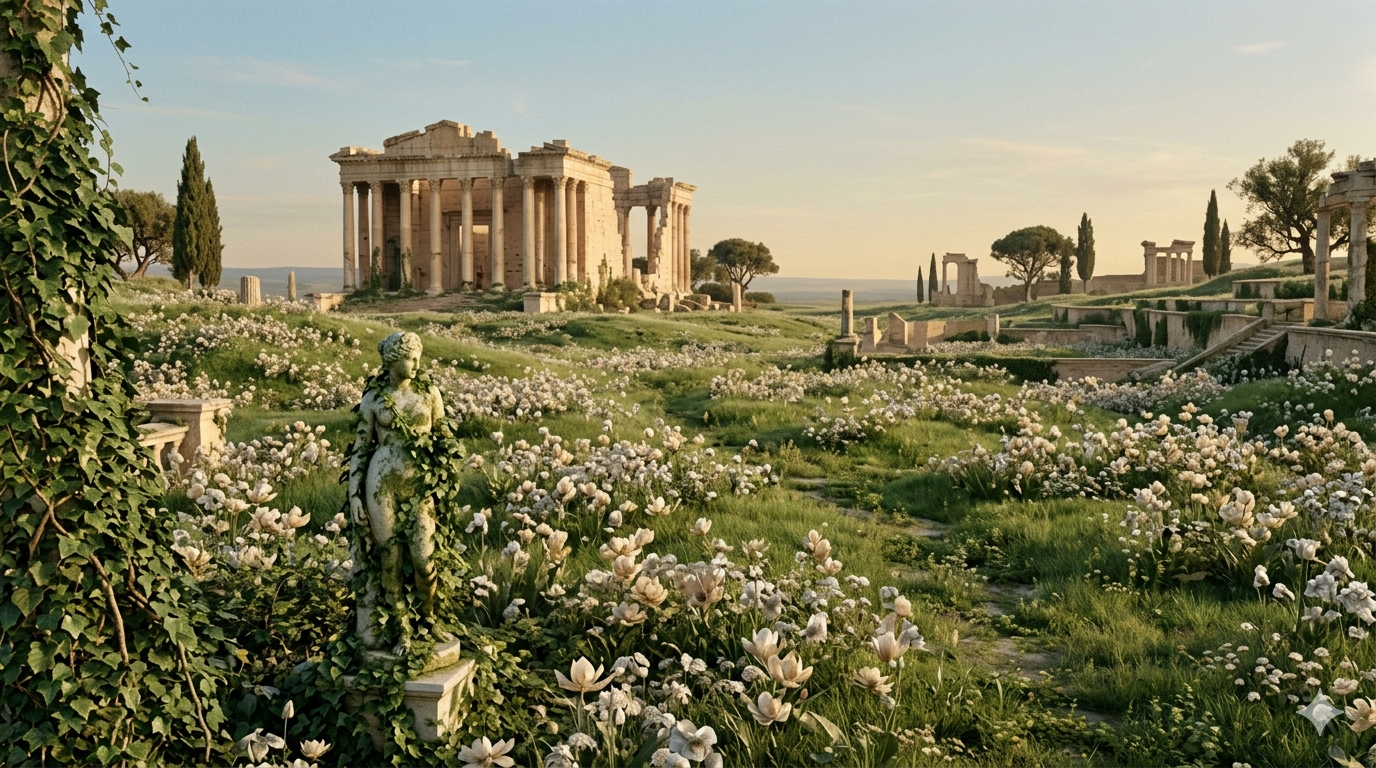
The world of 802,701 is, on its surface, a paradise. The landscape is gentle. The climate is mild. The buildings are beautiful, though decayed. The inhabitants, a small graceful people called the Eloi, live in apparent ease. They do not work. They do not study. They do not produce. They eat fruit, they bathe in rivers, they play, and they sleep.
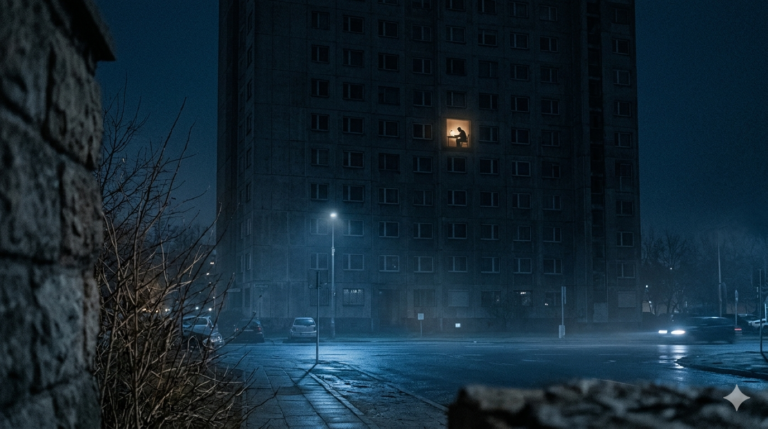
The Time Traveller, after some days among the Eloi, becomes aware that the world contains another population. The Morlocks live underground. They are pale, eyeless or nearly so, accustomed to dark and to machinery. They emerge at night. They are, the Time Traveller eventually discovers, the descendants of the working class of his own century, who have been driven below ground over hundreds of thousands of years of social separation.
The Eloi are the descendants of the leisure class. The Morlocks are the descendants of the workers. The two species have evolved into different forms of life, no longer interfertile, no longer recognising each other as kin.
The arrangement, at first, appears to be one of stratification, with the surface-dwelling Eloi enjoying the labour of the underground Morlocks. The Time Traveller eventually realises he has the arrangement backwards. The Morlocks have not been enslaved by the Eloi. The Morlocks farm the Eloi. They emerge at night and take Eloi for food. The Eloi, beautiful and useless, are livestock.
The Time Traveller escapes back to his own century. He tells the story. He shows his guests a few flowers an Eloi woman gave him, which appear to belong to no botanical family his guests recognise. The novel ends with the Time Traveller departing again, in search of either confirmation or escape. He does not return.
That is the plot. The work the novel is doing is something different.
What the Eloi Are For
The popular reading of the Eloi treats them as the novel’s tragic figures. They are beautiful. They are childlike. They are doomed. The Time Traveller’s growing affection for one of them, Weena, gives the novel its emotional centre. When she dies in a forest fire, the reader is invited to feel the loss as a human loss, and to feel that the Morlocks’ eventual victory over the Eloi will be a tragedy.
The careful reading is harder on the Eloi than this. The Eloi are not, in any meaningful sense, the novel’s victims. The Eloi are the novel’s evidence.
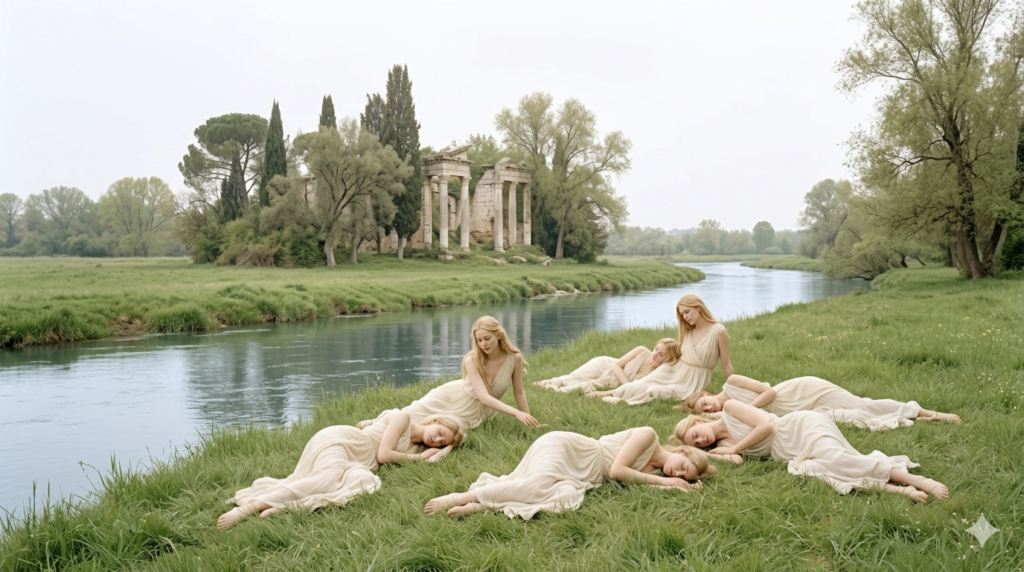
The Eloi are what the leisure class becomes if the leisure class is permitted to evolve unchecked across hundreds of thousands of years. They have inherited every advantage. They have inherited the gardens, the buildings, the climate, the surface of the planet. They have inherited the absence of labour. They have inherited the absence of struggle. The result, Wells argues, is not a higher form of human life. The result is a lower one.
The Eloi cannot read. They cannot remember. They cannot ask questions. They cannot follow a story longer than a few minutes. They cannot, in any sustained way, attend to their own situation. They are gentle, but the gentleness is not a moral achievement. It is what is left when the capacity for vigilance has been removed by hundreds of generations of having nothing to be vigilant about.
This is one of the most precise pieces of political analysis in nineteenth-century English fiction, and it has been almost entirely missed by the popular reading. Wells is making an argument the canonical dystopian tradition will spend the next century slowly catching up to. The argument is that comfort, sustained across enough generations, will produce a population incapable of recognising the conditions of its own existence.
This is, in compressed form, the same argument Huxley will make in Brave New World. The Eloi are the World State citizens, evolved over a much longer timescale. They have not been engineered by hatcheries. They have been engineered by inheritance. The result is the same. They are beautiful. They are content. They are completely unable to perceive the situation they are inside.
Huxley is sometimes credited with inventing the dystopia of pleasure. Huxley did not invent it. Wells invented it, in 1895, in a novel Huxley had certainly read.
What the Morlocks Are For
The Morlocks are even more misread than the Eloi. The popular reading treats them as monsters. They are described as pale, ape-like, eyeless, predatory. They emerge at night. They consume the Eloi. They are, in the popular reading, the novel’s antagonists.
The careful reading is significantly different.
The Morlocks are the descendants of the working class. Wells is explicit about this. He gives the Time Traveller a sustained passage of theorising, midway through the book, in which the Traveller works out what must have happened over the intervening millennia. The working class, driven by industrial conditions further and further below ground, eventually became a subterranean species. They retained the machinery. They retained the capacity for work. They retained, in some altered form, the capacity for sustained collective action.
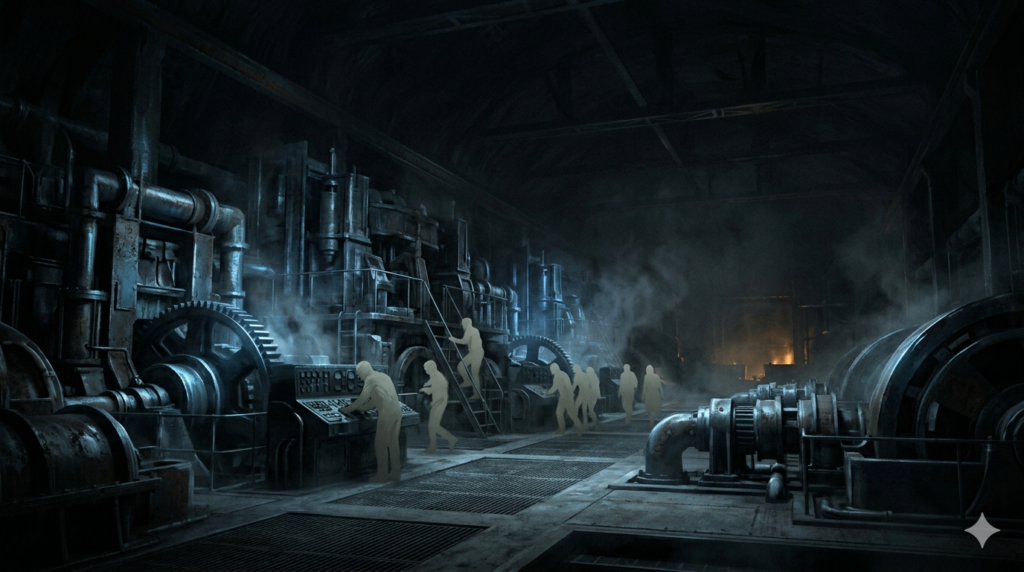
The Eloi, meanwhile, having lost every challenge that might have kept them sharp, became the soft useless creatures they are by 802,701. The two populations developed in opposite directions, but the underground population kept the capacities that the surface population lost. The Morlocks can remember. They can plan. They can act. They have, in Wells’s analysis, retained what the Eloi have shed.
What this means, in the novel’s economic terms, is that the relationship between the two populations has reversed. The surface dwellers used to live off the labour of the underground workers. By 802,701, the underground workers live off the bodies of the surface dwellers. The Morlocks no longer make goods for the Eloi to consume. The Morlocks raise the Eloi the way the Eloi’s ancestors once raised cattle.
This is one of the most rigorous pieces of political imagination in dystopian fiction. Wells is not predicting a class war. Wells is predicting a much stranger outcome, in which class separation, taken across a long enough time, produces not conflict but cohabitation, with the former owners now functioning as the food source for the former workers, and neither population aware of the original relationship from which the current arrangement derives.
The Morlocks are not monsters. They are the future of organised labour, after organised labour has been driven so far underground that it ceases to be recognisable as labour at all. They are, in their way, the only characters in the novel who can still do anything. They retain agency. They have not lost the capacity for collective action. They have, in Wells’s analysis, simply directed that capacity at the only food source available to them.
The novel asks the reader to feel horror at the Morlocks. The novel also, in its quieter passages, asks the reader to feel something more complicated. The Morlocks are the descendants of the people whose ancestors were exploited by the Eloi’s ancestors. The novel is not, finally, a moral fable in which the Morlocks are wrong and the Eloi are right. The novel is a piece of political economy, conducted at the timescale of evolution, in which the historical arrangement has produced its own slow reversal.
What the Time Traveller Is For
The Time Traveller himself is one of the most carefully constructed narrators in nineteenth-century fiction, and almost no one notices.
He is not a hero in the conventional sense. He is not particularly brave. He is not particularly principled. He is, in his own descriptions of himself, often confused, occasionally foolish, frequently mistaken about what he is observing.
This is deliberate. Wells has constructed a narrator whose limitations are part of the novel’s argument.
The Time Traveller, on first arriving in 802,701, makes immediate and confident judgements about what he is seeing. He assumes the Eloi are the descendants of all humanity. He assumes their world is a paradise. He assumes the absence of struggle is the achievement of utopia. These early judgements are presented as the natural reactions of a Victorian gentleman encountering a strange landscape.
The novel then, slowly and patiently, corrects every one of these judgements. The Eloi are not all of humanity. The world is not a paradise. The absence of struggle is not utopia. Each correction is delivered to the Traveller through experience, not through argument. He has to find out the truth by encountering the Morlocks, by losing Weena, by watching the dynamics of the two populations under conditions of stress.
This is one of the novel’s quietest pieces of formal sophistication. The narrator’s wrongness is the novel’s pedagogy. Wells is teaching the reader, alongside the Traveller, that initial appearances are not adequate to political analysis. The Traveller arrives expecting one thing and finds another. The reader, identified with the Traveller, is brought through the same process.
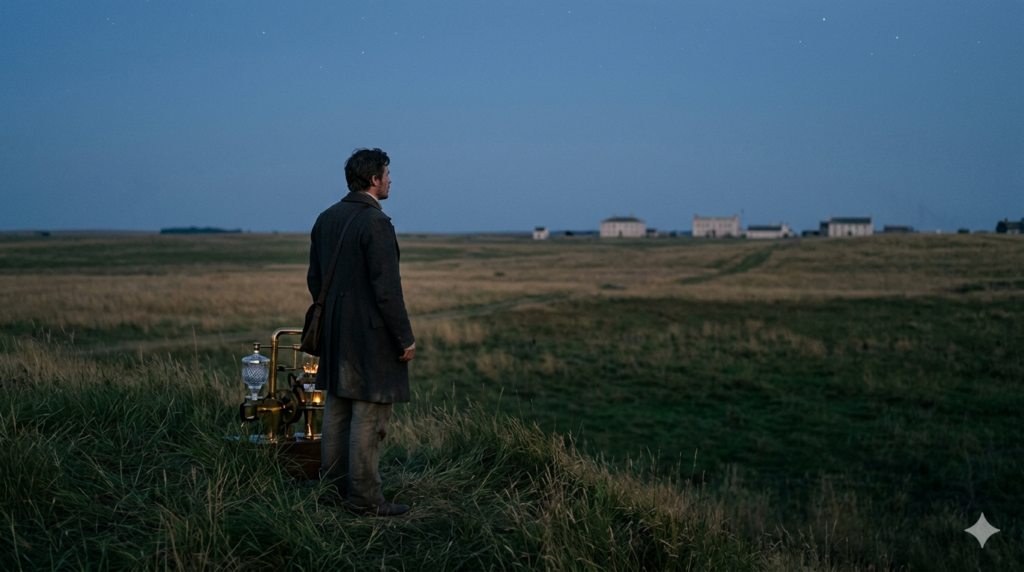
By the end of the book, the Traveller has become a different kind of observer. He no longer trusts his first impressions. He has learned to look for the second population, the underground arrangement, the hidden structure that the visible world is built on top of. He has acquired, through the experience of the novel, a particular kind of political seeing that he did not have when he started.
This is the seeing the dystopian tradition will be developing for the next century. The seeing that does not take landscapes at face value. The seeing that asks what produced the visible arrangement. The seeing that looks for the underground machinery behind the surface paradise.
Wells, in 1895, has already invented this mode of seeing. He has built it into the structure of his narrator. The Time Traveller is, by the end of the book, the kind of reader the dystopian tradition will spend a century trying to produce.
What the Novel Predicted
The novel was published in 1895. It is set in 802,701. It depicts the consequences of social separation across roughly eight hundred thousand years.
The standard reading is that the novel is a piece of evolutionary speculation, in which Wells extrapolates from Victorian class divisions into a remote evolutionary future. The novel is read as an extreme thought experiment, with its timeline so distant that the relevance to the present is meant to be primarily allegorical.
The careful reading is more uncomfortable.
What Wells actually predicted, in compressed form, has been arriving on a much shorter timescale than the novel’s eight hundred thousand years would suggest. The bifurcation of human populations into a surface class with no productive function and a hidden class that maintains the infrastructure has not required hundreds of thousands of years. It has been visible, in different forms, throughout the twentieth and twenty-first centuries. The visible affluent population that consumes the products of a hidden labour force whose conditions it does not see or examine. The leisure class that has lost the cognitive equipment to perceive its own situation. The working population that has retained the capacity for sustained labour but has been driven, geographically and politically, into spaces the leisure class does not visit.
The arrangement is not literal. There are no Morlocks emerging from underground tunnels at night to eat anyone. The political form, however, is recognisable. Wells described the form. The form has been arriving, in modified versions, for more than a century, well in advance of the eight hundred thousand years he gave it.
This is one of the most striking pieces of dystopian prediction in the genre, and it has been almost entirely uncredited. Wells did not predict surveillance. He did not predict pharmaceutical management. He did not predict the saturation of language with state speech. The major dystopian techniques credited to the twentieth-century tradition were not his contributions.
What he predicted instead was something the twentieth-century tradition has mostly failed to render with the same precision. He predicted what happens to people, across long periods, when their relationship to labour and to the conditions of their own life is broken. He predicted what the leisure class becomes when it is permitted to evolve without challenge. He predicted what the working class becomes when it is permitted to evolve without contact with the people who depend on its labour.
He predicted, in other words, the slow biological-political consequences of social separation. The other dystopians predicted regimes. Wells predicted what would happen if there were no regime at all, only the unchecked continuation of nineteenth-century class arrangements across enough time for evolution to act on them.
In its way, this is a darker prediction than any of the twentieth-century dystopias. The twentieth-century dystopias depict regimes that have done something to their populations. Wells’s novel depicts a future in which nothing has been done. The arrangement is simply the result of nineteenth-century England continuing for another eight hundred thousand years without anyone intervening to stop the slow biological consequences of class separation. The horror is not the regime. The horror is the absence of one. The horror is what happens to populations when no one is doing anything to them, when they are simply allowed to continue.
Why the Canon Has Been Slow to Recognise This
It is worth asking why The Time Machine has not been treated as a foundational dystopian novel in the canonical genre history.
A few reasons.
The first is the science fiction framing. Wells is known as one of the founders of science fiction, alongside Jules Verne. His novels are filed in the science fiction tradition by both publishers and academic departments. The dystopian tradition has been treated as a separate genre, and Wells’s contributions to it have been claimed by the science fiction side of the divide rather than the dystopian side.
This is a categorical accident. The two traditions overlap heavily, and many of the foundational works of dystopia, including Zamyatin’s We and Huxley’s Brave New World, also contain substantial speculative apparatus. The fact that Wells’s apparatus is more elaborate than theirs is not a reason to exclude him from the dystopian tradition. It is, on a careful reading, the very thing that makes his dystopian analysis possible.
The second is the timeline. The Time Machine is set so far in the future that the relevance to the present is easy to dismiss. A novel set in 1984 or in a near-future Gilead is felt as a warning about a recognisable future. A novel set in 802,701 can be filed as evolutionary speculation, with the political content treated as a remote thought experiment rather than a present-tense argument.
This too is a misreading. Wells set the novel so far in the future precisely because he wanted to show the long-term consequences of present-day arrangements. The eight hundred thousand years is not a way of distancing the argument from the present. It is a way of showing the present what it is producing on a long timescale. The novel is not, finally, about 802,701. The novel is about 1895, and what 1895 is in the process of becoming.
The third is the novel’s brevity. The Time Machine is short. The major dystopian novels of the twentieth century are not. There is a cultural assumption that major political novels must be long, that the seriousness of their political analysis correlates with their page count. Wells’s novel, at fewer than ninety pages, does not look like the canonical dystopias on the shelf. It looks slimmer, lighter, more readily consumed.
This is also a misreading. The compression of the argument is one of Wells’s achievements. He has built, in fewer than ninety pages, an analysis that has taken later writers four hundred or five hundred or seven hundred pages to develop. The brevity is the precision, not the limit.
The fourth, and the most important, is the cultural memory of Wells himself. Wells is remembered, in general literary culture, as a populariser. As a writer of adventure stories. As an optimist who believed in technological progress. None of these is fully accurate, but all of them have shaped how his novels are received. The dystopian tradition is associated with serious, often pessimistic political analysis. Wells, the popular memory holds, was the cheerful one. His novels are read accordingly.
This is the most damaging of the four reasons, because it is the one that most directly prevents readers from taking the novel seriously as political analysis. Wells, in The Time Machine, is not cheerful. He is grim. He is grim in a way that the rest of his career sometimes obscures but that is unmistakable on the page when the novel is read carefully. The argument is bleak. The vision is bleak. The novel is bleak.
The cultural memory of cheerful Wells has been protecting readers from the bleakness of his foundational dystopia for over a century. Recovering the novel requires setting the cultural memory aside.
Reading Between the Lines
The argument of this post is small and specific.
The Time Machine is a foundational dystopian novel that has been quietly mis-shelved by the canonical genre history for over a century. It performs, in compressed form, the central analytic work the dystopian tradition would spend the next hundred years developing. It does this work earlier than anyone else and, in several respects, more precisely.
The novel deserves to be read as dystopia. It deserves to be taught alongside Orwell, Zamyatin, Huxley, and Atwood. It deserves the close-reading attention the major novels of the twentieth-century tradition routinely receive and that this novel almost never gets.
The work the novel is doing is the dystopian tradition’s work. The seeing it produces in its narrator is the seeing the tradition will spend a century developing. The political form it describes, the bifurcation of populations across long timescales into incompatible biological and political forms of life, is the form that several other dystopian novels will partially attempt and that none will render with the same compression and precision.
The novel is on the shelf. It has been on the shelf for a hundred and thirty years. It is widely available. It is short. It can be read in an afternoon.
Read it again. Read it as a dystopian novel this time. Notice that the Eloi are the World State citizens, evolved across a longer timescale. Notice that the Morlocks are not monsters but a piece of long-term political analysis. Notice that the Time Traveller is being taught, through his experiences, the same kind of political seeing the later dystopian tradition will be teaching its readers.
The novel knew everything. It knew it in 1895. The canon has been slow to admit this.
There is no reason to keep being slow.
The novel is short. The argument is precise. The shelf is wrong.
Move the book.