Lord of the Flies Is Not About Children. It’s About What the Adults Trained Them to Become
There is a way Lord of the Flies gets taught, and the way is one of the most consistent misreadings in twentieth-century English literature.
The teaching runs like this. A group of British schoolboys are stranded on an uninhabited island after a plane crash. They attempt, at first, to organise themselves along civilised lines. They elect a leader. They hold meetings. They light a signal fire. The civilisation does not hold. The boys gradually descend into savagery. They paint their faces. They hunt. They kill. By the end of the novel, two of them are dead by violence, the island is on fire, and the remaining boys are being rescued by a passing naval officer who is appalled by what he finds.
The lesson the teaching draws from this is straightforward. Human nature, beneath the thin veneer of civilisation, is fundamentally violent. Remove the structures that contain it, and the violence will emerge. The boys are not anomalies. They are humanity in microcosm. The novel is a demonstration of what we all are, underneath.
This lesson is so widely taught that most readers absorb it without considering whether the novel actually supports it. The novel, on a careful reading, does not. The novel supports something much more specific and much more uncomfortable, which is a critique of the adults who produced the boys in the first place.
The boys do not descend into savagery because human nature is savage. The boys reproduce, with terrifying precision, exactly the behaviours they have been trained to perform by the institutions that raised them. The novel is not a study of natural depravity. The novel is a study of inheritance. The boys have inherited a specific set of practices, hierarchies, and habits of mind from British boarding school culture and from the wartime adult world they were being evacuated from. Stripped of supervision, they do not become natural. They become more completely what they were already being taught to be.
This is the argument the careful reading recovers. The novel is not about children. The novel is about what the adults trained them to become.
The First Clue Is in the Boys’ Own Voices
The opening chapters of the novel are usually read as a moment of innocence, before the savagery sets in. The boys are wandering the island. They are discovering the lagoon. They are calling each other by school nicknames. They are, in the popular reading, still mostly children.
A careful reading of these chapters reveals something else. The boys are not, at any point, behaving like ordinary children. The boys are behaving like products of a very specific institution.
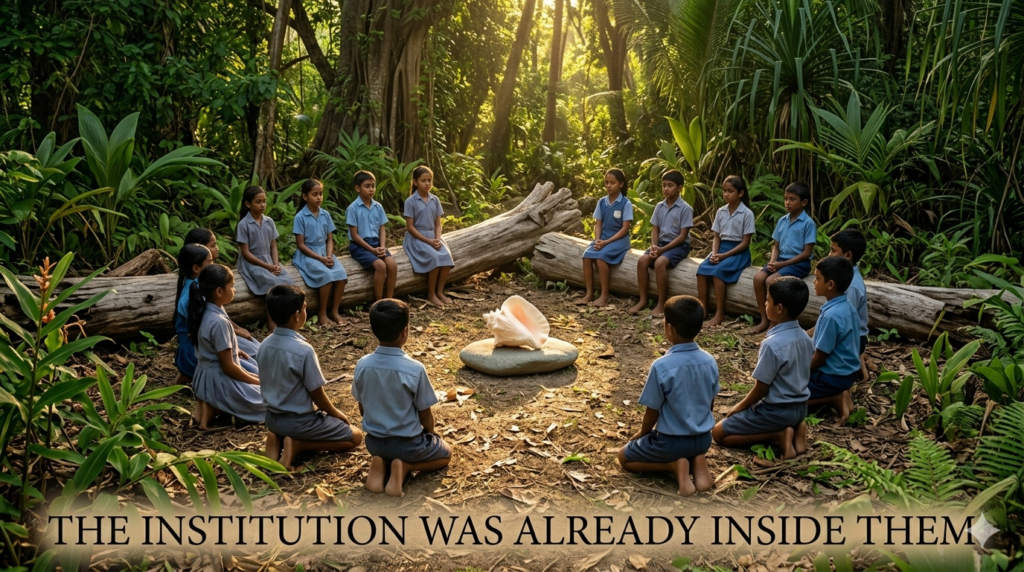
Listen to how they speak. They address each other by surnames, in the manner of British public schools. They organise themselves around the conch shell as if it were a parliamentary mace, complete with the conventions of who may speak and when. They elect a leader by show of hands. They appoint committees. They divide labour. They use, when describing their situation, the language of adventure stories aimed at boys of their class. They reference Coral Island and Treasure Island. They imagine the whole experience as a kind of project.
This is not the behaviour of children encountering an unsupervised situation. This is the behaviour of children who have been trained, for years, to organise themselves along specific institutional lines, and who, finding themselves without adults, immediately reproduce those lines without anyone having to suggest it.
Golding is signalling, in these early chapters, what the boys have been made into before the novel began. The boarding school has done its work. The boys have internalised its forms. When the supervising authority disappears, the forms do not disappear with it. The forms continue, performed now by the boys themselves, in the absence of the adults who originally enforced them.
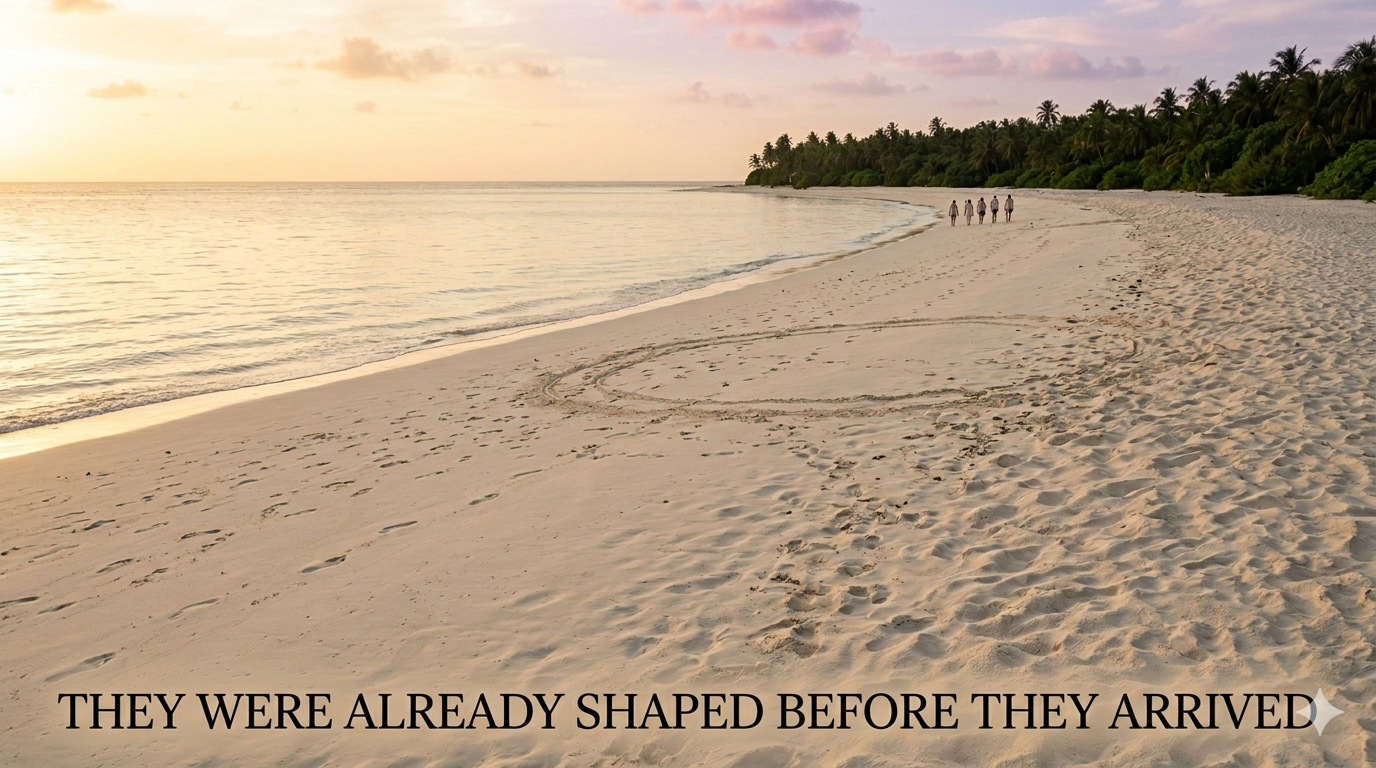
This is one of the most important features of the novel, and the popular reading almost never registers it. The boys are not innocent at the start of the book. The boys are already shaped. The shaping has been done by an institution the novel does not bother to describe in detail, because the novel assumes the reader knows what British boarding school culture looks like and what it does to the boys who are raised inside it.
The boys do not need to invent hierarchy. Hierarchy is already in them. They do not need to invent ritual. Ritual is already in them. They do not need to invent the practices that will eventually destroy them. The practices are already in them, embedded by the institution they have been removed from but not yet released from.
What Jack Already Knew
The figure who emerges as the novel’s antagonist is Jack Merridew. Jack is introduced in the first chapter as the head of a choir, marching the choir across the beach in formation, still wearing their black robes despite the tropical heat.
This introduction is doing more work than most readings register.
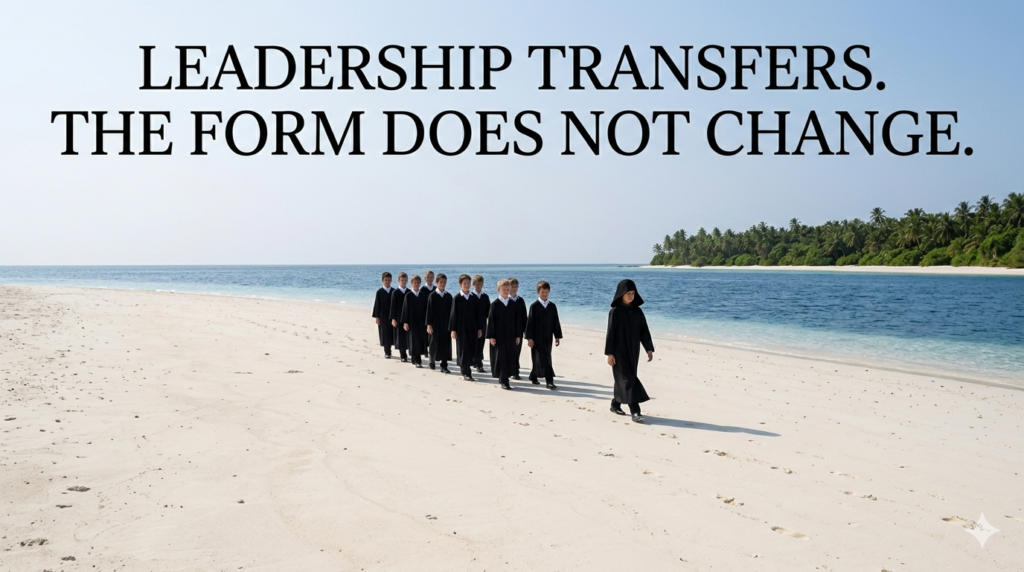
Jack is not, in the first chapter, a wild child. Jack is the most institutionally formed of all the boys on the island. He has been a chorister. He has been a head chorister. He has, by his own account, exercised authority over other boys for some time before the novel began. He is in his school uniform. He is marching his subordinates in formation. He addresses them by surnames. He demands obedience and receives it.
When Jack later in the novel becomes the leader of the hunters, paints his face, and presides over the ritualistic killing of Simon, the popular reading treats this as a descent. Jack has fallen. He has lost his civilised self and become a savage.
The careful reading is darker. Jack has not fallen. Jack has been promoted. He has gone from being the head of a choir to being the head of a different kind of formation, but the formation is the same in its essential structure. There is a leader. There are subordinates. There are rituals. There are uniforms, now made of paint rather than robes. There is the demand for obedience and the receipt of it.
What Jack has done, over the course of the novel, is to transfer his existing institutional skills from one context to another. The boarding school trained him to lead a choir. The island situation requires him to lead something else. He does not need to invent a new mode of leadership. The mode of leadership he already has, the mode the school trained him in, transfers smoothly to the new situation. He becomes a hunter-leader the same way he was a chorister-leader. The form is identical. Only the content has changed.
This is one of the novel’s most uncomfortable arguments, and it is the argument the popular reading most thoroughly erases. Jack is not the natural opposite of civilisation. Jack is what civilisation produces when it raises boys to lead other boys. The hierarchies Jack establishes on the island are continuous with the hierarchies he was raised inside. The cruelty he demonstrates is continuous with the cruelty British public schools were famous for, and that Golding, a teacher himself, had observed directly.
The face paint is not the rejection of British schooling. The face paint is the school uniform adapted to the new context. The hunting rituals are not the rejection of British public ceremony. The hunting rituals are the public ceremony of choir performance, adapted to a different purpose. Jack has not abandoned his upbringing. Jack has applied it.
What Piggy Could Not Inherit
The novel’s saddest figure is not Simon, who dies a martyr’s death. It is not Ralph, who survives but is broken. It is Piggy.
Piggy is the only boy on the island who is not from the same social background as the others. The novel signals this immediately. Piggy speaks in a different accent. He uses different vocabulary. He is from a lower-middle-class background, raised by an aunt who runs a sweet shop. He is, the other boys quickly recognise, not one of them.
The popular reading treats Piggy as the figure of intelligence and reason, contrasted with the others’ descent into irrationality. He has the glasses. He has the conch. He has the ideas about how the boys should organise themselves. He is the closest thing the novel has to an audience surrogate, the figure most readers identify with.
The careful reading is harsher. Piggy is not, in fact, the figure of reason in the novel. Piggy is the figure of exclusion. He is the boy who has not been to the right school. He has not learned the codes the others have learned. He has not been shaped by the institution that shaped the others. He has, in some respects, a clearer view of what is happening on the island, but he has no purchase on the boys around him, because he was never one of them in the first place.
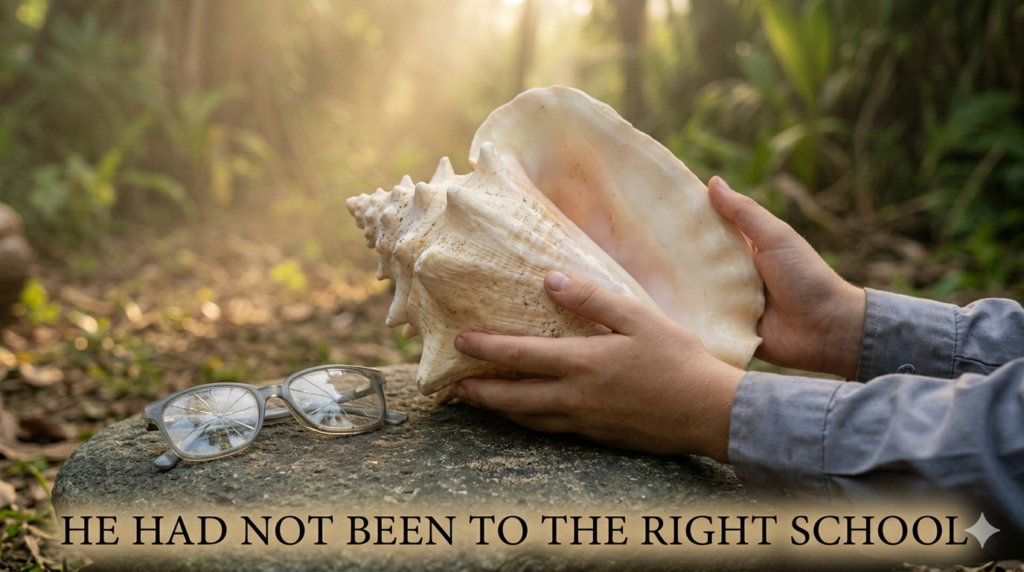
This is why Piggy’s interventions, throughout the novel, are so consistently dismissed by the others. He is not dismissed because his ideas are wrong. He is dismissed because he is the wrong sort. He speaks the wrong way. He has the wrong body. He came from the wrong background. The other boys have been trained, by the institution they were raised in, to recognise these markers and to disregard the person who carries them.
Piggy’s death is, in the popular reading, the moment the novel’s last piece of civilisation is destroyed. The conch shatters. Piggy falls. The boys’ descent into violence is complete.
The careful reading is different. Piggy’s death is the moment the institution finally completes its work on him. The boys who throw the rock down on him have been trained, all their lives, to find Piggy worthy of contempt. They have not, in killing him, abandoned their training. They have fulfilled it. The killing is the logical endpoint of the social system that produced them, applied to the boy that system was designed to exclude.
This is one of the most quietly devastating things in twentieth-century English fiction. Piggy does not die because the boys have descended into savagery. Piggy dies because British class culture, in concentrated form, will eventually kill the boy who does not belong. The boarding school does this slowly, over years, through humiliation, exclusion, and the steady production of an inner life that comes to believe in its own inferiority. The island, without adults to slow the process, does it in a few weeks.
The popular reading treats Piggy’s death as the breakdown of order. The careful reading treats it as the completion of an order that was always going to produce this outcome, given enough time and the absence of any intervening force.
What Simon Saw
The novel’s most strangely treated character is Simon. The popular reading treats him as a kind of mystical figure, a saint, a Christ analogue who dies trying to bring truth to the others. He has visions. He goes off alone. He encounters the pig’s head on the stake and has a conversation with it. He dies during a ritual frenzy, mistaken for the beast the boys have been hunting.
The mystical reading is not quite wrong, but it obscures what Simon is actually doing in the novel.
Simon is the only boy on the island who is not, in any meaningful sense, a product of the institution that produced the others. He is described as different from the early chapters. He is quiet. He keeps to himself. He has fainting fits. He has, the novel implies, some kind of inner life that does not respond to the social forms the other boys have inherited.
This is what allows Simon to see what the other boys cannot see. When he confronts the pig’s head, the famous Lord of the Flies of the title, the head tells him that the beast is not on the mountain. The beast is in the boys themselves. Simon understands this. He runs to tell the others. He is killed before he can speak.
The popular reading treats this scene as Simon’s mystical insight. The careful reading is more specific. What Simon has understood is not a mystical truth. What Simon has understood is a sociological one. The beast the boys have been pretending to hunt does not exist. The fear that has organised their social life on the island has no external object. The fear is what the boys have been doing to each other, projected outward and given a name that allows them to evade what is actually happening.
Simon understands this because Simon is not fully part of the social system that has produced the fear. He can see it from a slight distance. The other boys cannot, because they are inside it.
This is, in compressed form, the novel’s central insight. The boys are not afraid of a beast on the mountain. The boys are afraid of what they themselves are becoming under the conditions of their unsupervised social life. They cannot name this fear, because naming it would require them to acknowledge what they are doing to each other. So they project it outward, give it a name, organise their lives around the hunt for it.
The pig’s head tells Simon what every careful reader of the novel already knows. The beast is the boys. The beast is the institution that produced them, running now without adult supervision, doing what it was always going to do.
Simon’s death is the only thing that could have followed from his insight. The institution cannot survive being seen. The boys kill Simon not because they are savages but because Simon was about to tell them what they were. They preferred not to know.
What the Naval Officer Cannot See
The novel’s ending has been widely discussed and widely misunderstood.
A naval officer arrives at the island. He sees the boys, painted, half-naked, surrounded by destruction. He is appalled. He asks them what they have been doing. He suggests, with a kind of paternal regret, that British boys should have been able to make a better show of things.
The popular reading treats the officer’s arrival as a moment of restored adult sanity, framed against the boys’ descent. The boys are returned to civilisation. The novel ends with their rescue.
The careful reading is one of the most devastating in twentieth-century literature, and it is the reading the popular memory has most consistently failed to register.
The naval officer arrives in the middle of a war. His ship is at sea because the world is currently being torn apart by adult violence on a global scale. The plane that brought the boys to the island was an evacuation flight from a war zone. The boys were being moved because the adults were killing each other in numbers the adults themselves could not contain.
The officer who is appalled by the boys’ violence has been participating in an adult violence that is, by every measure, more thorough, more deadly, and more organised than anything the boys have managed. He is the agent of the very institutions that produced the boys’ behaviour. He commands a warship. He has, presumably, killed people. He is going to continue killing people once he is back at sea. He looks at the boys and sees savages. He cannot see, because he is not equipped to see, that the boys are simply doing, in miniature, what he is doing in larger scale.
This is the novel’s final argument. The boys have not failed to be civilised. The boys have succeeded in being exactly what the adults were teaching them to be. The naval officer is the proof. The naval officer is what the boys will grow up to be, if they survive their schooling and their war. The continuity between the boys on the beach and the man in uniform on the warship is the novel’s final and most devastating point.
Golding does not state this directly. Golding does not have to. The image of the officer looking down at the painted boys, from the deck of a warship, with the smoke of the burning island rising behind them, is doing the work without commentary. The reader who sees the image can complete the argument.
The popular reading treats the rescue as a return to safety. The careful reading sees that the boys are being rescued by the very forces that produced them, that the rescue ship is part of the same adult violence that necessitated the evacuation in the first place, and that the boys will, if they survive long enough, become officers like the one looking down at them with such uncomprehending concern.
There is no rescue in the novel. There is only the continuation, at a different scale, of the same processes.
Why This Reading Matters
The popular reading of Lord of the Flies has produced a lesson that has been delivered to millions of secondary school students around the world. The lesson is that human nature is fundamentally violent and that civilisation is a thin veneer over a darker reality. The lesson is, on a careful reading, almost the opposite of what the novel is saying.
The novel is saying that civilisation is not a veneer over savagery. The novel is saying that civilisation is itself a particular form of savagery, organised differently, and that the boys on the island reproduce what their civilisation has trained them to become. The savagery is not underneath the civilisation. The savagery is what the civilisation is.
This is a much harder lesson to teach. It is also a much more accurate description of what the novel is doing. It implicates the adult world rather than absolving it. It refuses the comfort of the natural-depravity reading, which permits the adult reader to feel that the boys’ behaviour reveals something about human nature in general rather than something about the specific institution that produced these specific boys.
The lesson plan does not allow this reading because the lesson plan is itself produced by the institutions the novel is critiquing. A British public school cannot easily teach a novel that argues British public schools produce the conditions for the kind of violence the novel depicts. An adult literary culture cannot easily teach a novel that argues adult culture is the source of the savagery it is so quick to condemn in children.
The novel has been protected, by the institutions that teach it, from the implications of its own argument. The natural-depravity reading is the version that the institutions can tolerate. The institutional-inheritance reading is the version that the institutions cannot. The careful reader has to recover the second reading on their own, against the pressure of the first, and against the considerable weight of decades of lesson plans.
Reading Between the Lines
The argument of this post is small and specific.
Lord of the Flies is not a novel about the inherent savagery of human nature. It is a novel about what specific institutions produce in the children they raise. The boys on the island are not natural children released into a state of nature. They are products of a specific cultural apparatus, displaced into a new context, who reproduce the apparatus without supervision and complete its work on its own internal terms.
The recovery of this reading requires close attention to what the boys actually do, how they organise themselves, where their hierarchies come from, and why Piggy, Simon, and the others fare as they do. The novel rewards this attention. It has been waiting for it.
The novel is short. It can be read in two evenings. It has been read by hundreds of millions of people. It has been read carefully by relatively few of them.
The careful reading is still available.
Read it again. Read it for the inheritance this time. Notice the surnames. Notice the choir. Notice the way Jack already knows how to lead before the novel begins. Notice that Piggy was excluded long before he reached the island. Notice the naval officer, and what he represents, and what he cannot see.
The book is not about children.
The book is about what was done to them.
It is also, by extension, about what has been done to you.
That is, in the end, the careful reading. It does not absolve the reader. It implicates them. It asks the reader to consider whether the apparatus that produced the boys is also the apparatus that produced the reader, and whether the reader’s own internal hierarchies, exclusions, and rituals might be, in some smaller way, the same forms the boys reproduced on the island.
The lesson plan does not ask this question. The lesson plan cannot.
The novel can. The novel has been asking it for decades. The novel is asking it now.
Read it again. Read it as if you had never been taught what it means.
That is who Golding wrote it for.


