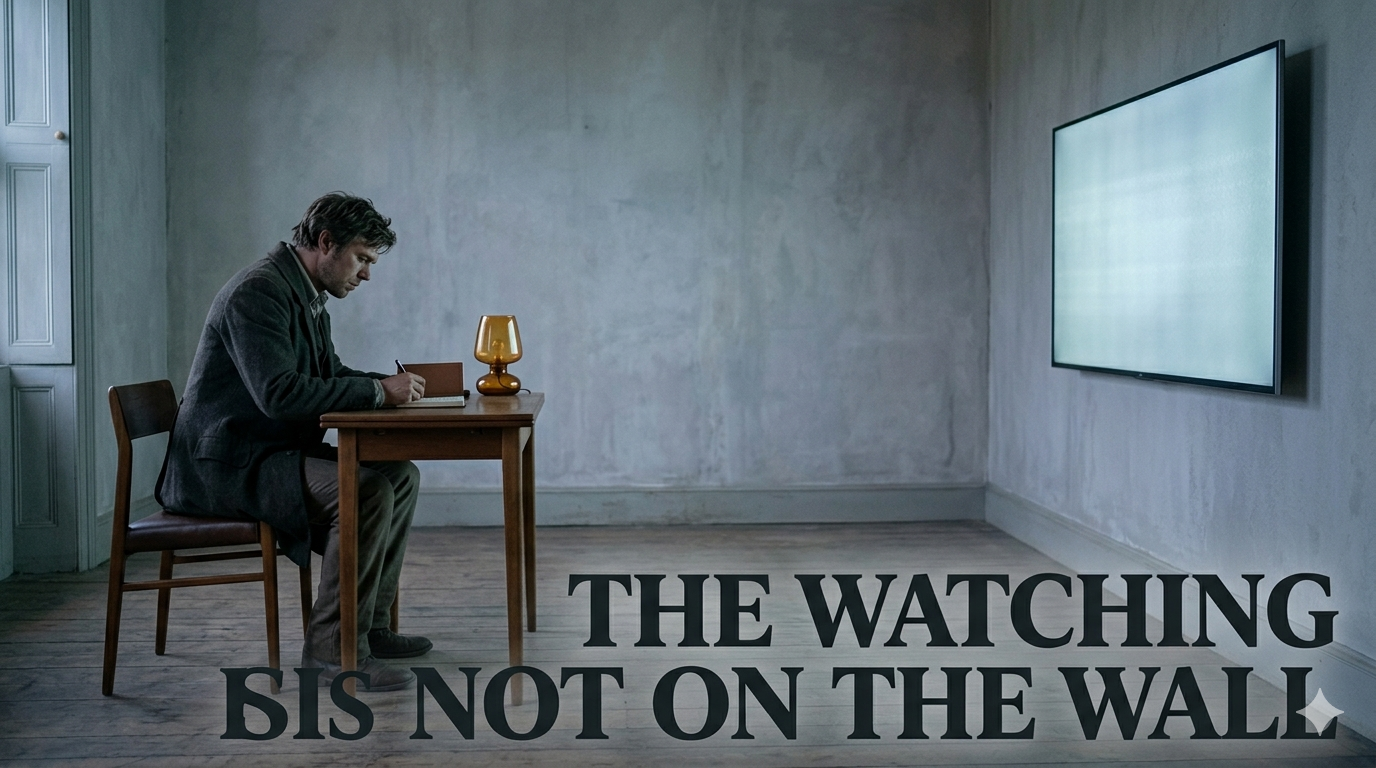
The Telescreen Is the Wrong Metaphor: What Orwell Actually Said About Being Watched
There is a near-universal cultural shorthand for surveillance, and it has been doing damage for several decades.
The shorthand is the telescreen. The device in Orwell’s 1984 that watches Winston while he watches it. The two-way television set on the wall of every Party member’s room, broadcasting propaganda and recording every movement and sound within its field of view. The telescreen has become, in the cultural memory, the foundational image of surveillance under totalitarian conditions. It is referenced every time a journalist writes about CCTV cameras. It is invoked every time someone wants to compare the present moment to Orwell’s vision. The phrase Big Brother is watching, on closer inspection, almost always means the telescreen is watching. The visual device has eaten the underlying argument.
This is one of the most persistent and damaging misreadings of 1984. The telescreen is the surveillance technology the novel makes most visible, and it is also, on a careful reading, the least important surveillance mechanism Orwell describes. The novel contains a much more sophisticated analysis of what being watched actually means under conditions of total politics, and that analysis has almost nothing to do with the telescreen.
This post is an attempt to recover what Orwell actually said. The argument is that the telescreen is a distraction, and that the cultural fixation on it has prevented readers from seeing the deeper and stranger analysis the novel is conducting. Once you can see past the telescreen, the novel discloses an argument about surveillance that is not about cameras at all. It is about something much more disturbing, and much more present in the reader’s own life than any camera could be.
What the Telescreen Actually Does
A reminder of how the telescreen functions in the novel.
The telescreen is a two-way device. It transmits state broadcasts, including propaganda, news, and the periodic Two Minutes Hate. It also records the movements and sounds of the room it is installed in. It cannot be turned off, only turned down. It is installed in the homes of all Party members. The position in the room of Winston’s telescreen is such that there is a small alcove out of its sightline, where he can sit unobserved if he is careful, though he can still be heard.
This is the basic technical apparatus. The novel describes it carefully and returns to it often. Winston’s awareness of the telescreen shapes his behaviour throughout the book. He writes his diary in the alcove. He arranges his face to avoid facecrime. He performs his morning exercises in front of the screen with appropriate vigour, knowing he can be seen.
The popular reading treats the telescreen as the primary mechanism of Party surveillance. The Party watches its members through this device. The Party knows what they do because the device shows the Party. This reading is intuitive. It is also wrong in a small but consequential way.
The novel itself is more careful about this. Orwell explicitly states that the telescreen is not, in practice, watched constantly. There are not enough Thought Police to monitor every screen in the country at every moment. The watching is intermittent. The Party knows, in principle, what any individual is doing at any given moment, but in practice it cannot afford to know. The watching is selective. The mechanism is a possibility rather than a continuous fact.
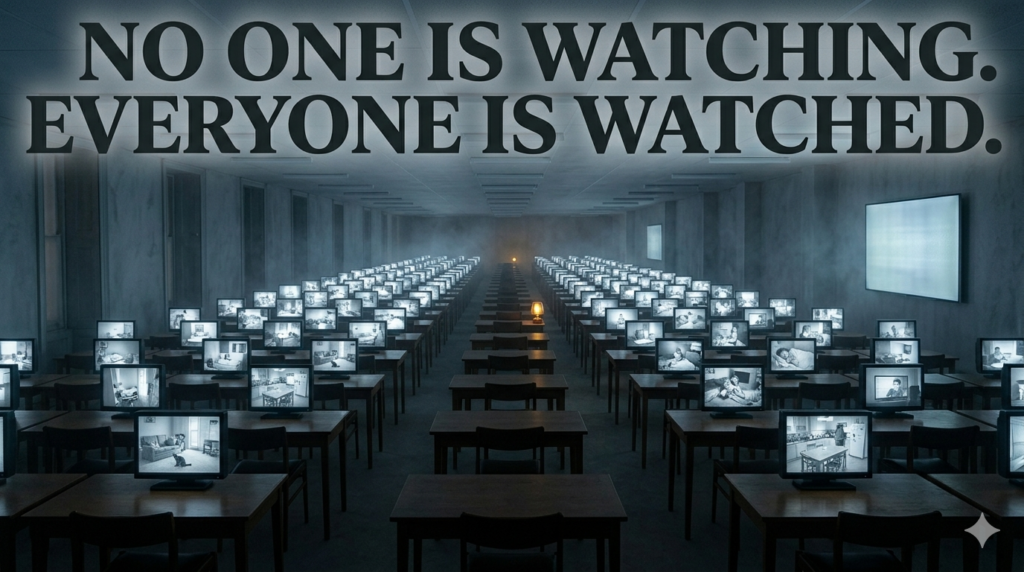
This is the first place where the popular reading goes wrong. The telescreen does not work because it watches you. The telescreen works because you do not know whether it is watching you at any given moment. The mechanism is probabilistic. The effect is not the recording of behaviour. The effect is the production of behaviour, in the watched person, that anticipates the watching.
Orwell understood this. He says so in the novel, more than once. He notes that the citizens of Oceania behave as if they are always being watched, even though they know perfectly well that they cannot always be. The behaviour is the surveillance, not the watching. The Party has installed a device that makes the citizens watch themselves on the Party’s behalf, knowing that any one of their movements might be observed but never knowing which.
This is, in its bones, Bentham’s panopticon, which I have discussed in an earlier post on Zamyatin’s We. The panopticon works not by watching everyone but by making everyone watch themselves. The telescreen is a panopticon in the home, redesigned for the twentieth century. The device is the visible component. The work is done by the citizen’s anticipation of being watched.
A reader who has internalised the popular reading thinks the telescreen is the surveillance. A reader who has paid careful attention to what Orwell says thinks the telescreen is the cue that prompts the surveillance, which is actually performed by the citizen on themselves.
Why This Distinction Matters
The distinction sounds small. It is not.
If the telescreen is the surveillance, then the surveillance can be defeated by destroying or evading the telescreen. The reader who fears Orwell’s vision can imagine resistance as the disabling of the device. Smash the screen. Cover the lens. Hide in the alcove.
If the surveillance is the citizen’s own anticipation of being watched, then no act of evasion can defeat it. The surveillance has been installed in the citizen’s nervous system. The device on the wall is incidental. Even if the device were removed, the citizen would continue to behave as if it were there, because the citizen has been trained, over years, to perform that behaviour. The anticipation has become the citizen.
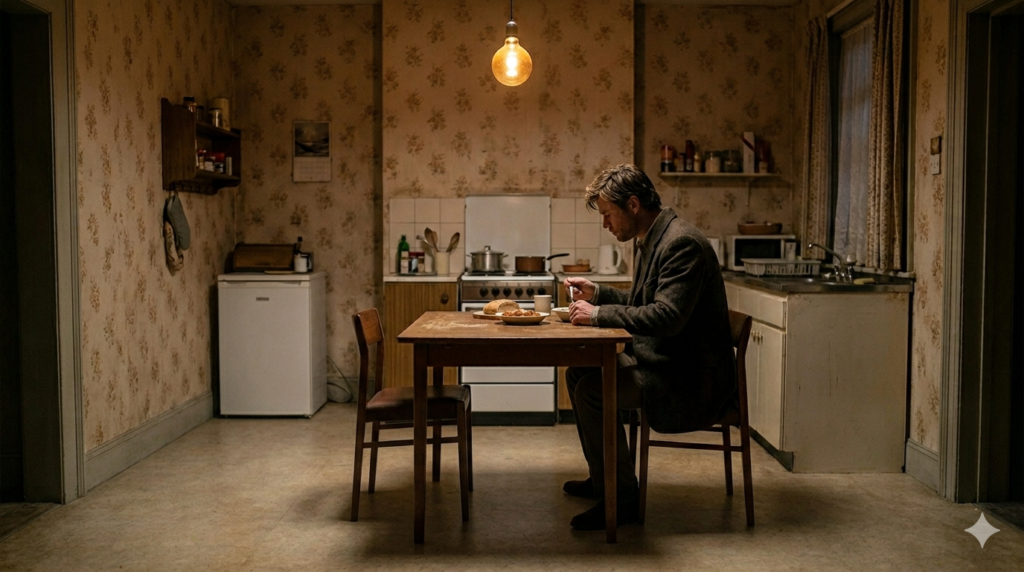
This is the harder reading, and it is what the novel is actually doing. Winston cannot escape the surveillance by hiding from the telescreen. Winston, even when no telescreen is present, behaves as if one is. He arranges his face. He composes his thoughts. He watches his own behaviour. In the room above the antique shop, where he believes he and Julia are unobserved, he is still performing surveillance on himself. He is still suppressing certain thoughts before they fully form. He is still adjusting his posture in case anyone is looking.
The novel makes this explicit late in the book. The room above the shop turns out to have been bugged the whole time. The telescreen the reader thought was absent was simply hidden. But the more important point, the one Orwell is quietly making, is that Winston’s behaviour in the room was not significantly different from his behaviour elsewhere. He had already internalised the watching. The hidden telescreen confirmed what was already operating inside him.
This is the argument the popular reading has not absorbed. The watching is not done by the device. The watching is done by the watched. The device is the trigger, the reminder, the prompt. The work is done elsewhere.
What This Means for the Reader’s Present
If the telescreen is the wrong metaphor, what is the right one?
The cultural memory of 1984 has invoked the telescreen so often, in so many contexts, that the question feels almost rhetorical. Cameras, smartphones, smart speakers, computer microphones, doorbell cameras, satellite imagery, traffic cameras, license-plate readers. Each of these has been compared, at some point, to the telescreen. Each comparison has been treated as illuminating.
The careful reading of 1984 suggests that the comparison has been misdirecting us.
The cameras of the present are doing something different from what the telescreen was doing. The cameras are, for the most part, actually watching. They are recording continuously. They are storing the footage. They are, increasingly, processing the footage with software that can identify faces, movements, patterns. The watching is no longer probabilistic. The watching is comprehensive.
This sounds, on its surface, like a more total version of what Orwell described. It is, in fact, a different mechanism altogether.
The telescreen worked because the watching was uncertain. The citizens behaved as if they were being watched at any moment because they could not know whether any particular moment was being observed. The uncertainty was the engine. Remove the uncertainty, and you remove the mechanism. A citizen who knows they are being watched at all times does not need to anticipate the watching. The anticipation collapses into the watching itself.
A citizen who knows they are not being watched, on the other hand, is the most dangerous kind of citizen for any surveillance regime, because they have no internal mechanism producing the desired behaviour. The Party in Oceania cannot afford this. So the Party constructs a regime in which the watching is uncertain, the threat is continuous, and the citizen is trained to do the work themselves.
The present moment is producing something different. The watching is no longer uncertain. The watching is constant. But the watching is not, for most people, experienced as constant. The watching has been moved out of view. The cameras are small. The data centres are far away. The processing is automated. The citizen does not look at the surveillance and adjust their behaviour. The citizen looks at their phone, which is also the surveillance, and uses it as if it were not.
This is a more sophisticated arrangement than anything Orwell imagined. The surveillance is total, but it has been engineered to be invisible to the surveilled. The citizen does not need to anticipate the watching because the citizen does not perceive themselves as being watched. The behaviour the watching produces is not the careful self-monitoring of Winston in front of his telescreen. The behaviour is the casual self-disclosure of a person who believes themselves to be alone with their device.
What Orwell predicted was a regime in which the citizen polices themselves because they know they might be watched. What the present has produced is a regime in which the citizen discloses themselves freely because they have forgotten they are watched. The two arrangements achieve similar political effects through opposite psychological mechanisms.
This is one of the reasons the popular invocation of the telescreen has been so unhelpful in describing the present. The telescreen is the wrong metaphor not because the present has avoided surveillance but because the present has surpassed the kind of surveillance the telescreen represents. The kind of attention Orwell asked his readers to pay to being watched is no longer the kind of attention the situation requires. The watching is not above the screen. The watching is in the screen. The screen is in the hand. The hand is in the pocket. The pocket is on the body. The body has stopped noticing.
What the Diary Is Doing
The diary in 1984 is the novel’s most important object, and the popular reading has missed what it is for.
The popular reading treats the diary as Winston’s act of rebellion. He writes down forbidden thoughts. He records his contempt for Big Brother. The diary is the evidence that Winston has not been fully assimilated. He retains some interior life that the regime has not yet captured.
The careful reading is more specific. The diary is not, primarily, a record of Winston’s thoughts. The diary is a demonstration that Winston still has thoughts. The act of writing is the point. The content is secondary.

Orwell understood that a citizen who has been fully colonised by a surveillance regime has nothing to record. There is no inner life to write down. There is no thought that has not already been adjusted to anticipate the watching. The diary functions, for Winston, as a kind of test. Can he produce a sentence that is his own? Can he write something the Party has not pre-formed?
The early diary entries are clumsy because Winston is finding out, in real time, whether his interior is still his. He writes DOWN WITH BIG BROTHER over and over, not because the slogan is profound but because the writing of it confirms that he can still produce forbidden language. The repetition is the proof. The thought has been thought. It exists on the page. It has not been swallowed by the regime.
This is a much more disturbing reading of the diary than the popular version permits. The diary is not Winston’s last redoubt of freedom. The diary is Winston’s attempt to verify that he has not yet been fully erased. The verification is fragile. The diary is destroyed by the end of the novel. Winston, by then, has been broken to the point where there is no longer anything to verify.
What this means, in the context of the surveillance argument, is that the regime’s most successful product is not the citizen who is watched. The regime’s most successful product is the citizen who can no longer write the diary because there is no longer any thought to record. Winston, at the start of the novel, is not yet that citizen. Winston, by the end, is. The work the regime has done on him is not the work of catching him. The work is the work of producing a person whose interior has been so completely adjusted to the regime that the diary becomes impossible.
The telescreen has been an instrument in this process, but it has not been the agent. The agent is the citizen’s own continuous self-monitoring, which the telescreen has prompted but which the citizen has performed.
What the Watchers Themselves Are
There is one more piece of the surveillance argument that the popular reading has almost entirely missed.
The novel never shows us a Thought Police officer at a screen, observing Winston. The novel does not depict the watchers. They are referred to. Their existence is acknowledged. But Orwell does not give them a face.
This is deliberate. The watchers in 1984 are not the agents of the regime in the way the popular reading assumes. The watchers are themselves caught in the same system. They are watched too. They are subject to the same surveillance, the same internal monitoring, the same probabilistic uncertainty about whether their own behaviour is being observed. The Party that watches Winston is also a Party that watches the people who watch Winston. There is no exterior position from which the watching is performed.
This is one of the most chilling features of the novel, and it is the one most readers miss. The watching has no centre. The watching is distributed. The watching is not done by a person or a group of people who are themselves outside the system. The watching is the system itself, operating on everyone within it, with no privileged position from which a single watcher could observe the whole.
O’Brien, when he reveals himself to Winston, is not the master of the surveillance. O’Brien is one of its most senior operatives, but he is operating inside the same architecture. He has been watching Winston for years. He is also being watched, by mechanisms he may not fully understand. He will, at some point, fall in turn. The watching that has produced Winston’s destruction will eventually produce O’Brien’s.
The popular reading wants there to be a control room somewhere, with a watcher who is in charge. The novel refuses to provide one. The watching has no operator. The watching is the structure. Everyone is in it. No one is outside.
This is the deepest argument the novel makes about surveillance, and it is the argument the telescreen metaphor most thoroughly obscures. The telescreen, as a piece of cultural shorthand, implies a watcher on the other side of the screen. The novel does not provide this watcher. The novel provides only the screen, only the citizen, and only the internal mechanism that the screen has prompted. The watcher, if there is one, is the watched. The watching is what they do to themselves, because they cannot stop, because the regime has produced no other mode of being.
Reading Between the Lines
The argument of this post is small and specific.
The telescreen is a piece of visible technology in 1984 that the cultural memory has elevated into the novel’s central metaphor for surveillance. The elevation has been a misreading. The novel’s actual analysis of surveillance is not about the device. The novel’s actual analysis is about the internal mechanism the device produces in the citizens it watches. The mechanism is what Orwell was warning against. The device was the cue.
The cultural fixation on the telescreen has produced a reading public that looks for the cameras and feels reassured when it does not see them. This reading public has been ill-equipped to recognise the surveillance regimes that have actually arrived, which are not built around visible devices but around invisible processing, ambient data collection, and the engineered casualness of self-disclosure. The Orwellian apparatus is not the apparatus we are living inside. The Orwellian apparatus is in fact one of the things that has prevented us from seeing the apparatus we are living inside, because the cultural memory of 1984 has been trained to look for the wrong shape.
Recovering Orwell’s actual argument requires putting the telescreen aside. The argument is not about being watched. The argument is about what being watched does to a person who has internalised the possibility of being watched. The argument is about the diary, and the alcove, and the face Winston composes before he opens the door. The argument is about everything Winston does when no telescreen is in the room, because the telescreen is no longer needed by the time Winston has been fully trained.
This is what Orwell was trying to make visible. The visible device was the part of the apparatus he could show. The invisible internal mechanism was the part he could only describe. The cultural memory has retained the visible and lost the invisible.
The novel is on the shelf. It has been on the shelf for over seventy-five years. It is widely read. It is widely cited.
It has been read carefully by relatively few of the people who cite it.
The careful reading is still available.
Read it again. Read it for what the telescreen actually does, which is to train Winston to do the watching himself. Notice the alcove. Notice the diary. Notice the room above the shop. Notice that the watching never stops, even in places where the telescreen is not. Notice that this is the point.
The telescreen is the wrong metaphor.
What Orwell actually said about being watched is something the present moment needs to hear more urgently than the cultural shorthand has been allowing.
Read the novel again.
Read it for what is inside, not what is on the wall.