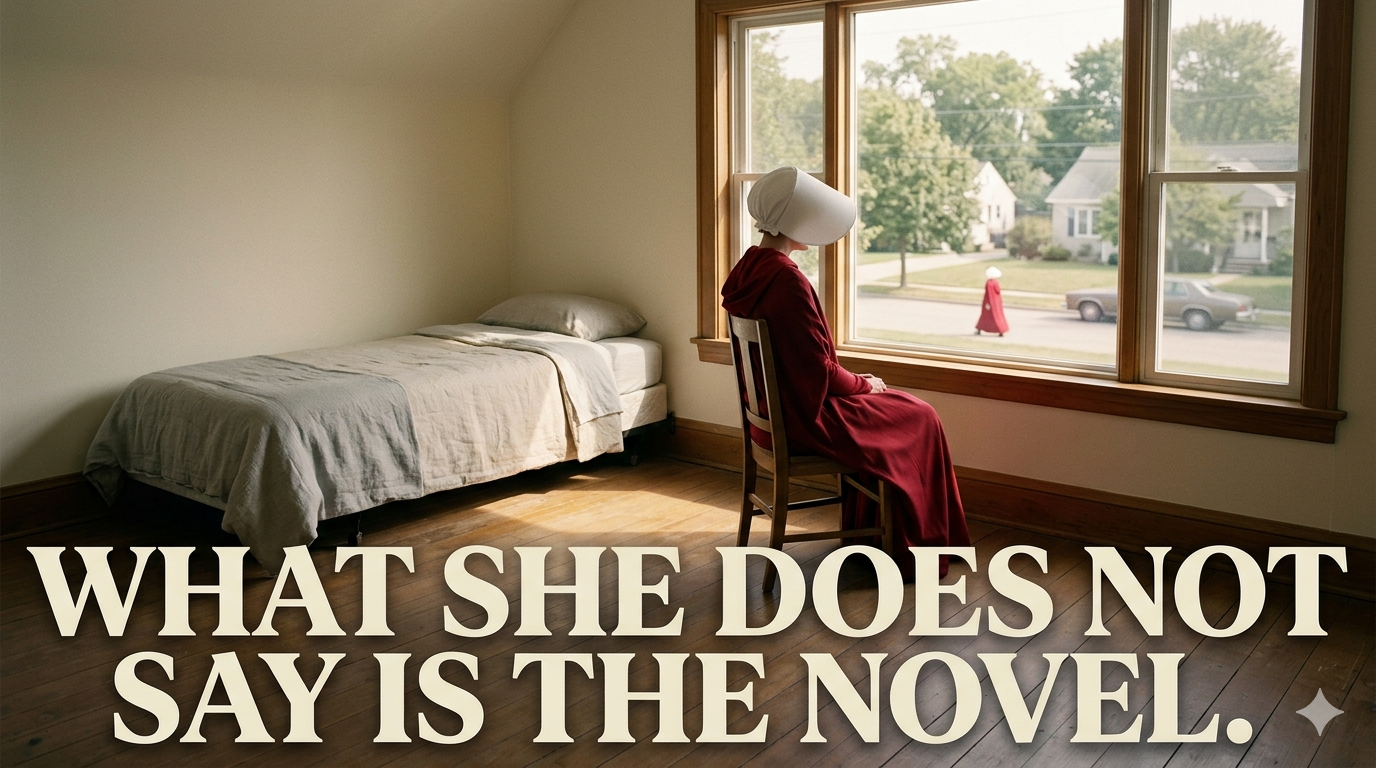
What Offred Doesn’t Say: The Architecture of Silence in The Handmaid’s Tale
There is a particular kind of attention that Margaret Atwood’s The Handmaid’s Tale asks of its readers, and almost no readers are equipped to give it.
The novel is narrated, in first person, by a woman whose name we never learn. She is called Offred, which is not a name but a possession marker. Of Fred. The Handmaid currently assigned to the Commander Fred. When the assignment changes, the name will change. The previous Handmaid in the same household was called Offred too, just as the current one is. The name is the position, not the person.
The narration is intimate. We are given Offred’s thoughts, her observations, her memories, her interior conversations. The voice is patient and detailed. The reader feels, on a casual reading, that they are being granted full access to a woman’s inner life under conditions of extreme constraint.
The careful reading is harder. The careful reading attends to what Offred is and is not saying, and discovers, slowly, that the novel’s most important argument is being made through silence rather than through speech. Offred is not, in fact, telling us everything. She is omitting more than she is including. The omissions are not accidental. They are the architecture of the book.
This post is an attempt to read the novel through what Offred does not say. The argument is that the silences in the narration are not gaps in an otherwise complete account. The silences are the account. They are doing the work that no direct statement could do, and the work they are doing is some of the most precise political analysis in twentieth-century English fiction.
The First Silence Is the Name
The most fundamental silence in the novel is the one the reader encounters before the first chapter begins.
The narrator does not tell us her name.
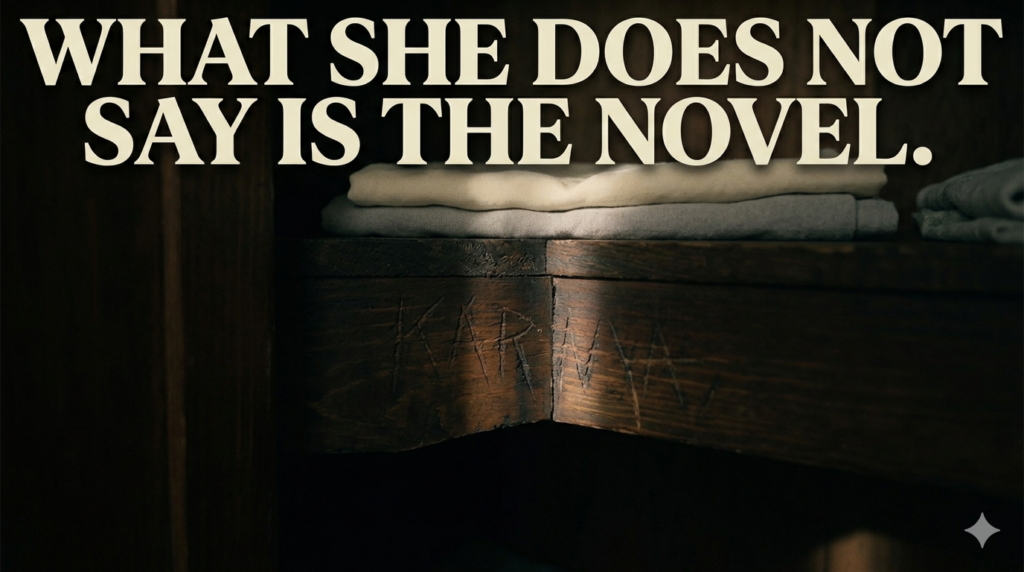
This is so consistent throughout the book that most readers stop noticing it. The narrator’s actual name, the one she was given at birth and used through her former life, is never spoken. The Handmaid name, Offred, is used throughout. Her real name is withheld.
There has been some critical discussion of whether the name June in the early pages, mentioned among a list of names exchanged by the Handmaids during night-time whispers in the gymnasium where they are being trained, refers to her. The novel leaves this ambiguous. The television adaptation has chosen to interpret it as her name. The book itself refuses to confirm or deny.
This refusal is one of the novel’s deepest political moves. Atwood is not withholding the name to create mystery. Atwood is withholding the name because the novel’s argument requires that we, the readers, be placed in the same condition as the regime itself, which knows the Handmaids only by their Handmaid names. The reader cannot have access to the woman behind the name, because the regime does not permit such access. The narrative position is the regime’s position, even though the narrator is the regime’s victim.
This is one of the most uncomfortable formal decisions in modern fiction. Atwood has built into the structure of the novel a small replica of the regime’s own erasure. We read the book. We are inside the narrator’s head. We are given everything except the one thing the regime has taken. The novel performs the taking. The reader participates in it, by reading, by accepting the Offred name as the only name available.
A reader who notices this discovers that the silence around the name is the book’s first piece of evidence about what Gilead does. The regime does not need to forbid the name explicitly. The regime simply removes the conditions under which the name can be used. The name continues to exist somewhere inside the narrator. The novel does not show us this somewhere. The somewhere is the silence.
What She Cannot Say About Luke
The second large silence in the novel concerns Luke, Offred’s husband from her former life.
Offred remembers Luke. She thinks about him often. She remembers their daughter. She remembers the day they tried to escape across the border and were caught. She remembers Luke being taken away from her at the border. She does not know what happened to him after that.
This is the surface of the Luke silence. The reader is given access to her memories, her uncertainty, her unresolved grief. The silence around Luke’s fate is presented as an open wound the narrator carries with her.
What the careful reading notices is that the silence is more layered than this surface treatment suggests. Offred does not only fail to know what happened to Luke. She also, throughout the novel, refuses to consider certain possibilities about him. She does not, for instance, allow herself to fully entertain the thought that Luke is dead. She acknowledges the possibility in occasional flashes, but she does not stay with it. She moves past it quickly. She returns to imagining a version of him that might still be alive.
This is not denial in the conventional sense. Offred is intelligent. She knows the statistics. She knows what Gilead does to men of Luke’s profile. She knows that her hope for his survival is, on the evidence, unrealistic.
What she is doing is something subtler. She is preserving the possibility of his survival because the possibility is the only thing that maintains a certain version of her former self. If Luke is alive somewhere, then she is still his wife, even though Gilead has assigned her elsewhere. If Luke is dead, then she is something else, something the regime has produced rather than something her former life has carried into the present.
The silence around Luke’s fate is therefore not a silence about Luke. It is a silence about what Offred has become. The narrator cannot allow herself to know what happened to Luke because knowing it would require her to acknowledge what she now is. The silence is doing work on Offred’s interior life. It is protecting a self that the regime has been trying to erase.
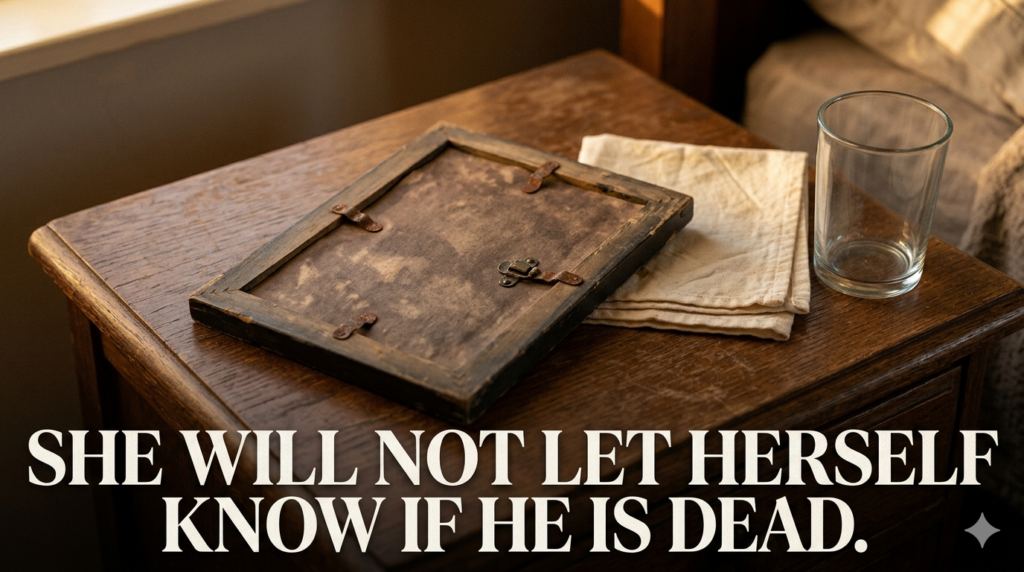
Atwood lets this silence operate throughout the novel without ever directly explaining it. The reader who is paying attention can see what is happening. The reader who is not paying attention reads the Luke passages as the residual love of a wife for her missing husband. Both readings are true. Only the careful reading registers the political function of the silence, which is to keep Offred’s pre-Gilead identity alive at the cost of refusing to know the truth.
This is one of the deepest things the novel does. It shows the reader that survival under a regime like Gilead may require certain calculated silences within the self. The regime cannot be fought directly. The interior life cannot be defended through resistance. What can be done is the refusal to know certain things, the maintenance of certain hopes against the evidence, the cultivation of certain ignorances that keep the self from collapsing.
The Luke silence is the architecture of this maintenance. Offred has built it carefully. The novel respects it. The reader, if they are paying attention, can see it being built around them.
What the Wives Do Not Know
The third major silence in the novel is one that operates between the Handmaids and the Wives.
The Wives are the senior women of Gilead. They are the wives of the Commanders. They have legal status. They occupy the households. They preside over the rituals. They are, on the surface of the regime, the women who have benefited from the new arrangement.
The Handmaids are the lower-status women. They are the surrogate bodies. They are present in the household specifically to bear children for the Commander and his Wife. The Wife is present at the monthly ceremony, the Commander performs the act on the Handmaid, the child belongs to the Wife and the Commander, the Handmaid is moved to a new posting.
The popular reading treats the relationship between Wives and Handmaids as one of structural antagonism. The Wives hate the Handmaids for sharing the marital bed. The Handmaids resent the Wives for the privilege of legal status. The two groups are kept apart by mutual disdain.
The careful reading is sadder. The relationship between Wives and Handmaids is, in fact, structured around a series of mutual silences. The Wives do not say that they cannot bear children, even though their barrenness is the reason the Handmaids exist. The Handmaids do not say that they are being raped, even though the monthly ceremony is, by any honest description, rape. Neither group can name the situation they are inside.
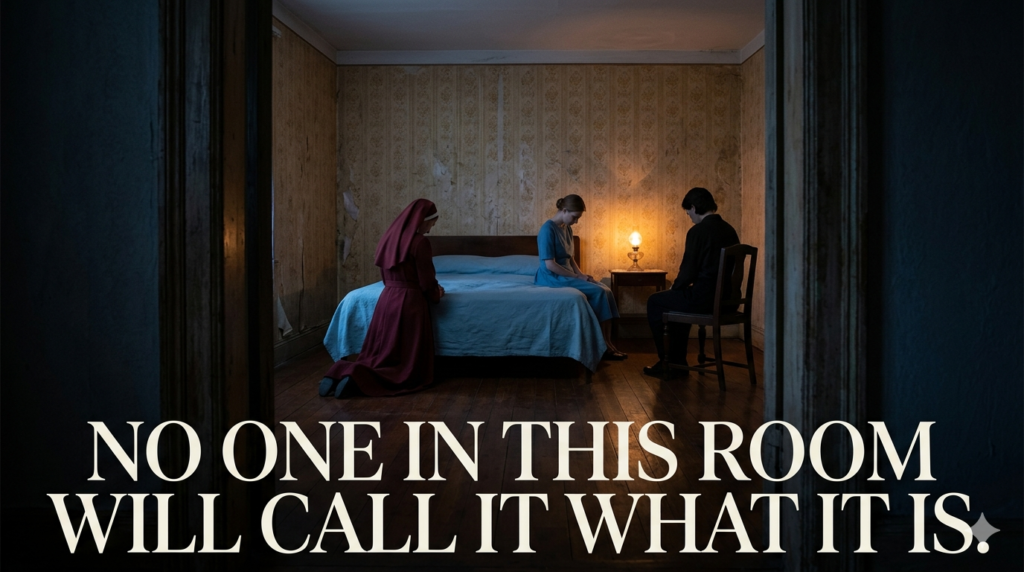
Atwood handles this with extraordinary care. The ceremony itself is described in the novel in language that is almost neutral, almost clinical. Offred does not call it rape. The text does not call it rape. The other Handmaids do not call it rape. The Wives certainly do not call it rape. The regime has produced a vocabulary, the ceremony, which has the effect of preventing the act from being named for what it is.
This is not because the women are deceived. Offred knows what is happening. The Wives know what is happening. The silence is not about belief. The silence is about the absence of any social form in which the truth could be said. To call the ceremony rape would be to require both groups to acknowledge what they are participating in, the Wives as enablers, the Handmaids as victims. Neither group can afford this acknowledgement, because the acknowledgement would make the daily continuation of life in the household impossible.
So they share the silence. The Wives perform their role in the ceremony. The Handmaids perform theirs. The act takes place. Afterwards, everyone goes on with their day. The thing is not named. The not-naming is what permits the household to keep functioning.
This is one of the most precise pieces of political analysis in the book. Atwood is showing the reader that regimes do not have to suppress speech in order to suppress truth. Regimes can simply organise social life such that the truth cannot be said, because there is no relationship within which the saying would be possible. The Wives and the Handmaids cannot speak truthfully to each other because there is no form of address that would survive the truth. The silence is not imposed by the regime. The silence is produced by the social architecture the regime has built.
A reader who reads the novel attentively will notice this silence operating across hundreds of pages. The Wives and the Handmaids interact constantly. They are in the same rooms. They observe each other. They share meals at certain rituals. They never, at any point in the novel, speak the truth of their relationship. Not once. The silence is total.
The careful reading discovers, in this silence, one of the regime’s most successful technologies. It does not need to control what the women say. It only needs to ensure that there is no relationship within which certain things could be said. The silence is the relationship. The relationship is the silence. Gilead has organised the household around the impossibility of certain truths.
What She Cannot Say About Herself
The most painful silence in the novel is the one Offred maintains about herself.
There are moments throughout the book where the reader expects Offred to say something direct about her own condition. She is being held against her will. She is being forced to bear children for a regime she did not consent to. She is being subjected, monthly, to a ritualised assault that her culture refuses to name. She has lost her husband, her daughter, her name, her property, her bodily autonomy, her professional life, her freedom of movement, her right to read.
The reader, knowing all this, waits for the moment when Offred will say, out loud, even just to herself, what has been done to her.
The moment does not come.
Offred does not, at any point in the novel, render her own situation in the direct political vocabulary that would describe it accurately. She does not call herself a slave. She does not call herself a victim of state-organised rape. She does not call her loss what it is. She circles around her condition through metaphor, through fragmented observation, through the language of the body and of small daily concerns. The political vocabulary that would be adequate to her situation is never used.
The popular reading treats this as a function of her trauma. Offred is too damaged to name what is happening. The trauma has produced a narrator whose voice cannot rise to the description of its own conditions.
The careful reading is more specific. Offred is not unable to name what is happening. Offred is refusing to name it. The refusal is one of the few acts of agency available to her. To name her condition in the regime’s political vocabulary would be to accept the regime’s terms for what she is. To name it in the pre-Gilead political vocabulary would be to invoke a world that no longer exists. The naming is impossible because every available vocabulary belongs to a regime, and Offred has elected, on some deep level, to refuse the framing both regimes would impose.
What she does instead is a much harder thing. She narrates in fragments, in observations, in the small dignities of attention paid to objects, to weather, to the texture of cloth, to the colour of a tulip. She refuses both the regime’s vocabulary and the pre-regime vocabulary. She inhabits, instead, a third position, which is the position of the woman who notices.
This is the novel’s deepest political move, and it is the one that has been almost entirely missed by the popular reading. Offred has constructed, inside herself, a mode of attention that no regime has yet provided a vocabulary for. The regime cannot capture her noticing, because the regime has not yet built the system that would describe noticing as an act of resistance. The noticing happens inside her. The noticing is the silence. The silence is the only thing she has that the regime has not taken.
A reader who recognises this discovers that the novel is not narrated by a broken woman. The novel is narrated by a woman who has retained, against extraordinary pressure, the small unspoken capacity to notice the world around her. The capacity is fragile. The regime is constantly trying to extinguish it. The narration is the proof that the regime has not yet succeeded.
The silence around her own condition is, paradoxically, the most powerful thing she has. It marks the place where the regime cannot reach. Everything else has been taken. The noticing remains. The noticing cannot be spoken aloud because speaking it would expose it to the regime’s vocabulary, which would consume it. So she keeps it inside, where it continues, in silence, as the last unconquered territory of her interior life.
What the Historical Notes Reveal
The novel famously ends not with Offred’s own voice but with a piece of academic commentary set centuries in the future. The Historical Notes describe a conference of scholars studying the period of Gilead, who have come into possession of cassette tapes containing what may or may not be Offred’s narration.
The popular reading treats the Historical Notes as a moment of relief. Gilead has ended. The future has arrived. The story is being studied as history. The reader can exhale.
The careful reading is, again, sadder. The Historical Notes are themselves an exercise in silence. The academic narrator, Professor Pieixoto, treats the Handmaids’ suffering with a kind of distant intellectual courtesy. He makes jokes. He speculates about which Commander she might have been assigned to. He focuses on the puzzle of identification. He does not, at any point, acknowledge the woman whose tapes he is studying as a person whose suffering matters in itself.
This is a second regime of silence, layered on top of the first. The original silence was Gilead’s. The new silence is the academic one. Both silences treat Offred as a piece of evidence to be analysed rather than as a person to be heard. The Historical Notes show the reader that even the end of Gilead does not produce the conditions under which Offred could finally be heard. The future has its own ways of not listening.
Atwood is performing, in the Historical Notes, one of the most devastating moves in the novel. She is showing the reader that the silence around Offred is not simply a feature of Gilead. The silence is what survives Gilead. It is what continues into the future. It is what the academic apparatus reproduces, in different forms, even as it claims to study what Gilead did.
The reader who has been paying attention to silence throughout the novel recognises, in the Historical Notes, the final instance of the architecture they have been observing. The silence does not end with the regime. The silence is older than the regime and outlasts it. The regime was an intensification of a condition that was already operating, and that will continue to operate, in the academic conferences and the cultural conversations that follow.
This is one of the most quietly bleak things in twentieth-century English fiction. Gilead is not an aberration. Gilead is a concentration of forces that the surrounding culture has always tolerated and continues to tolerate after the regime falls. The silence around Offred is the same silence that surrounded Handmaid-like figures before Gilead, and that surrounds them after. The regime gave the silence a name. The silence itself is older.
Reading Between the Lines
The argument of this post is small and specific.
The Handmaid’s Tale is not, primarily, a novel about what Offred says. It is a novel about what Offred cannot, or will not, or chooses not to say. The silences in the narration are not the absences of an incomplete account. The silences are the account. They carry the novel’s most important arguments about the operation of patriarchal authoritarianism, about the architecture of the household, about the survival of the self under conditions designed to erase it.
A reader who reads the novel for its spoken content will absorb a strong but partial book. A reader who reads it for its silences will discover that the silences are doing the deepest political work the novel performs.
The novel is on the shelf. It has been on the shelf for over forty years. It has been read by tens of millions of people. It has been adapted into a television series, an opera, a graphic novel, a stage production. The Handmaid’s red cloak and white bonnet have become a global symbol of resistance.
It has been read carefully by relatively few of the people who recognise the cloak.
The careful reading is still available.
Read it again. Read it for what Offred is not saying. Listen for the name she will not give. Listen for the husband she will not declare dead. Listen for the ceremony she will not call by its accurate name. Listen for the self she will not describe in political terms.
The silences are the architecture.
The architecture has been there from the first page.
It has been waiting for the reader who can hear it.
That reader is the one Atwood was writing for, all along.