Animal Farm Is the Saddest Book Orwell Ever Wrote, and Nobody Teaches It That Way
There is a particular way Animal Farm gets taught, and the way is wrong in a small but important sense.
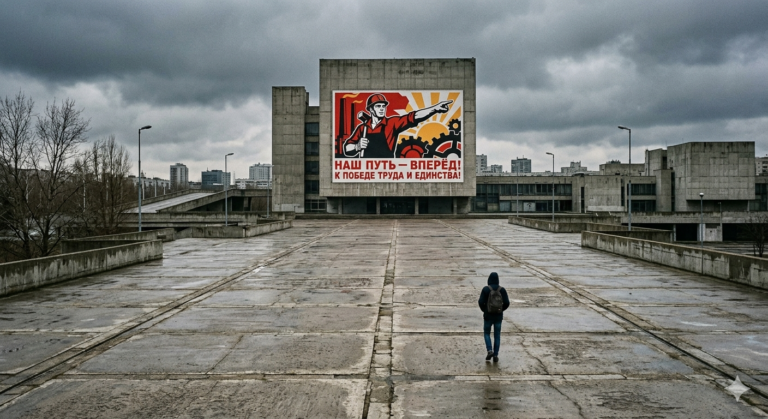
The book is presented, in secondary schools across the English-speaking world, as a satirical allegory of the Russian Revolution. Napoleon is Stalin. Snowball is Trotsky. Old Major is Lenin or Marx, depending on which teacher you got. The pigs become the Bolsheviks. The dogs become the secret police. The sheep become the propagandised masses. The final scene, in which the pigs and the men have become indistinguishable, is the punchline of a long historical joke.
The teaching is accurate at the level of the allegory. Orwell did intend the parallels. He said so. The book was written, in 1945, as a deliberate piece of political writing directed at a specific historical moment.
What the teaching misses is that the allegorical reading is not the only reading the book supports, and it is not the most important one. Animal Farm is a much stranger and sadder book than the lesson plan allows. It is, on a careful reading, one of the most quietly devastating things Orwell ever wrote. It is also, when read for what it is actually doing rather than for what it is taught to be doing, almost unbearable.
This post is an attempt to read the book at the level it actually operates. The argument is that the allegorical reading, by directing the reader’s attention to the historical parallel, obscures what the book is doing emotionally. Once you can see past the allegory, the book discloses an argument about loyalty, exhaustion, and the slow betrayal of ordinary lives that no historical reading can fully contain.
The Book Is Not About Revolutions. It Is About Boxer.
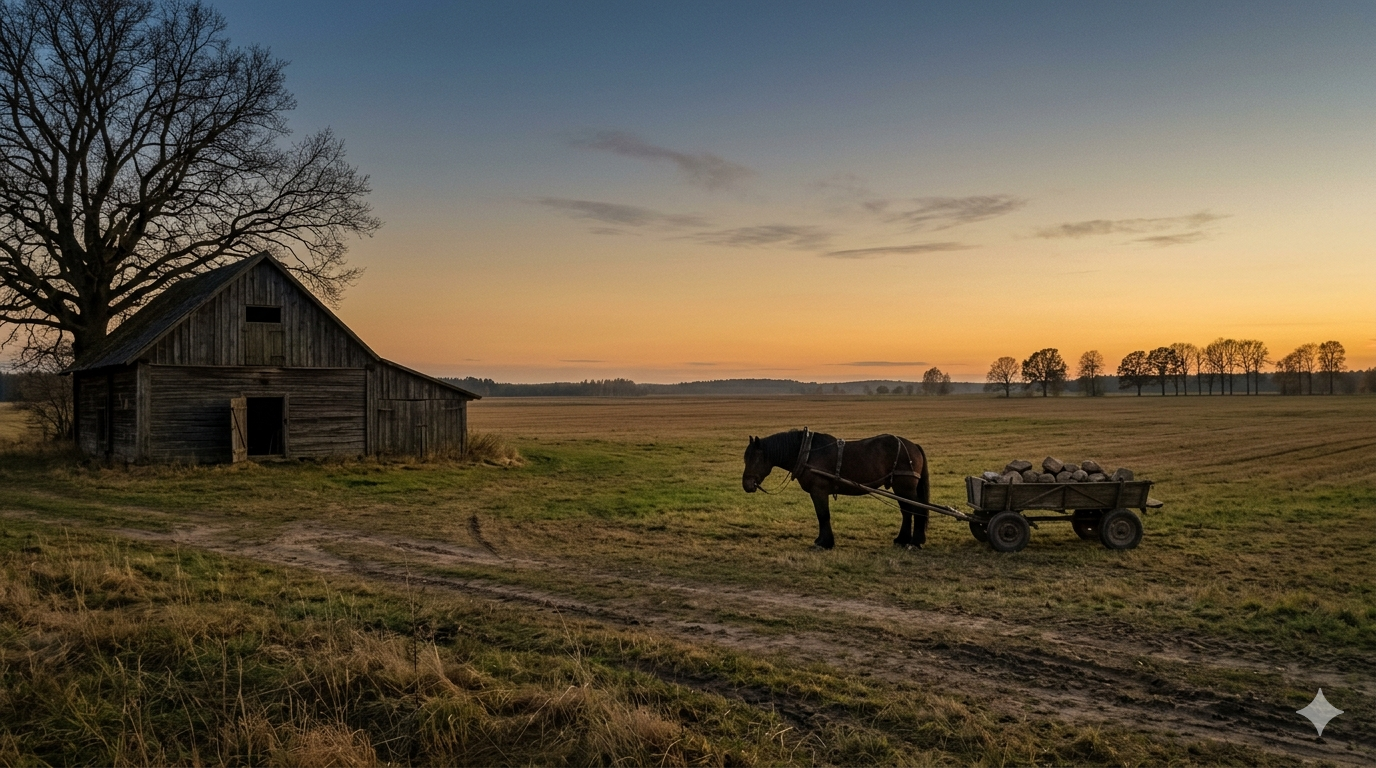
The most important character in Animal Farm is not Napoleon. It is not Snowball. It is not Old Major. The most important character is a horse called Boxer.
Boxer is a cart horse. He is enormous. He is described, in the early chapters, as not particularly intelligent, but unusually strong and unusually willing. He believes in the revolution from the first day. He adopts two personal mottos. The first is I will work harder. The second is Napoleon is always right. He repeats these mottos to himself, throughout the book, as a way of organising his life inside the new political situation.
Boxer is the moral centre of the novel. The reader knows this from the early chapters. Orwell makes no attempt to hide it.
Boxer is also the character the lesson plan most consistently underplays. The allegorical reading wants to focus on the pigs, because the pigs are doing the political work the allegory is most clearly tracking. Boxer is offstage from the political plot most of the time. He is working. He is pulling stones. He is building the windmill. He is recovering from injuries and going back to work.
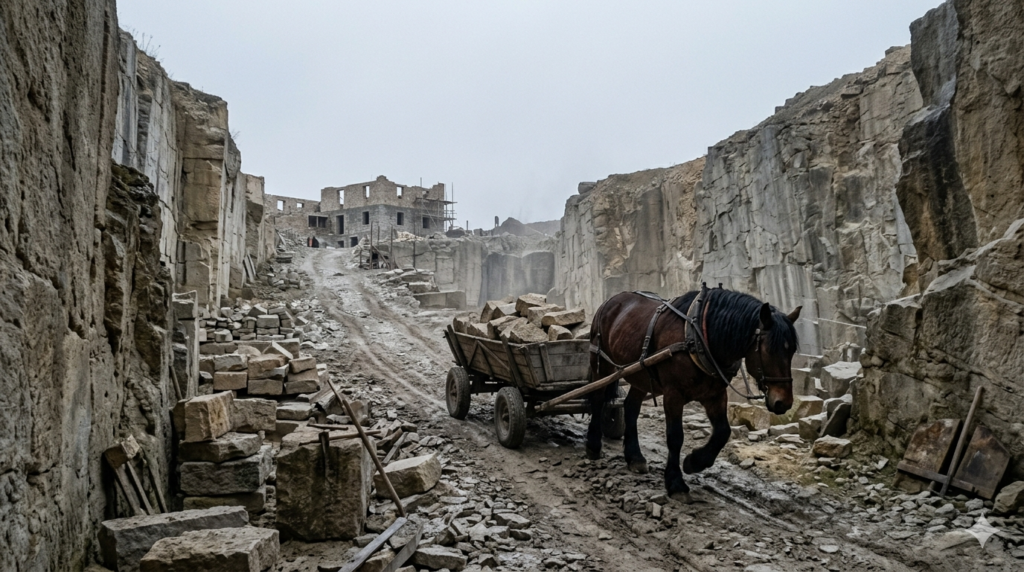
But the book’s emotional architecture is built around Boxer, and the allegorical reading cannot register this. The pigs are doing the politics. Boxer is doing the labour. The novel is not, finally, interested in the politics for their own sake. The novel is interested in what the politics do to Boxer, and through Boxer, to every animal who believed the revolution was for them.
The careful reader will notice that almost every section of the book contains a small moment in which Boxer is shown working slightly past the point of reasonable effort, or believing slightly more than the situation warrants, or accepting a piece of pig propaganda with slightly less question than the moment deserves. These small moments accumulate. They are the book’s true plot. By the time the reader reaches the late chapters, Boxer has become unable to see what is happening around him, because seeing what is happening around him would require him to acknowledge that the mottoes he has organised his life around were wrong.
This is the book’s central tragedy. The pigs are bad. That is the allegorical surface. Underneath the surface, the deeper tragedy is that Boxer cannot afford to know they are bad. His sense of himself depends on the framework they have given him. To see the pigs clearly, he would have to see his own life as having been wasted on a cause that was not what it claimed to be. He cannot do this. So he keeps working harder, and saying Napoleon is always right, and falling deeper into the framework that is using him up.
The pigs do not need to suppress Boxer’s awareness. Boxer suppresses it himself. The regime has found, in him, the kind of subject who will do the regime’s work of self-deception without being told to.
What Happens to Him
Late in the book, Boxer collapses while working. He has been overworking for years. He is no longer young. He cannot recover from the collapse. The pigs announce that he will be taken to a veterinary hospital in the nearby town, where he will be properly treated.
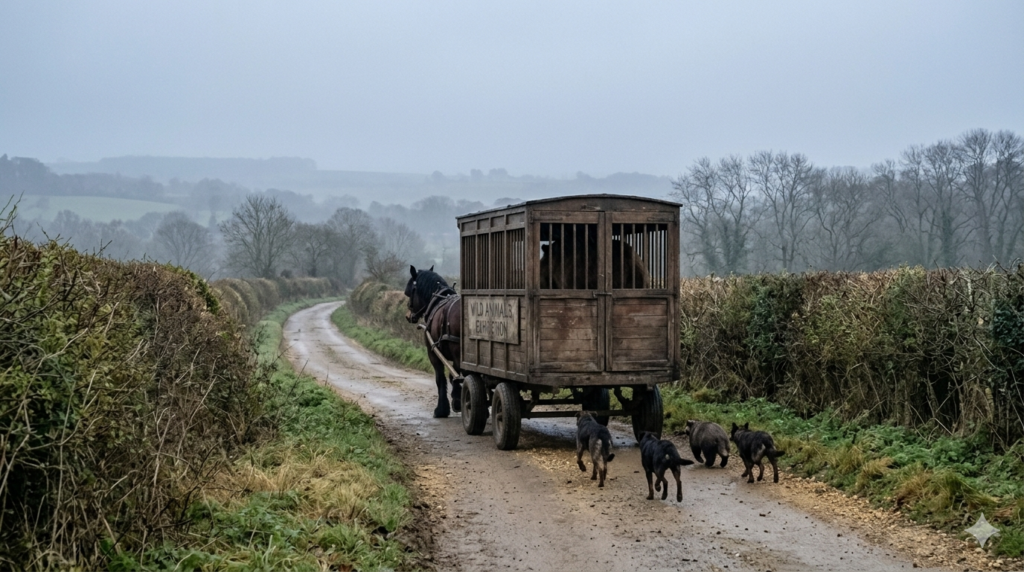
A van arrives. Boxer is loaded into it. The van begins to drive away.
It is Benjamin the donkey who, almost too late, reads the writing on the side of the van. The van is not from a veterinary hospital. It is from a knacker’s yard. Boxer is being taken to be slaughtered, his body sold for glue.
The animals run after the van. They call to Boxer through the wooden slats. Boxer, inside the van, eventually understands what is happening. He tries to kick his way out. He is no longer strong enough. The van drives on. Boxer is killed.
This is the scene most readers remember from the book. It is the scene most teachers use to demonstrate the cruelty of the new regime. The allegorical reading uses it to show how Stalin’s regime treated the working class once they had served their purpose.
The allegorical reading is correct, but it is not what the scene is doing.
What the scene is doing, on a careful reading, is far worse than the allegory suggests. The scene is showing the reader the precise mechanism by which Boxer’s loyalty to the regime has cost him his life. Boxer did not die because the pigs decided to kill him. Boxer died because Boxer worked himself into a state from which there was no return, in service of a regime that was always going to dispose of him when he could no longer pull stones.
The pigs are not even the primary cause of his death. The primary cause is the framework Boxer believed. The framework told him to work harder. The framework told him that the leadership was always right. The framework gave him no resources with which to question the conditions of his labour, or to notice when the labour was becoming unsustainable, or to imagine a life in which his worth was not measured by his output.
Boxer worked himself to death in the literal sense. The knacker’s van is only the final administrative step. The dying had been happening for years, in plain view, on every page of the book. The reader who has been paying attention will have been watching it happen. The pigs have only arranged the disposal.
This is one of the most quietly horrifying things Orwell ever wrote. It is also one of the most universal. Boxer is not just the Russian working class. He is every person who has been raised inside a framework that asks them to measure their worth by their service to it, and who will, when they can no longer serve, be quietly disposed of by the framework they spent their lives believing in.
The book is teaching this lesson on every page. The lesson plan, in its haste to draw parallels to the Russian Revolution, almost never lets the lesson land.
The Sheep
The sheep are the easiest characters to misread in the book. The allegorical lesson plan treats them as the propagandised masses. They chant. They drown out reasoned argument. They follow the pigs. They are the comic relief of the early chapters and the chilling backdrop of the later ones.
The careful reading is sadder.
The sheep, throughout the book, are repeatedly described as not very intelligent. This is not Orwell expressing contempt for them. This is Orwell describing them honestly. The sheep, in his book, are limited. They do not have the resources to evaluate complex political arguments. They cannot follow Snowball’s blueprints. They cannot understand Squealer’s statistics. They have, at most, the cognitive equipment to recognise simple slogans and to repeat them when prompted.
The pigs understand this. The pigs design slogans that the sheep can chant. The first is Four legs good, two legs bad. The second, much later, is Four legs good, two legs better. The shift between the two slogans, on its surface, is the book’s most famous piece of propaganda satire.
But notice what Orwell is actually doing. He is not, primarily, showing the reader how slogans can be reversed. He is showing the reader that the sheep, who have nothing else, will use the slogan they are given to make sense of their lives. The sheep are not stupid because they chant. They chant because chanting is the form of belonging that the regime has made available to them. To stop chanting would not produce a more thoughtful sheep. It would produce a sheep who had been deprived of the only social participation they were capable of.
The pigs have not deceived the sheep. The pigs have given the sheep a piece of language they can use. The sheep have used it gratefully. When the language changes, the sheep adapt, because the language was always more important to them than what it referred to. The slogan is not a piece of propaganda the sheep have been tricked into accepting. The slogan is the sheep’s way of being present in the world.
This is one of the most devastating things in the book, because it implies that the regime does not actually have to lie to the sheep. The regime only has to provide the sheep with slogans to chant. The sheep will fill in the meaning of the slogans themselves, because the slogans are doing emotional work, not informational work. The sheep are not deluded. They have found, in the available rhetoric, a way to feel they are part of something. The pigs have provided the rhetoric. The pigs have not done anything to the sheep that the sheep did not, in some sense, request.
A reader who registers this will close the book with a much heavier feeling than the allegorical reading produces. The sheep are not the easy targets of satire. The sheep are evidence of a structural condition. Many populations, in many political situations, function like the sheep. They are not stupid. They have not been deceived. They have been given language they can use, and they have used it, because they had no other tools available, and the alternative was a silence they could not bear.
Benjamin
The character the lesson plan most badly fails is Benjamin the donkey.
Benjamin is the only animal on the farm who can read fluently. He has, the book tells us repeatedly, the intellectual capacity to follow what the pigs are doing. He sees the lies. He sees the manipulations. He sees the slow corruption of the Seven Commandments. He sees everything.
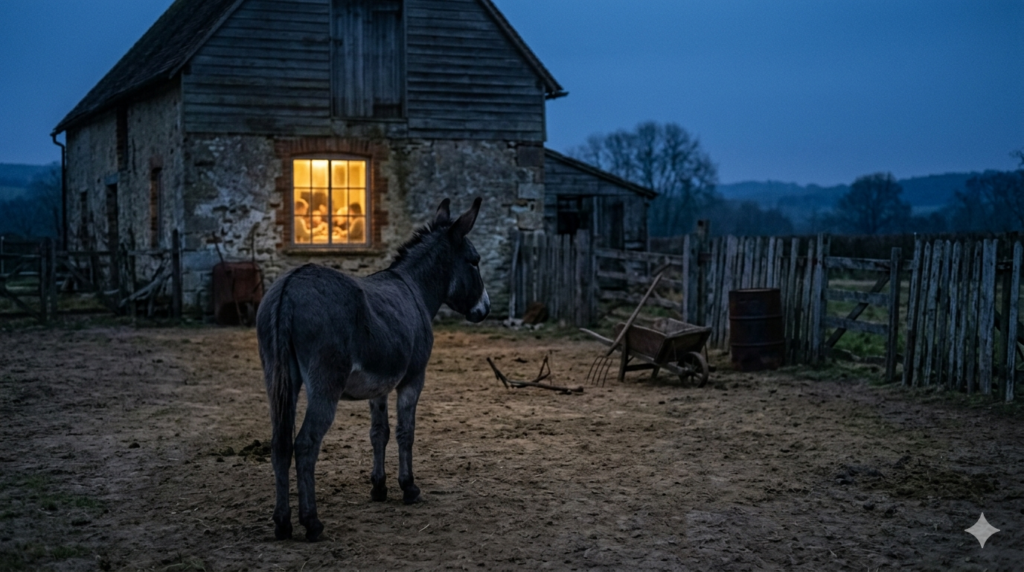
He says nothing.
The lesson plan tends to treat Benjamin as a kind of resigned wise man. He is the cynic who knows better. He is the figure of clear sight in a landscape of deception. The students are sometimes invited to admire him, or to feel that he stands above the foolishness of the other animals.
The careful reading is harder on Benjamin than this. Benjamin is not the moral compass of the book. Benjamin is the book’s most precise piece of moral indictment.
Benjamin sees what is happening. He has the resources to name it. He has Boxer’s affection. He could, at various points in the book, have intervened. He could have read the slogans aloud to the other animals at moments when his reading would have made the deception visible. He could have warned Boxer that the work was killing him. He could have warned everyone that the van was a knacker’s van before the van drove away.
He does none of these things. He maintains his ironic distance. He says, when pressed, that donkeys live a long time and that nothing ever really changes. He keeps his clear sight to himself, while the animals around him are being used up by a regime he understands perfectly.
This is one of the bleakest portraits Orwell ever wrote. Benjamin is the character with the most knowledge and the least courage. He is the figure who could have made a difference if he had been willing to risk his ironic distance, and who chose, again and again, to preserve his distance instead. The book does not condemn him directly. The book does not have to. The reader can see, in every chapter, what Benjamin is failing to do.
The cost of Benjamin’s silence is Boxer’s life. The cost of Benjamin’s silence is the gradual reshaping of the farm into what it eventually becomes. The cost is paid by everyone except Benjamin, who survives the book with his clear sight intact and his commitments to anything outside his own irony unspent.
A reader who closes the book and thinks of Benjamin as the wise one has misread the character. The book is asking the reader, in fact, to consider whether they themselves are Benjamin. The figure with knowledge and without commitment. The figure who watches the regime do its work and tells themselves that nothing ever really changes anyway.
This is a much harder reading than the lesson plan permits. The lesson plan wants the students to be able to identify the historical parallels and produce an essay about Stalinism. The careful reading asks the students to identify themselves in Benjamin, which is a different kind of work entirely, and one that no exam can easily mark.
The Last Scene
The final scene of the book is well known. The pigs and the men are sitting around a table at the farmhouse, drinking together. The animals are looking in through the window. They look from pig to man, and from man to pig, and from pig to man again, and they cannot tell the difference.
The allegorical reading is that this is the punchline. The revolution has gone full circle. The pigs have become what they were supposed to overthrow. Stalin has become a tsar. The cycle is complete.
The careful reading is, again, sadder than the allegory permits.
The closing image is not, finally, a statement about the pigs. It is a statement about the animals at the window. The animals are the ones who cannot tell the difference. They are the ones whose entire political life has come to nothing. They have spent years working, believing, sacrificing, dying. They watch through the glass while the new oppressors negotiate with the old ones. They have no language for what they are seeing. They have no framework that would allow them to act on it. They turn, eventually, and go back to their work.
This is what the book is leaving the reader with. Not the betrayal of an idea, in the abstract. The exhaustion of a population that has been used up. The animals are not angry at the end. They are not planning a counter-revolution. They are not preparing to overthrow the pigs as they once overthrew the men. They are, more accurately, beyond all of that. They have been worked to a state in which political imagination is no longer available to them. They have been reduced to the small acts of looking through the window and not knowing what they are looking at.
This is one of the deepest things any twentieth-century novel says about political defeat. The defeat is not the moment when the new tyrants reveal themselves. The defeat is the moment when the population that suffered for the revolution has lost the capacity to be surprised by the revelation.
The animals at the window are not horrified by what they are seeing. They are tired. They have been tired for years. The book ends because their tiredness has reached the limit of what literary form can render.
Why This Book Is Sadder Than 1984
This is the heart of the argument, and I want to be precise about it.
1984 is a more famous book than Animal Farm. It is a more frequently cited book. It has produced more cultural influence. It is treated, by the canon, as Orwell’s masterpiece.
The careful reading of both books, taken together, suggests that 1984 is the more spectacular book and Animal Farm is the sadder book.
1984 is set inside a fully developed totalitarian state. The horror is presented at scale. The torture is explicit. The defeat of the protagonist is dramatic. The reader closes the book devastated by the largeness of what has happened.
Animal Farm is set on a farm. The horror is presented at the scale of ordinary lives. The exhaustion is gradual. The defeat of the population is quiet. The reader closes the book carrying a heaviness that is harder to articulate than the 1984 devastation, because the heaviness in Animal Farm is not about a regime. It is about the ordinary people, or in this case the ordinary animals, who have given everything to a cause that has used them up.
The animals in Animal Farm are not protagonists in the way Winston is a protagonist. There is no single mind whose breaking is the book’s central event. The breaking is distributed across the whole population. Every animal is, in some small way, breaking. Boxer is breaking through overwork. The sheep are breaking through the substitution of slogan for meaning. Benjamin is breaking through chosen silence. The hens are breaking through the rebellion that is crushed. The horses are breaking through the loss of their friend.
The accumulated breaking is, on a careful reading, much sadder than Winston’s single breaking. Winston is one man. His tragedy is large because the reader has been inside it for hundreds of pages. The animals are many. Their tragedies are smaller individually and immense in the aggregate. The book asks the reader to feel, page by page, the slow grinding down of an entire community by a regime that has been engineered to do exactly that.
The lesson plan does not allow the reader to feel this. The lesson plan keeps directing the reader’s attention to the historical allegory. The allegory is intellectually satisfying. It produces tidy paragraphs in essays. It can be examined and graded.
The careful reading is not intellectually satisfying. It is emotionally exhausting. It leaves the reader unable to say anything tidy about the book, because the book is doing something the tidy formats cannot register. The book is mourning a community. It is mourning Boxer, and the sheep, and the hens, and even Benjamin, who could have done something and did not. It is mourning every person who has ever given themselves to a cause that used them up and disposed of them when they could no longer serve.
This is what Orwell wrote. The allegory is the surface. The mourning is the book.
Reading Between the Lines
The argument of this post is small and specific.
Animal Farm is most commonly taught as a satirical allegory of the Russian Revolution. The teaching is accurate at the level of the allegory. The teaching is misleading at the level of the book’s emotional architecture, which is built not around the pigs but around Boxer, and not around the betrayal of an idea but around the exhaustion of a population.
The careful reading recovers this architecture. The book is not, finally, about Stalin. The book is about everyone who has been Boxer, in any context, in any country, in any century. It is about the loyalty that gets exploited, the language that gets substituted for meaning, the silence that costs other people their lives, and the slow accumulated tiredness that ends, eventually, with a population standing at a window watching their oppressors negotiate with the people they replaced, and being unable to tell the difference, and being too tired to care.
This is a much harder book than the lesson plan allows. It is also a much more useful one.
Read it again. Read it for Boxer this time. Notice every small moment in which he chooses to work harder rather than to ask a question. Notice every small moment in which Benjamin sees what is happening and says nothing. Notice the sheep, and what they have been given, and what they have been deprived of. Notice the animals at the window in the final scene, and what they are no longer capable of feeling.
The book is short. It can be read in a single afternoon.
It has been read by hundreds of millions of people.
It has been read carefully by relatively few of them.
The careful reading is still available.
Read it as if you had never been to school.
That is, in the end, what the book asks for. It is asking you to put down the lesson plan and to look, with whatever attention you can manage, at what is actually happening on every page. The looking is hard. The looking is sad. The looking is also the only way to receive what the book is offering, which is one of the most precise pieces of writing about political exhaustion in the English language.
Read it again.
Read it for Boxer.
That is who Orwell wrote it for.