The Forgotten Architecture of We: Reading Zamyatin’s Glass Apartments as Political Theory
There is an exercise worth performing before reading any further. Picture, as clearly as you can, the apartments in Yevgeny Zamyatin’s We.
If you have read the novel, you probably picture something. Glass walls. A small room. The narrator at his desk. Maybe a bed. Maybe the suggestion of a corridor outside.
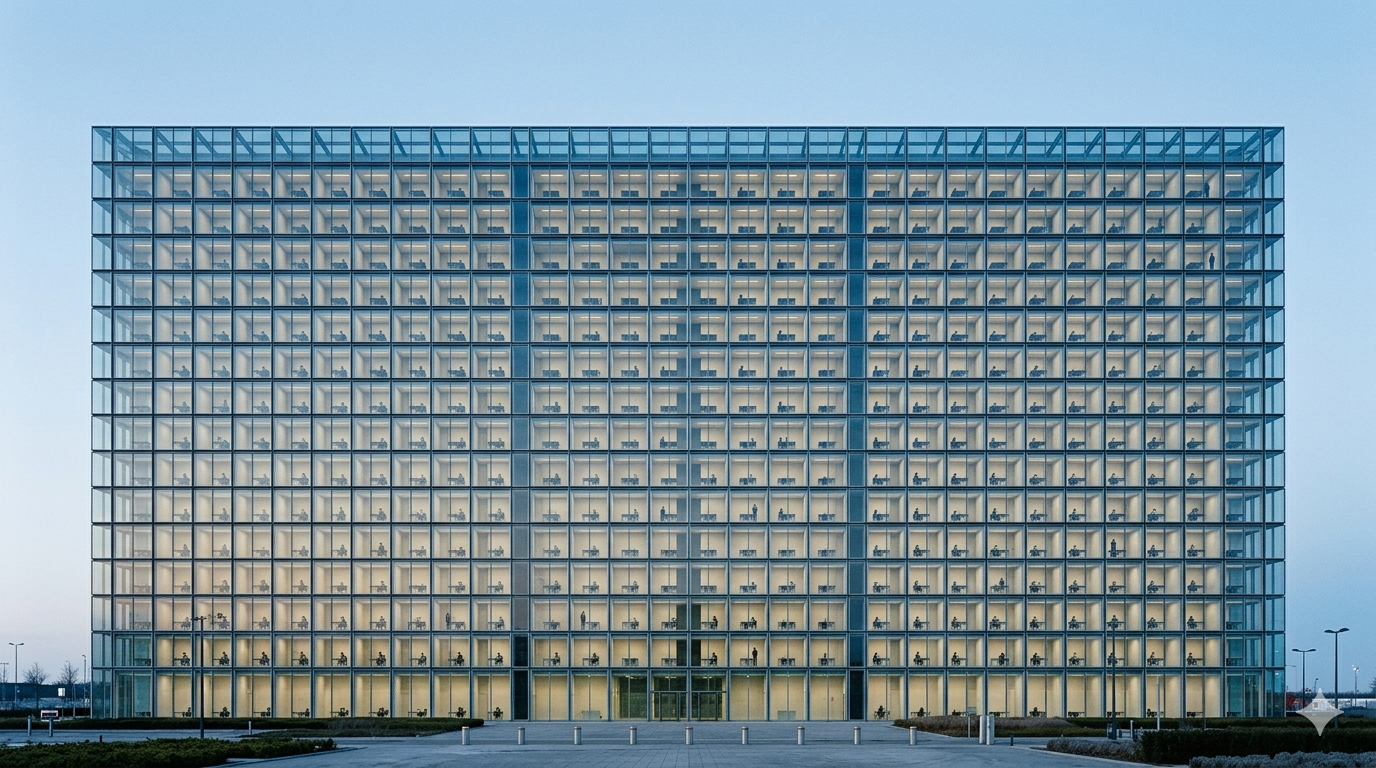
Now ask yourself how much of that picture comes from the novel and how much of it comes from your own assumptions about what such a building would look like. Zamyatin does not, in fact, describe the apartments in much detail. He gives you a few elements. He tells you the walls are glass. He tells you the citizens can lower a curtain only during sanctioned Personal Hours. He tells you the buildings are arranged in geometric regularity along the great avenue. Beyond that, the apartments in We are mostly built by the reader, from whatever cultural materials the reader has on hand.
This is one of the most interesting things about the novel. The architecture of the One State has entered the cultural imagination of dystopian fiction so completely that most readers assume Zamyatin described it more thoroughly than he did. The glass apartments have become a shorthand. They have been borrowed by other writers, adapted into other novels, referenced in essays, and reproduced in film. They have, over the past century, become a kind of public property.
What gets lost in this borrowing is the specific political argument the apartments were originally making. Zamyatin did not invent the glass apartments to be a metaphor. He invented them as a piece of political theory expressed in architectural form. The apartments are doing analytical work that the cultural shorthand has erased.
This post is an attempt to recover that work. The argument is that the glass apartments in We are not a setting for the novel’s political analysis. They are the political analysis. Once you can see them this way, the novel becomes clear in a way the cultural memory has been preventing for almost a hundred years.
What the Apartments Actually Are
A reminder, for readers who have not opened the book in a while, of what the apartments are like in the novel.
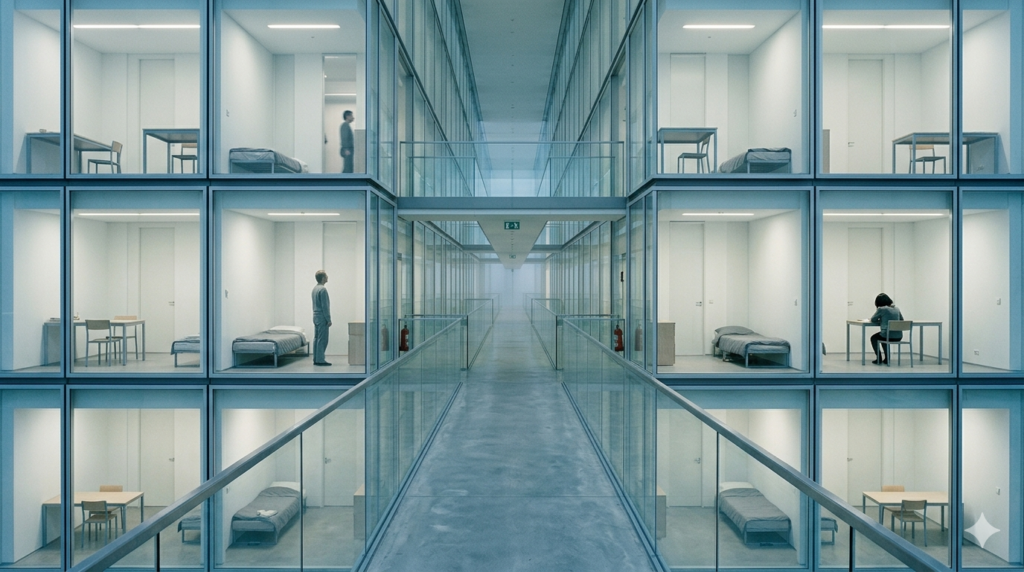
The citizens of the One State live in apartment buildings that are built almost entirely of glass. The exterior walls are glass. The interior walls between rooms are glass. The corridors are glass. The buildings, taken together, are described as a kind of vast transparent grid, through which every citizen can be seen by every other citizen at almost all times.
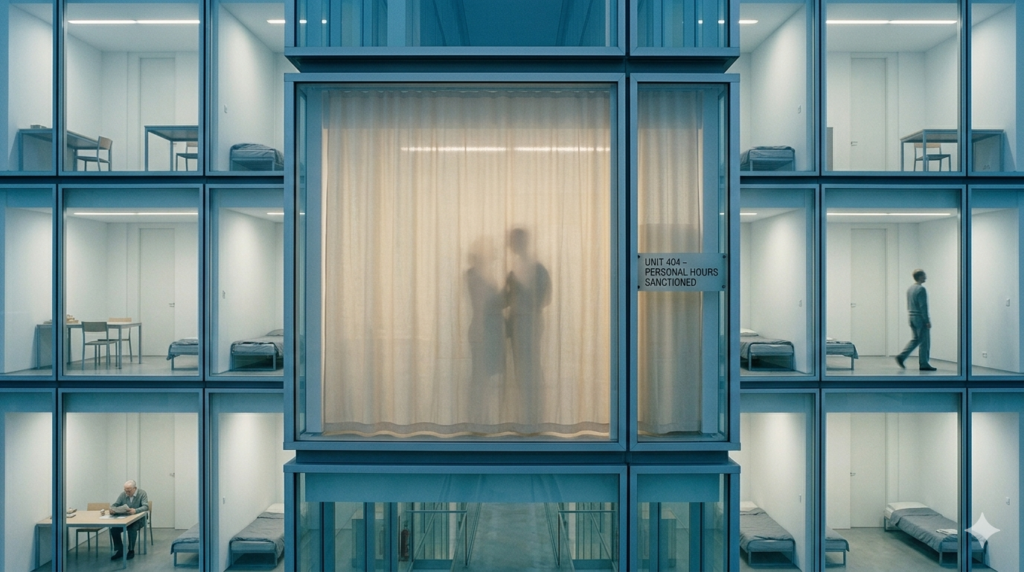
There is one exception. During Personal Hours, which the regime grants to permit sanctioned sexual encounters, citizens may lower a kind of curtain that briefly hides their apartments from view. The curtain is the regime’s only concession to privacy, and even this concession is bounded. The Personal Hours are scheduled. The curtain may only be lowered during them. The use of the curtain itself is monitored.
The narrator, D-503, treats this arrangement as obvious. He has grown up inside it. He does not describe it as strange, because to him it is not strange. He mentions the glass apartments in passing, the way someone describing their day might mention the kitchen.
This casualness is one of the most important features of the novel. The architecture is not, for the citizens of the One State, an oppressive feature of their lives. It is the background against which their lives take place. They have not been forced to live in glass apartments. They were born in them. They do not, in any conscious way, mind.
A reader who comes to the novel from outside the One State experiences the architecture differently. The glass apartments produce, in the outside reader, an immediate sense of suffocation. The reader cannot imagine living that way. The reader projects this discomfort backwards onto the narrator and assumes that D-503 must also, secretly, find his living conditions intolerable.
Zamyatin will not permit this assumption. The novel is structured to show that the narrator does not find the apartments intolerable. The architecture has produced citizens for whom transparency is not a violation. The reader’s discomfort is the reader’s problem. The citizens are fine.
This is the first piece of political analysis the architecture is performing. Zamyatin is showing the reader that a regime that has been operating long enough does not need to coerce its subjects into accepting its conditions. The subjects, raised inside the conditions, simply do not perceive them as conditions. The conditions are the world.
What Zamyatin Knew About Bentham
To understand what the apartments are doing in the novel, it helps to know what Zamyatin had read.
Zamyatin trained as a naval engineer. He spent significant time in England during the First World War, supervising the construction of icebreakers for the Russian fleet. He was, by background and by temperament, a builder. He knew how buildings worked. He understood architectural form as a serious intellectual matter.
He had also read Jeremy Bentham. Bentham’s Panopticon, sketched in the late eighteenth century, was a proposal for a prison designed around a single principle. The cells of the prison would be arranged in a ring around a central tower. The walls of each cell facing the tower would be transparent or open. The tower would be opaque. The guards inside the tower could see every prisoner at any time. The prisoners, unable to see into the tower, would never know whether they were being watched at any given moment.
Bentham’s argument was that this arrangement would produce obedient prisoners without requiring constant active surveillance. The mere possibility of being watched, internalised by the prisoners over time, would do the work that active watching could not. The prisoners would, in effect, learn to watch themselves.
Zamyatin had taken this idea and extended it. The glass apartments are a panopticon in which every citizen is both a prisoner and a guard. There is no central tower. There is no single watcher. Every citizen can see every other citizen. The watching is distributed throughout the population.
This is a more advanced piece of political architecture than Bentham’s original proposal. Bentham needed a guard. The guard was the limit of the panopticon, the point at which it required institutional resources. Zamyatin’s design eliminates the guard. The citizens guard each other. The regime does not need to staff the watching. The watching staffs itself.
What this means in practical terms is that the regime in the One State has produced something Bentham could not have produced. Bentham’s panopticon required prisoners and guards. Zamyatin’s glass city has only citizens, each of whom performs both functions simultaneously, without ever being told to do so, because the architecture makes the dual role inevitable.
A reader who has not thought about Bentham will miss this. A reader who has Bentham in mind will see, in Zamyatin’s apartments, the answer to a problem that Bentham could not solve. The answer is that the surveillance has to be horizontal rather than vertical. It has to be distributed rather than concentrated. It has to be the architecture itself rather than the institution behind the architecture.
This is one of the deepest political insights in the novel. Zamyatin understood that the most efficient form of authoritarianism does not require a state at all, in the conventional sense. It requires only an architecture that produces the right kind of citizen. The state, once such an architecture exists, can become almost invisible. The citizens manage themselves.
The Curtain
The most interesting feature of the apartments, on a careful reading, is not the glass. It is the curtain.
The curtain is the only concession the regime makes to privacy. Citizens may lower it during Personal Hours. This single feature has been the focus of less critical attention than it deserves, because readers tend to register it as a small modification of the surveillance system. It is not. It is the system’s most precise piece of engineering.
Consider what the curtain does. It tells the citizens that the regime acknowledges, in principle, the existence of activities that should not be watched. The regime is not, by this acknowledgement, denying that privacy exists. The regime is granting that privacy is possible, in carefully bounded conditions, during specific hours, for specific purposes.
This is a much more sophisticated piece of political design than total transparency would have been. A regime that simply forbade privacy would have had to argue, constantly, against the citizen’s intuition that some activities should be private. The argument would have been exhausting and would have produced resentment.
Instead, the One State grants the principle. It says, in effect, that the regime understands the need for privacy and has provided for it. The curtain is the proof. The citizen who has access to the curtain cannot easily argue that the regime is denying privacy, because the regime is visibly granting it.
What the regime is actually doing, of course, is defining privacy on its own terms. Privacy, in the One State, exists only during sanctioned hours, for sanctioned purposes, under sanctioned conditions. Outside these conditions, privacy is not legitimate. The regime has not abolished privacy. It has redefined it as something the regime grants, rather than something the citizen has by right.
This is a far more powerful technique than abolition would have been. The citizens have been trained, through the existence of the curtain, to accept that privacy is a gift from the regime. The regime can therefore expand or contract the conditions under which privacy is permitted, and the citizens will receive these adjustments as administrative changes rather than as fundamental violations.
Zamyatin understood, before the political theorists who would later develop the idea, that the most effective way to control a population is not to remove the things they want. It is to make those things conditional on the regime’s permission. The thing then becomes a privilege rather than a right, and the regime acquires, over time, the unchallenged authority to grant or withhold it.
The curtain is the single piece of architecture in the novel that performs this work most clearly. It is the place where the regime’s deepest political technique becomes visible to the careful reader. The technique is not surveillance. The technique is the redefinition of human goods as administrative concessions.
Why D-503 Is the Architect
The narrator of the novel is, by occupation, an engineer. He is the chief builder of the Integral, the spaceship the regime is constructing to extend its mathematical happiness to other planets. The novel is structured as D-503’s diary, which he is writing partly as a personal record and partly as a contribution to the great propaganda project the Integral will carry to the rest of the universe.
D-503 is, in other words, the architect of the regime’s expansion. He is the man whose work is going to take the One State beyond Earth. He is the most committed of the regime’s intellectual workers. He is the regime’s success.
This matters because the novel is, at one level, the story of an architect coming to see the architecture he has helped to build.
D-503 does not, at the start of the novel, perceive the apartments as oppressive. He has lived in them his whole life. He has helped to maintain them. He has, in his own quiet way, contributed to the cultural infrastructure that produces the kind of citizen who finds the apartments acceptable.
What happens in the novel is that D-503 begins, slowly, to see what he has been part of building. The seeing is painful. The seeing happens through I-330, the woman he becomes involved with, who is part of a resistance movement. But the seeing is also, on a careful reading, internal to D-503’s own work. He is an engineer. He builds. The novel asks him to look at what he has built.
This is one of the novel’s most quietly devastating moves. The narrator is not an outsider being shown the regime. The narrator is the regime’s own builder. The novel is the diary of an architect coming to understand the political content of his own architecture.
By the end of the novel, when D-503 has been subjected to the procedure that removes his capacity for imagination, the loss is not just personal. It is professional. The man who had begun to see what he was building has been engineered so that he can no longer see it. He returns to his work, presumably, with the perceptions that made the seeing possible quietly amputated. The Integral will be built. The architecture will be extended. The architect will not, this time, ask any uncomfortable questions about what he is constructing.
This is the novel’s final argument about architecture. The architecture is not the prison. The architects are the prisoners. They have built the conditions of their own confinement, generation by generation, while believing they were doing engineering. The regime that has produced this arrangement does not need to threaten its architects. It only needs to remove, surgically, the perceptions that would allow them to see what they have made.
What the Apartments Predicted
I have been writing for several months about the relationship between dystopian fiction and the present moment. The architecture in We has aged in a specific and disturbing way, and it is worth being precise about how.
The popular reading of We treats the glass apartments as a metaphor for surveillance, broadly construed. The apartments are sometimes invoked in present-day discussions of CCTV, of social media, of corporate data collection. These invocations are not wrong, but they are imprecise. They treat the architecture as a metaphor for any kind of seeing, which dilutes the specific political claim Zamyatin was making.

What Zamyatin actually predicted, with extraordinary precision, was the architectural condition of a particular kind of digital existence. The condition in which the citizens are visible to each other, continuously, through a transparent medium that has no central authority but that nevertheless organises every interaction. The condition in which privacy is not abolished but is redefined as a permission granted by the medium, under conditions that the medium itself controls. The condition in which the watching is performed by the population rather than by a state apparatus, and in which the population has been engineered to find the watching unremarkable.
The condition is not CCTV. The condition is social media. It is the platform economy. It is the gradual rearrangement of social life around interfaces that make every citizen continuously visible to every other citizen, with the medium itself granting carefully bounded forms of privacy under terms it controls.
Zamyatin saw this in 1921. He did not see the technology. He did not need to. He saw the political form, which is independent of any particular technology that might eventually implement it. The form is the distributed panopticon. The form is the redefinition of privacy as administrative concession. The form is the architect who cannot see what he is building. The form is the citizen who finds the conditions of her life unremarkable because she has never known anything else.
The technology, when it arrived, simply provided the materials. The architecture was always going to be possible. Zamyatin had described it before the materials existed.
This is what the novel actually predicted, and it is the prediction the popular reading has almost entirely missed. The popular reading is looking for the cameras. The cameras are not the point. The point is the form the cameras enable, which was already complete in Zamyatin’s diagrams before any camera that could do this work had been invented.
Reading Between the Lines
The argument of this post is small and specific.
The glass apartments in We are not a metaphor for surveillance. They are a piece of political theory expressed in architectural form. They demonstrate, with unusual precision, how a regime can produce a population that polices itself, accepts the regime’s conditions as natural, and treats privacy as a permission granted by the regime rather than as a right held by the citizen.
The architecture is the argument. The architecture has been borrowed, repeatedly, by writers and filmmakers who have used the glass apartments as a visual shorthand for any kind of dystopian seeing. The shorthand has erased the precision of Zamyatin’s original analysis.
The recovery of the analysis requires a careful reading of the novel, with attention to what the apartments are actually doing, what role they play in D-503’s developing perception, and what the curtain is performing. The novel is short. It can be read in two evenings.
Read it again. Read the architectural details this time. Notice what Zamyatin has built. Notice that the building is not the prison. Notice that the architect is.
The book has been on the shelf for over a century. It has been read by millions of people. It has been read carefully by relatively few of them.
The careful reading is still available.
Read it as if you were an engineer being shown, for the first time, what you have built.
That is what Zamyatin wrote.
That is who the novel is for.