Fahrenheit 451 Is Not About Book Burning. It’s About Why the Books Stopped Mattering.
There is a particular way Ray Bradbury’s Fahrenheit 451 gets summarised, and the summary tells you almost nothing about what the novel is doing.
The summary runs like this. In a future America, books have been outlawed. The job of firemen, in this future, is not to put out fires but to burn books wherever they are found. The protagonist, Guy Montag, is a fireman. Over the course of the novel he gradually becomes disillusioned with his work, falls in with a small group of dissidents who have memorised books, and ends up as a kind of carrier of literature into a future where the regime that produced him has collapsed.
The summary is accurate. It is also misleading.
Most readers come to the novel believing it is a book about censorship. They expect a regime that fears books, an apparatus that hunts them, a hero who resists. They expect, in other words, 1984 with paperbacks.
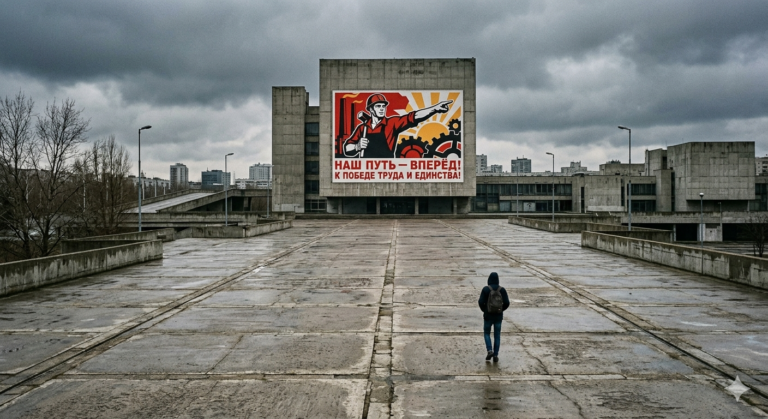
What Bradbury actually wrote is something stranger and more uncomfortable than this. The regime in Fahrenheit 451 did not start burning books because the books were dangerous. The regime started burning books because nobody was reading them anyway.
This is the argument the novel makes, repeatedly, in the first half. It is also the argument the popular memory of the novel has most thoroughly erased. The popular memory has retained the image of the fire. It has lost the explanation of why the fire was even necessary.
I want to read the novel here for what it is, rather than for what it is remembered as. The argument it makes is more disturbing than the censorship reading allows, and the disturbance is exactly what the novel was written to produce.
What Captain Beatty Actually Says
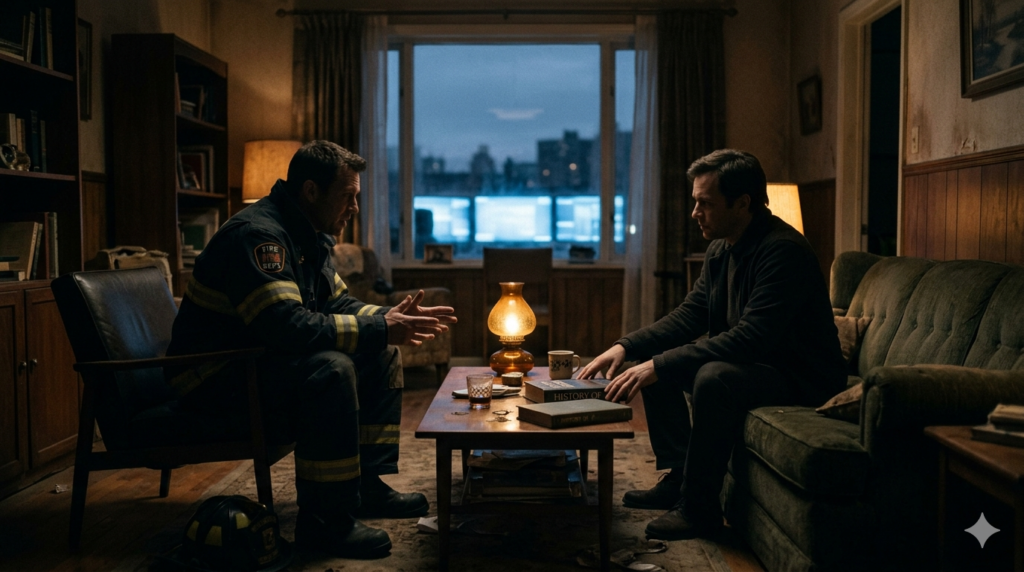
The most important speech in the novel is delivered by Captain Beatty, who is Montag’s superior at the fire department. Beatty visits Montag’s house when Montag has begun to falter in his work, and he delivers a long monologue explaining how the current arrangement came about.
Most readers, when they reach this speech, are looking for the regime’s official justification. They expect Beatty to say that books are dangerous, that ideas threaten the state, that reading produces dissent.
Beatty does not say any of this. He says something more interesting.
He says that books became unpopular gradually, over many decades, because people stopped wanting to read them. He says that the population grew. He says that magazines and films and television and radio multiplied. He says that attention fragmented. He says that people began to want shorter things, faster things, things that did not require the slow patient work that books demand.
He says that as books became less popular, they also became more contested. The more carefully a book argued a position, the more readers it offended. Minority groups objected to depictions they found insulting. Religious groups objected to representations they found blasphemous. Political groups objected to ideas they found dangerous. Editors began to soften their books. Publishers began to commission books that would not offend anyone. The result was books that had been edited into harmlessness, which then attracted fewer readers, which then provoked further edits, until books had become so bland that nobody bothered with them at all.
Beatty says that by the time the firemen were founded, the population had already abandoned reading. The books were already mostly gone from people’s lives. The regime did not have to fight a population of readers. The regime had to clean up after a population that had already, quietly, voluntarily, stopped caring.
This is the part of the novel the popular memory has lost. The firemen, in Bradbury’s account, are not the cause of the cultural condition. They are the consequence of it. The book burning is the visible end of a process that had been running, invisibly, for two or three generations before the firemen came into existence.
Bradbury was writing in 1953. He had been observing, with a writer’s careful eye, the early stages of mass television. He had been watching attention spans change. He had been watching what happened to print when the new media arrived. He had not imagined a future in which a regime would attack the readers. He had imagined a future in which the readers would simply disappear, and the regime would arrive afterwards to tidy up.
This is a much bleaker argument than the censorship reading allows.
Why Montag’s Wife Is the Real Centre of the Novel
If Beatty’s speech is the novel’s argument, Mildred Montag is the novel’s evidence.
Most readers remember Mildred only vaguely. She is Montag’s wife. She watches the television parlour walls. She attempts suicide early in the book. She is replaced by another version of herself, more or less, by the medical technicians who arrive to pump her stomach. She informs on Montag at the end. She is, in plot terms, a minor character.
In thematic terms, she is the most important figure in the novel.

Mildred is the case study. She is what the population has become. She lives inside a sealed environment of constant low-grade entertainment. The walls of her parlour are screens that play interactive shows. She wears small radio devices in her ears at all times. She has no friends in any meaningful sense, only the women who come over to watch the parlour with her. She has no memory of anything that has happened to her, including her own attempted suicide.
What Bradbury renders in Mildred, with patient and unsparing precision, is the texture of a life that has been fully colonised by the entertainment infrastructure. Mildred is not unhappy. She is not oppressed. She is not, as far as she can tell, missing anything. She has been engineered, by the conditions she lives inside, to want exactly the life she has, which is to say no life at all in any sense that would have been recognisable to a reader of an earlier century.
Montag’s slow horror, throughout the novel, is the horror of realising what his wife is. He has lived with her for years without seeing it. The novel’s machinery requires him to see it now, because the recognition is the precondition of everything else that happens.
This is, on a careful reading, the novel’s most powerful piece of writing. The Mildred sections are quieter than the burning sections, but they are doing the deeper work. Bradbury is showing the reader what produced the regime, by showing the reader what the regime’s most successful citizen looks like up close.
A reader who reads the novel at the level of plot will register Mildred as an obstacle to Montag’s awakening. A reader who reads at the level of argument will register her as the novel’s strongest piece of evidence for the claim Beatty made out loud. The population stopped reading. This is what they became. The firemen showed up afterwards to take the books that nobody wanted anymore.
The Friend Who Was Already Gone
There is a small subplot in the novel that almost no one remembers, and it is the place where Bradbury’s argument lands hardest.
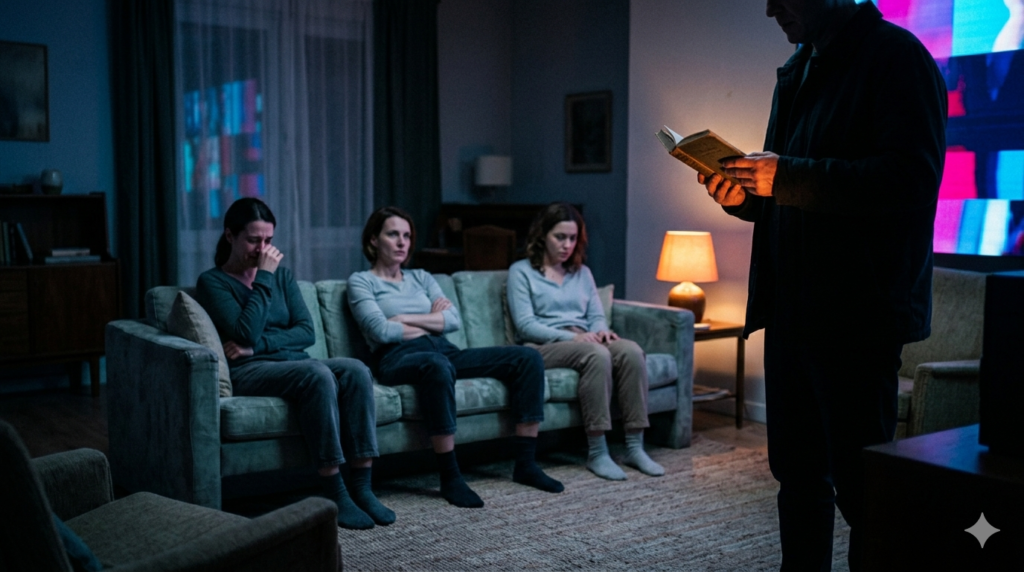
Mildred has a friend called Clara Phelps. Clara comes over with another friend, Mrs Bowles, to watch the parlour walls. The three of them sit together in the family room while the screens play. Montag, in one of the novel’s most uncomfortable scenes, interrupts their viewing to read aloud from a book of poetry he has hidden in the house.
He reads them Matthew Arnold’s Dover Beach.
This is not a random choice. Dover Beach is a Victorian poem about the receding of religious certainty, about standing on a cliff above a darkening sea and listening to the sound of belief being withdrawn from the world. It is a poem about exactly the cultural condition Beatty has been describing, written eighty years before Bradbury sat down to write his own novel about the same condition.
Montag reads it aloud. He thinks he is delivering a piece of literature to women who have been deprived of literature. He thinks he is breaking through the screens.
What actually happens is that Mrs Phelps begins to cry. She cannot say why. She does not understand the poem. She has not been moved by the meaning of the words, because she does not know what the meaning is. She has been touched by something underneath the words, some texture of attention, some quality of patient address, that she has not encountered in years and that her body remembers even though her mind no longer has the vocabulary for it.
Mrs Bowles, the other friend, becomes furious. She accuses Montag of cruelty. She says that this is exactly why she has been telling Mrs Phelps not to read poems. She says that poems are unhealthy. She says they make people sad. She gathers her things and leaves.
This scene is, on a careful reading, one of the most devastating things Bradbury wrote. The two women are not the enemy. They are not agents of the regime. They are not informants. They are ordinary citizens who have lived their entire adult lives inside an entertainment infrastructure that has hollowed them out, and the small piece of poetry has produced in one of them an emotional response she cannot account for, while producing in the other a defensive rage at the source of that response.
The regime, by this point in the novel, does not need to do anything. The population is policing itself. Mrs Bowles is the one who wants to leave. She is the one who is angry. She is the one who feels the poem as a threat. The firemen, if they had walked into that room and burned the book, would have been performing a service Mrs Bowles had already demanded.
This is what Beatty was trying to explain. The censorship is downstream of the cultural condition. The population had stopped wanting the books long before the books became illegal.
What the Burning Actually Is
Once you have read the Beatty speech, the Mildred sections, and the Mrs Phelps scene carefully, the book burning that the novel takes its title from looks different.
The popular reading treats the burning as the regime’s central act of violence. The firemen arrive at a house. They drag out the books. They pour kerosene. They light the fire. The reader is meant to recoil at the destruction of literature, at the spectacle of cultural memory being incinerated.
The careful reading treats the burning as something quieter. The burning is the regime’s cleanup. The books being burned are the books that were left over after the population had already moved on. They are the books in the houses of the small remaining minority who still read. They are the books of the few people for whom the cultural shift Beatty described did not fully take. The firemen are not extinguishing a vibrant reading culture. They are tidying up the residue of one.

This is why Beatty’s role in the novel is so strange, and so often misread. Beatty is not a villain in the conventional sense. He is a man who has read deeply, who can quote literature freely, who understands exactly what is being destroyed. He chooses, despite this understanding, to be the man who destroys it.
He chooses this because he believes the destruction is a small completion of a larger process that was already underway. He is not lying when he tells Montag that books became unpopular before they became illegal. He believes the cultural shift was inevitable. He has decided that since the books are not going to be read anyway, someone might as well perform the funeral. The firemen are the funeral directors. The fires are the ceremony.
This is one of the most uncomfortable arguments in twentieth-century fiction, and it is the argument the popular summary erases entirely. The novel is not saying that books are too dangerous to be allowed. The novel is saying that books became too useless to be defended, and that a culture which lets its books become useless will eventually arrange for their disposal.
The disposal is not the horror. The uselessness was the horror. The disposal is just the public acknowledgement of something that had already happened in private.
What the Novel Is Predicting
I have been writing for several months about the relationship between dystopian fiction and the present moment. Most canonical dystopias get something right about the present and something wrong. Fahrenheit 451, on a careful reading, has aged in an unusual way. The thing the novel is most often credited with predicting is not what it actually predicted. The thing it actually predicted is happening, and almost no one is naming it.
The popular memory says Bradbury predicted censorship. He did not, particularly. The censorship in his novel is a late-stage symptom, not a primary mechanism.
What Bradbury actually predicted was the cultural condition that produces the desire for censorship in the first place. He predicted the saturation of public life with entertainment that asks nothing of its consumers. He predicted the fragmentation of attention. He predicted the social production of readers who would feel attacked by demanding texts. He predicted the gradual replacement of reading with passive media consumption. He predicted the way this consumption would change people, not by making them stupid in any obvious sense, but by making them incapable of the patient sustained attention that reading requires.
He predicted, in other words, the conditions that have produced the present.
The screens on the walls of Mildred’s parlour are not far from the screens in the average present-day home. The radio in Mildred’s ear is not far from the AirPods in the average present-day commuter. The interactive shows in which Mildred is invited to participate are not far from the algorithmically curated feeds of the present-day social media platform. The friends who gather to watch the parlour are not far from the gathered scrolling that passes for socialising in many present-day living rooms.
None of this is censorship. None of it is the regime hunting books. It is, however, the cultural condition Beatty describes. The condition in which books gradually stop being read, not because they are forbidden, but because the population has been engineered, by the available infrastructure, into a state where books no longer fit.
This is what Bradbury saw. It is not the future he is sometimes credited with predicting. It is the future the novel was actually trying to warn against, and the warning has been almost entirely missed by readers who came to the novel expecting the censorship story they had been told to expect.
Why the Ending Has Been Misread
The ending of the novel has been read, for decades, as hopeful. Montag escapes the city. He joins a small group of dissidents who have memorised great works of literature. They walk down a river toward an uncertain future. The city behind them is bombed. The novel ends with the group walking on, carrying the books in their heads, ready to rebuild civilisation when the time is right.
The popular reading is that this is a redemption. The books survive. The culture has a future. The dissidents will carry the inheritance forward.
The careful reading is more pessimistic.
The dissidents in the closing sections are not the carriers of a vibrant tradition. They are the last fragments of a tradition that was, by Beatty’s account, mostly gone before the firemen arrived. They are not many. They are not young. They are walking through a country that has, for two or three generations, lost the ability to read. The bombing of the city does not represent the regime’s fall. It represents the regime’s continuation by other means, in a war the novel never fully explains.
What will the dissidents do, when they walk back into the country with their memorised books? They will encounter a population of Mildreds. The population will not want what they are carrying. The population has not wanted it for a long time.
Bradbury is not naive about this. The ending of the novel is suspended deliberately at the moment before the dissidents have to find out. The reader is given the small hope of the walk, but the novel does not pretend that the walk leads anywhere certain. It leads back into a country that has been engineered, over decades, to find the dissidents’ inheritance incomprehensible.
This is what makes the ending so quietly devastating. The hope is small. The work the dissidents have done is patient and partial. There is no guarantee that the work will matter. The novel ends in the gap between the carrying and the reception, and the gap is where the real question lives.
A reader who has been trained on the censorship reading will close the novel with the sense that the books have won. A reader who has been trained on the cultural-condition reading will close the novel with a much harder feeling, which is the recognition that even if you save the books, you have not saved the readers, and the readers were what mattered.
What This Means for Reading the Novel Now
The argument of this post is small and specific.
Fahrenheit 451 is not a novel about censorship. It is a novel about the cultural conditions that produce the eventual irrelevance of books, with censorship arriving at the end of the process as a kind of administrative tidying. The popular memory has retained the censorship and lost the cultural conditions. The careful reading restores them.
The implications of this restoration are not small. If the novel is about the conditions that produced the censorship rather than about the censorship itself, then the novel is asking us to look at the present moment differently than the popular reading allows. We are not, in the present, living through a moment of literary censorship in any serious sense. Books are widely available. The state is not hunting readers. The firemen are not at the door.
But the cultural condition Bradbury described is here. The screens are everywhere. The attention is fragmented. The patient sustained reading that books require has become, for many people, a difficult skill they no longer practise. The population that produced Mildred and Mrs Phelps has been quietly arriving for several decades, and the books they no longer read are still on the shelves, waiting.
This is the warning the novel was actually trying to deliver. It is the warning the present moment most needs to hear. It is also the warning that the popular summary of the novel has been actively obscuring, because the popular summary directs the reader’s attention to the wrong threat.
The threat is not the regime taking the books away. The threat is the population deciding, in small ordinary ways, that the books are no longer worth the effort.
The novel was published in 1953. The population Bradbury was warning against did not yet exist in the form he was describing. It does now.
The book is short. It can be read in two evenings.
Read it again. Read Beatty’s speech this time. Read the Mildred sections. Read the Mrs Phelps scene. Notice what Bradbury was actually saying.
The fire is not the warning.
The cold living room is the warning.
The cold living room is here.