
The African Dystopia Was Never Regional. It Was Early.
There is a quiet rearrangement happening in the way people read political fiction, and most readers have not yet noticed it.
For most of the twentieth century, dystopian novels by African writers were read, when they were read at all, as accounts of distant political conditions. The regimes they described were understood to be regional, post-colonial, a specific historical product of European empire’s collapse and its aftermath. Western readers approached these books with the same anthropological distance with which they approached travel writing or political journalism from the global South. The conditions were real, but they were elsewhere. The dictatorship was someone else’s. The colonised mind was someone else’s. The genocide as cultural infrastructure was someone else’s. The novels were valuable, but the valuable thing about them was the report from a faraway place.
This reading was always partly wrong, and over the last fifteen years it has become almost entirely wrong. The political conditions the African dystopian tradition has been writing about for the better part of fifty years are no longer regional. They are arriving in places that thought themselves immune. The Western reader who has been treating African dystopian fiction as exotic dispatch is now, without realising it, reading their own present in a coded form.
This post is an argument for what the present looks like when you read it through the apparatus the African dystopian tradition has been quietly building.
What the Tradition Was Describing
Across the six posts I have written in this vertical, a small catalogue of political conditions has emerged. Each of them was identified by an African writer working in the dystopian register, and each of them was, at the time of the writing, dismissed by the Western critical establishment as a regional phenomenon. The catalogue is worth restating clearly, because what becomes visible in the present moment is the way each item is now operating outside its original setting.
Ngũgĩ described the personalist dictatorship, the regime in which the body of the leader and the body of the state have fused into a single organism, and in which the leader’s psychology determines national policy. He described the saturation of public language with state speech until meaning drains away. He described the megaproject, the perpetually unfinished monument that performs the regime’s permanence. He described the resistance that works not by overthrow but by curing populations of their fear.
Dangarembga described the colonised interior, the regime so total that its subjects do its work for it, choosing the systems that unmake them and competing for the privilege of being remade. She described the body’s refusal of what the mind has been trained to accept, the political symptom expressed through illness because the system has made the refusal unspeakable. She described the slow attrition of inherited language and the resulting thinning of available thought.
Okorafor described the engineered violence on the female body embedded in cultural ritual and presented under the description of honour. She described the international community’s selective non-intervention. She described the use of magic as the marker of where realist political vocabulary has failed. She described the dystopia in which the catastrophe has already happened and the question is what to do inside what is left.
Across these three writers, a portrait of authoritarian political reality emerges that is unlike the Western dystopian portrait. The regime is generational rather than recent. It has no outside. It is held in place by the participation of its targets. It produces compliance through saturation rather than through scarcity. It operates on the body through ritual rather than through visible coercion. It is too embedded to be escaped and too distributed to be overthrown. The resistance, if there is one, is not the recovery of a lost freedom but the imaginative construction of one that has not yet existed.
For most of the twentieth century, this portrait was read as a description of certain African political conditions. It was treated as accurate within its setting and limited in its broader application. The Western reader could acknowledge the precision of the description while assuming that nothing in the description applied to their own political situation.
This assumption is no longer tenable.
What the Present Looks Like Through the Apparatus
Look at the current global political situation through the African dystopian apparatus, and several things become visible that the Western tradition’s apparatus cannot fully render.
The personalist dictatorship is no longer regional. The pattern of leaders whose psychology determines national policy, whose physical health is a state secret, whose moods produce visible consequences in the lives of millions, is now operating in countries the Western reader was trained to think of as immune. Russia, Turkey, Hungary, India, the Philippines, and several Western democracies have produced, in the last twenty years, leaders whose relationship to the state more closely resembles the Ruler in Wizard of the Crow than anything in the canonical Western dystopias. The fusion of leader and state, which Ngũgĩ described as the central feature of post-colonial African authoritarianism, is now a feature of authoritarian and authoritarian-adjacent regimes globally. The apparatus is no longer regional. The book has gone everywhere.
The saturation of language is no longer regional. Ngũgĩ described it as the technique by which African dictatorships drowned meaning rather than restricting it. The Western reader of 2010 might have considered this a particular feature of regimes that had to overcompensate for limited literacy and limited information infrastructure. The Western reader of 2026 lives inside the same technique, performed at vastly greater scale by social media platforms and state-affiliated content production. The flooding of public discourse with so much state-aligned or state-tolerated speech that the words themselves stop carrying meaning is now the daily condition of political life in much of the world. Ngũgĩ was not describing a regional inefficiency. He was describing a technique that scales.
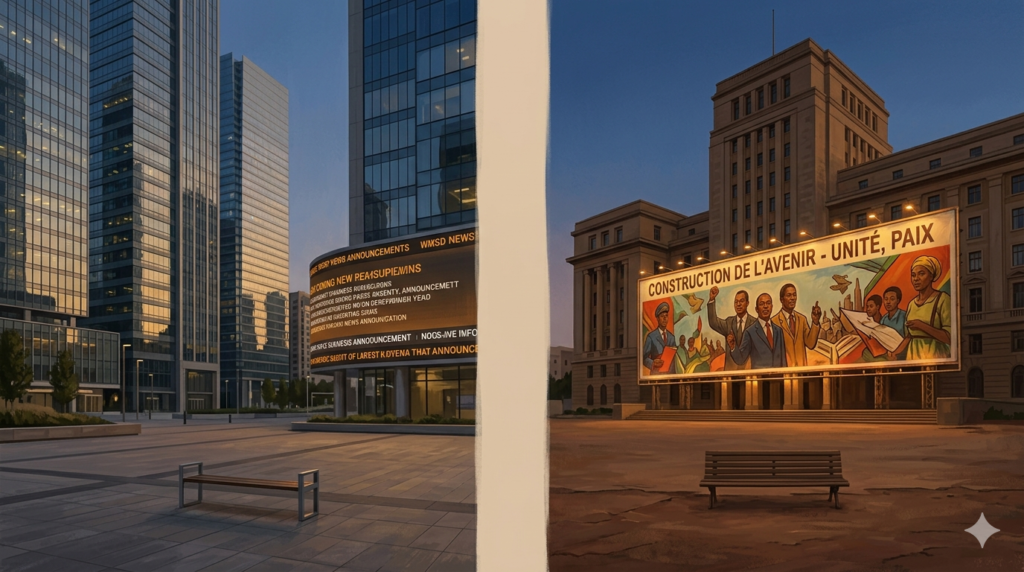
The colonised interior is no longer regional. Dangarembga described it as the specific psychological condition of populations who had been engineered, over generations, into wanting the systems that unmade them. The Western reader of the 1980s might have considered this a feature of the relationship between coloniser and colonised in the specific historical setting of late-colonial Africa. The Western reader of the present sees the same condition operating in their own societies through different mechanisms. Populations trained, by the institutions that shape them from childhood, to internalise the values of systems that produce their own immiseration. Workers competing for the privilege of overwork. Young people performing happiness for platforms that monetise the performance. Citizens defending the very economic arrangements that hollow out their communities. The colonised interior, in Dangarembga’s sense, is not a feature of post-colonial Africa alone. It is a feature of any society in which the dominant system has been operating long enough to be internalised by its subjects as desire.
The body as political infrastructure is no longer regional. Okorafor described it in the context of engineered sexual violence and ritualised genital cutting. The Western reader who has not been paying attention might consider this a regional condition with no application to their own societies. The Western reader who has been paying attention sees the same logic operating, in different forms, through the criminalisation of abortion, the surveillance of trans bodies, the algorithmic management of female appearance, the engineering of beauty standards across populations of girls who will spend their lives trying to embody them. The body has been a piece of political infrastructure in every authoritarian and patriarchal system that has ever existed. The African dystopian tradition described this with unusual precision because the African writers were writing from inside societies in which the operation was relatively unconcealed. The Western dystopian tradition, with the partial exception of Atwood, has been slow to describe it, because the operation in Western societies has been better concealed. The concealment is now thinning.
The absence of an outside is no longer regional. The African dystopian tradition wrote from inside political situations that could not be escaped by emigration, because the regime was continental, global, or embedded in international structures. The Western reader of the twentieth century could still imagine an outside, a place beyond the regime, a Canada to flee to. The Western reader of the present is beginning to lose this consolation. Climate collapse is global. Surveillance capitalism is global. The financial system that produces precarity is global. The political moods that are reshaping democracies are transnational. The conditions a reader might want to escape are increasingly the conditions of the world itself. The Canada is shrinking. The African dystopian tradition has been writing from inside this condition for half a century. The Western tradition is just beginning to feel it.
What the Apparatus Lets You Read
What the African dystopian apparatus lets you read, when you point it at the present, is the texture of the political situation rather than its surface.
The Western dystopian tradition trained generations of readers to recognise authoritarianism by its surface features. Uniforms. Slogans. Surveillance cameras. Show trials. Public executions. A leader’s face on every wall. When these features were present, the reader knew they were looking at authoritarianism. When they were absent, the reader assumed authoritarianism was not present.
The African tradition trained its readers to recognise authoritarianism by its texture. The way language behaves. The way the body responds. The way time feels under the regime. The way young people relate to their parents’ world. The way the regime is held in place by the participation of its targets. The way the cultural rituals organise people into compliance without anyone naming compliance as the goal. The way the resistance, when there is one, looks more like patience than like rebellion.
A reader trained on the African apparatus can identify the texture of authoritarianism in situations where the surface features have not yet arrived, or are mild, or are masked by democratic forms. A reader trained only on the Western apparatus often cannot. They are still waiting for the uniforms. They are still looking for the leader’s face on every wall. They are still expecting the surveillance camera to be visible, rather than embedded in the device in their pocket. The apparatus they were given is calibrated for the political reality of the mid-twentieth century. The political reality of the present has moved past it.
This is what the African dystopian tradition has been quietly preparing readers for, without those readers knowing they were being prepared. The tradition was not writing about elsewhere. It was writing about a kind of political condition that, at the time of writing, happened to be more visible in some places than in others, and that has, since the time of writing, become much more widely distributed.

Why the Tradition Was Read as Regional
It is worth being honest about why the African dystopian tradition was read as regional for so long.
The Western critical establishment of the twentieth century was structured around the assumption that political modernity proceeded from the centre to the periphery. The centre was the North Atlantic. The periphery was everywhere else. Political and literary developments in the centre were treated as universal. Political and literary developments in the periphery were treated as regional, particular, applicable mainly to themselves.
This assumption was always wrong, but it was operationally functional for a long time because the centre was producing the political conditions to which the rest of the world had to respond. The colonial system was a centre-out operation. The Cold War was a centre-out operation. The post-1989 economic order was a centre-out operation. The Western critical apparatus, calibrated to the political reality of the centre, was treated as adequate to the political reality of everywhere.
The political reality has now reversed. The political conditions that the periphery was writing about for the last fifty years are arriving in the centre. The African dystopian tradition, which was describing the consequences of long-duration authoritarianism, generational colonisation, and engineered population management, is now describing conditions that are emerging in places that thought themselves immune.
The critical apparatus, however, has not yet reversed. The Western reading public still treats African dystopian fiction as an account of distant political conditions, even as those conditions are arriving on their own doorstep. The tradition that was treated as regional is, in fact, the tradition that has the right apparatus for reading the present.
This is the rearrangement I mentioned at the beginning of this post. It is happening slowly. Most readers have not yet caught up. The tradition that was kept off the dystopia shelf is, in fact, the tradition that was reading the future correctly.
What This Asks of the Reader
The reader who recognises this rearrangement is in a different position from the reader who does not.
The reader who recognises it cannot continue to read African dystopian fiction as travel literature. The novels are not reports from elsewhere. They are reports from earlier. The conditions they describe are, with modifications, the conditions the reader is now living in. The novels have to be read as instruments calibrated to the reader’s own situation, not as anthropological texts about a place the reader is not.
The reader who recognises it has access to a critical vocabulary the Western tradition did not give them. They can describe what their own regime is doing using language Ngũgĩ developed, which is more precise than the language Orwell developed because Ngũgĩ was writing about conditions Orwell did not see coming. They can describe the operation of their own political situation using the apparatus Dangarembga built, which is more accurate than the apparatus the Western tradition built because Dangarembga was writing from inside the kind of regime that has now generalised.
The reader who recognises it is also obliged, in some sense, to the writers who built the apparatus. The African dystopian tradition was kept off the canonical shelf for a long time, dismissed as regional, filed under categories that disguised its central genre work. The reader who benefits from the apparatus the tradition built has a small but real responsibility to acknowledge the source. The novels were not telling stories from elsewhere. They were doing critical work the centre did not yet know it needed.
Reading Between the Lines
There is a way of reading the argument of this post that treats it as a kind of triumphal vindication of African writing. The Africans were right all along. The conditions they described are everywhere now. They were ahead of the curve.
This is not the right reading. The conditions they described are not desirable conditions. The vindication, if there is one, is not pleasant. The African dystopian tradition was right about authoritarianism, about colonised interiors, about the saturation of language, about the body as political infrastructure, about the absence of an outside. Being right about these things does not improve them. It just means the tradition has been writing the manual for a future that is now arriving.
The right reading is more demanding. It is that the Western reader, having been trained on the wrong apparatus, has spent a long time being unable to see the political situation clearly. The apparatus that would have allowed them to see it was available. It was being developed, in plain sight, by writers the canon was filing elsewhere. The reader is not at fault for not knowing what they were not told. The reader is now responsible for what they do with the knowledge once they have it.
The African dystopian tradition is not a regional curiosity. It is the most accurate body of dystopian fiction the genre has produced. It has been quietly waiting, for fifty years, for the rest of the world to catch up to the situation it was describing.
The rest of the world is now catching up.
The novels are still on the shelves. They have always been there.
You can read them. You always could.
Now you also need to.


