How North Korea Built a Real-World 1984 and What Literature Gets Wrong About It
There is a comparison so frequently made that it has become a reflex.
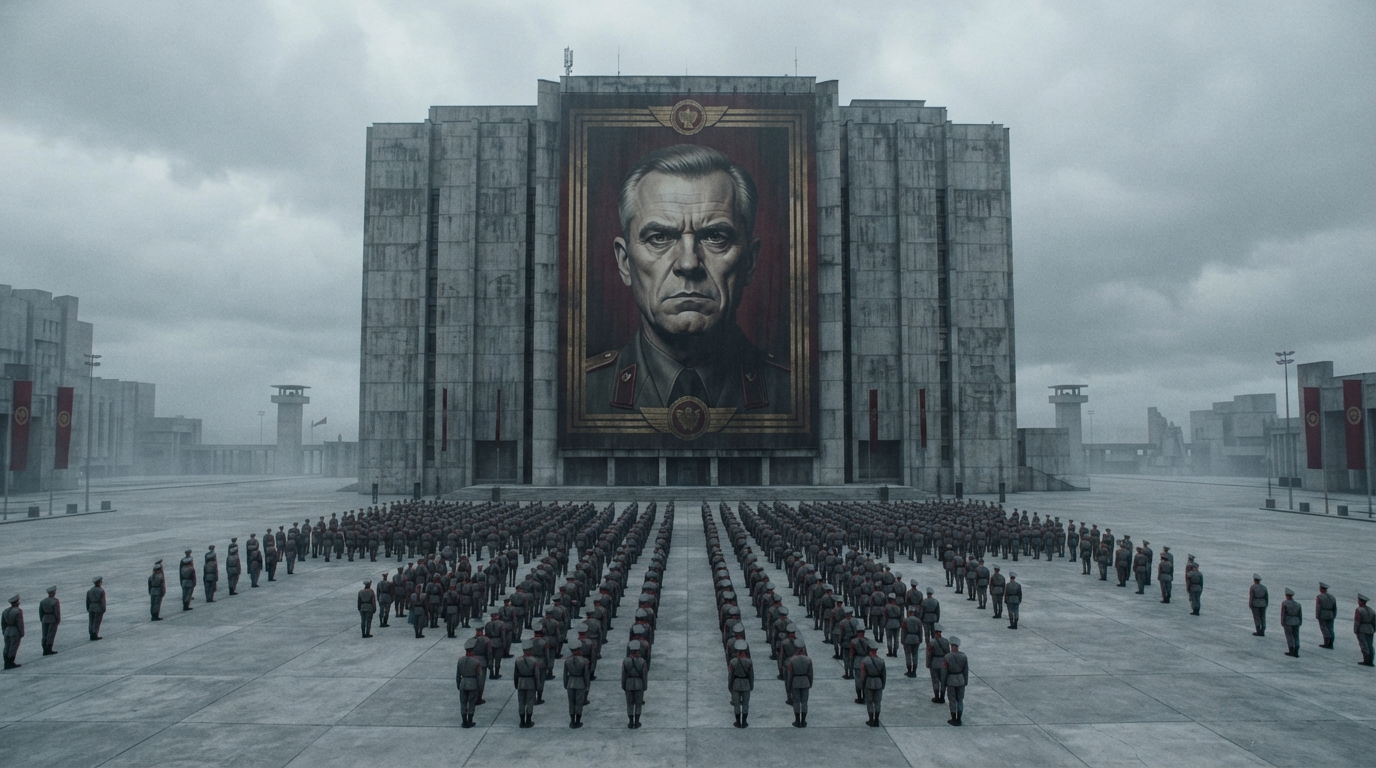
North Korea is 1984. Kim Jong-un is Big Brother. The portraits on the wall, the mandatory worship, the surveillance, the rewriting of history, the enforced public grief when a leader dies, the citizens who inform on their neighbours, the prison camps where people disappear. Every journalist who visits Pyongyang and every analyst who studies the regime reaches for Orwell within the first few paragraphs. The comparison feels exact. It feels inevitable.
It is also, in several important respects, wrong.
Not wrong in its observation that North Korea is a totalitarian state, which it plainly is. Not wrong in recognising that Orwell’s novel anticipated features of political control that North Korea has since realised in practice. But wrong in the specific ways it applies the novel’s framework to the reality, and wrong in what it misses about North Korea by looking at it through an Orwellian lens rather than on its own terms.
The comparison with 1984 is one of the most revealing things we reach for when trying to understand North Korea. It is also one of the things that most reliably prevents us from understanding it.
What North Korea Got Right That Orwell Predicted
Begin with what the comparison does correctly identify, because there is genuine substance here.
The personality cult surrounding the Kim family is among the most elaborate ever constructed. Kim Il-sung, the founder of the state, was not merely a political leader. He was positioned as the eternal father of the nation, the source of all life and prosperity, the man to whom every North Korean owed not merely political allegiance but filial love. When he died in 1994, the grief displayed by North Koreans in the streets of Pyongyang was so extreme, so physically uncontrolled, that foreign observers watching the footage assumed it must be performed. People collapsed. People wailed. People beat their chests and threw themselves to the ground.
Whether that grief was genuine, performed, or some third thing that is neither genuine nor performed in any way that maps cleanly onto those categories, is one of the central questions about North Korea that the 1984 comparison cannot help you answer.
The rewriting of history is real and systematic. Kim Il-sung’s role in the Korean War has been fabricated almost entirely. His biography has been revised multiple times to remove inconvenient facts and add invented ones. His birth was reportedly accompanied by a double rainbow and a new star in the sky. The Mount Paektu mythology, which positions the Kim family as born from the sacred mountain at the spiritual heart of Korean identity, is a relatively recent invention that has been retrojected into the official history as though it were ancient and established.
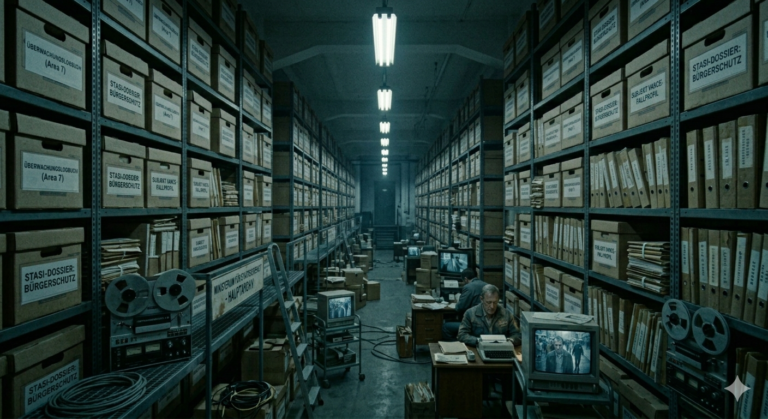
The surveillance is real, though its mechanisms differ from Orwell’s telescreens in ways that matter. The Inminban system, the neighbourhood watch units that organise North Korean society at the most granular level, assigns a group leader to every five to twenty-five households, with responsibility for monitoring the activities, attitudes, and associations of every member of those households and reporting deviations to the authorities. This is surveillance, but it is surveillance conducted through human social networks rather than through technology, and its dynamics are consequently quite different from what Orwell imagined.
The prison camps are real. The network of political prison camps, known as kwanliso, holds an estimated eighty thousand to one hundred and twenty thousand people at any given time, depending on the source. Survivors who have escaped and been interviewed by researchers describe conditions of forced labour, starvation, torture, and execution that are among the worst documented in the contemporary world. These camps are real-world analogues of what Orwell imagined as the Ministry of Love, the place where the inconvenient are sent and unmade.
Where the Comparison Breaks Down
The 1984 comparison begins to mislead almost as soon as it is made precise.
Orwell’s Oceania is a society organised around the explicit and conscious suppression of truth. The Party knows that two plus two equals four. It requires its members to simultaneously know this and assert that it equals five. Doublethink is the cognitive mechanism by which this contradiction is maintained. The Party is consciously, deliberately lying, and it has built a psychological technology to manage the consequences of lying inside its own membership.
North Korea is not organised this way.
The Kim regime does not, in its internal communications and training, present itself as an organisation that knows it is lying to its population. It presents itself as an organisation that genuinely represents the interests and the destiny of the Korean people. The mythology is not understood by its propagators as mythology. Or rather, the relationship between the propagators of the myth and the myth itself is considerably more complicated than Orwell’s model of conscious lying managed through doublethink allows for.
B.R. Myers, the scholar who has most carefully analysed North Korean propaganda on its own terms, argues in his essential study of the subject that the Kim regime’s ideology is not primarily Stalinist, Confucian, or Marxist-Leninist, as various analysts have suggested at various times. It is racist. The core myth of North Korean ideology is the purity and innocence of the Korean race and the necessity of protecting that purity from contamination by foreign elements, primarily Japan and America. Kim Il-sung and his successors are positioned not as supreme leaders in the Soviet mould but as parental protectors, uniquely capable of shielding the pure and childlike Korean people from the corrupt and dangerous outside world.
This is not what 1984 describes. Orwell’s Party does not claim to protect its citizens from a threatening outside world. It manufactures an enemy in order to maintain a state of permanent war that justifies the conditions of scarcity and surveillance under which its population lives. The enemy is deliberately kept abstract and interchangeable. Oceania has always been at war with Eastasia.
North Korea’s external enemy, America and Japan, is not interchangeable and not abstract. The Korean War, which North Korea calls the Fatherland Liberation War and teaches as a story of heroic resistance against American aggression, is the founding trauma of the state’s mythology, and it is a real war with real casualties and a real outcome that is genuinely disputed between the parties involved. North Korea’s propaganda about America is not pure fabrication. It is a selective and heavily distorted version of real events. That distinction matters enormously for understanding why the propaganda works and how it is received.
What Literature Gets Wrong About Totalitarian Belief
The most significant thing that 1984 gets wrong about North Korea, and about totalitarianism more generally, is the question of belief.
Orwell’s model assumes that the citizens of a totalitarian state know, at some level, that they are being deceived. Winston knows. The proles know in a different, less articulate way. Even the Party members, through the mechanism of doublethink, know and do not know simultaneously. The knowledge is there, suppressed and managed, but present.
This assumption produces the narrative shape of 1984, in which the novel’s drama is the drama of a consciousness trying to hold onto what it knows against the pressure of a system trying to make it unknow it.
The evidence from North Korea, gathered from defectors who have been interviewed in South Korea and third countries over several decades, suggests a considerably more complicated picture.
Some defectors describe the moment they began to doubt the regime’s narrative as a sudden and disorienting experience, not a recovery of something they always knew but a genuine rupture, an encounter with information that forced a reorganisation of everything they had previously understood. This suggests that their belief in the regime’s version of reality was, for a period, genuine rather than performed. They were not secretly knowing and publicly performing. They were, in some meaningful sense, believers.
Others describe a more gradual and more ambiguous process, in which doubt accumulated slowly through small inconsistencies, through encounters with black market information, through experiences that did not fit the official narrative, without ever producing a clean break. They continued to perform loyalty while accumulating private reservations, not because they had a sophisticated theory of self-protection but because the reservation and the performance existed in separate cognitive compartments that did not have to be reconciled.

Neither of these accounts maps cleanly onto Orwell’s doublethink. Doublethink is a form of conscious, managed contradiction. What defectors describe is something more like the ordinary human capacity to hold inconsistent beliefs simultaneously without experiencing them as a contradiction, a capacity that is not unique to totalitarianism and that does not require a political technology to maintain.
The Songbun System and What Orwell Missed
One of the features of North Korean society that the 1984 comparison consistently obscures is the songbun system, the hereditary class classification that assigns every North Korean citizen to one of three broad categories based on the perceived loyalty of their family during the founding period of the state.
Citizens classified as the core class, whose families were deemed loyal, have access to better housing, food distribution, education, and employment. Citizens classified as the wavering class occupy a middle position. Citizens classified as the hostile class, whose families included collaborators with Japan, religious leaders, capitalists, or people who fled to South Korea during the war, face systematic discrimination across every dimension of life.
The songbun system is inherited. If your grandfather was classified as hostile, you are hostile, and your children will be hostile. The classification follows the family line for three generations.
This is not anything Orwell imagined. The world of 1984 is a world in which class has been abolished, in which the Party recruits on the basis of intellectual capacity and political reliability rather than hereditary status, in which the social hierarchy is maintained through surveillance and indoctrination rather than through a formalised inherited caste system. Orwell’s model of totalitarianism is, in this respect, more modern and more egalitarian than North Korea’s reality.
The songbun system introduces a dimension of social control that is not primarily ideological. A citizen in the hostile class does not need to be convinced of the regime’s legitimacy or subjected to intensive indoctrination. They simply need to understand that their opportunities in life are circumscribed by a classification they inherited and cannot escape. The control is structural rather than psychological. It does not require the citizen to believe anything in particular. It requires them to navigate a system in which their options are already narrowed by a fact about their family history that is not subject to revision.
The Information Environment
One of the features of North Korea that makes it genuinely comparable to Oceania is the information environment, the systematic exclusion of outside information from the population.
North Korea is one of the most information-isolated societies on earth. Access to the internet is restricted to a tiny elite. Foreign radio and television signals are illegal to receive and punishable by severe penalties. The domestic media consists entirely of state-produced content. Until the spread of USB drives and DVD players via the black market in the 2000s, the average North Korean had essentially no access to any information about the outside world that had not been filtered and approved by the state.
This isolation is genuinely Orwellian. It is the closest real-world approximation of the information control that Orwell describes in the Ministry of Truth. But even here the comparison is inexact.
Orwell’s Ministry of Truth is a reactive institution. Its job is to continuously revise the historical record to conform to the Party’s current position, to ensure that no evidence of previous positions survives that would embarrass the current position. It is an institution engaged in active falsification.
North Korea’s information control is more passive. It does not primarily work by falsifying outside information. It works by ensuring that outside information does not arrive. The difference is significant. Falsification implies a relationship with the truth being falsified. Exclusion implies no relationship at all. The citizens of Oceania live in a world where the truth is constantly being processed and altered. Many citizens of North Korea live in a world where the outside truth has simply never arrived.
What the Comparison Costs Us
The 1984 comparison is not wrong to reach for Orwell when confronted with North Korea. It is wrong to stop there.
When we look at North Korea through the lens of 1984, we see the features of the society that fit the Orwellian template clearly and we tend to underweight or miss entirely the features that do not. We see the surveillance and the propaganda and the prison camps. We miss the songbun system, the racial mythology, the specific dynamics of the Korean War’s role in the state’s self-understanding, the complicated and various ways in which North Korean citizens actually relate to the regime’s claims about reality.
We also, most importantly, import Orwell’s implicit framework for thinking about what it would take to change such a society.
If North Korea is 1984, then the path to change runs through the Orwellian logic of 1984, which is that the population secretly knows the truth and is being prevented from acting on it. If you could only get the truth to them. If you could only penetrate the information blockade and reach the Winston Smiths who are writing DOWN WITH BIG BROTHER in the margins of their consciousness.

The actual path to change in North Korea, to the extent that such a path exists and can be identified, is considerably more complicated than this, because the society it would need to change is considerably more complicated than Orwell’s model allows for. The songbun system would need to be dismantled. The mythology of racial purity and external threat would need to be addressed. The economic interests of the elite who benefit from the current system would need to be managed. The psychological and social consequences of seventy years of information isolation would need to be worked through over a period of years or decades.
None of this is captured by saying North Korea is 1984.
Orwell’s novel is one of the greatest political novels ever written. It is not a comprehensive theory of totalitarianism, and it was never intended to be. It is a novel about a specific kind of psychological and linguistic domination, rooted in Orwell’s understanding of Stalinism and his extrapolation of trends he observed in mid-twentieth-century Britain and Europe.
North Korea is a real country with a real history and a real population living inside a political system that has its own specific logic, its own specific mythology, and its own specific mechanisms of control that are not fully captured by any fictional template, however brilliant.
The comparison illuminates. The comparison also blinds. Knowing which it is doing at any given moment is the difference between using literature to understand the world and using the world to confirm what literature has already told you.
One is analysis. The other is pattern matching dressed as analysis.
North Korea deserves the harder work.