Why Wizard of the Crow Is the Greatest African Political Novel Ever Written
There is a novel that does everything.
It is comic and tragic simultaneously, in proportions that shift without warning. It is a realistic political satire and a work of magic realism and a folktale and an epic and a love story and a bureaucratic farce. It is set in a fictional African country called Aburiria and it is about every African country and no specific one.
It is about a dictator and it is about the people who serve the dictator and it is about the people who resist the dictator and it is about the ways in which all three of these categories bleed into each other until the distinctions become unreliable. It is about language, about who controls it, about what it does to people who are forced to speak in tongues that are not their own.
It is about the body, about illness as political metaphor, about the ways in which power inscribes itself on flesh. It is about the global economy and the conditions it imposes on postcolonial states and the grotesque theatre those conditions produce.
It is Ngugi wa Thiong’o’s Wizard of the Crow, published in Gikuyu in 2004 and in English translation in 2006, and it is the greatest African political novel ever written.
This is not a claim made lightly or without awareness of the competition. The African literary tradition contains Achebe and Soyinka, Armah and Emecheta, Sembene and Farah, writers of extraordinary power and political intelligence. To place Wizard of the Crow above all of them is to make an argument, not merely an assertion, and the argument requires accounting for what Ngugi does in this novel that no other African novelist has done, or has done with quite this scope, this ambition, and this devastating accuracy.
The Scale of the Achievement
Wizard of the Crow is, to begin with the most obvious fact, enormous. The English translation runs to over seven hundred and fifty pages. The original Gikuyu text, from which Ngugi translated it himself, took him over two decades to complete. It is the longest novel in the African literary tradition, and its length is not padding. Every page is doing work.
The scale is the first signal of the novel’s ambition. Ngugi is not writing a portrait of a moment or a crisis. He is writing a portrait of an entire political dispensation, the dispensation of postcolonial African dictatorship as it has operated across the continent since independence, in all its grotesque variety, its tragic comedy, its violent absurdity, and its terrible human cost.
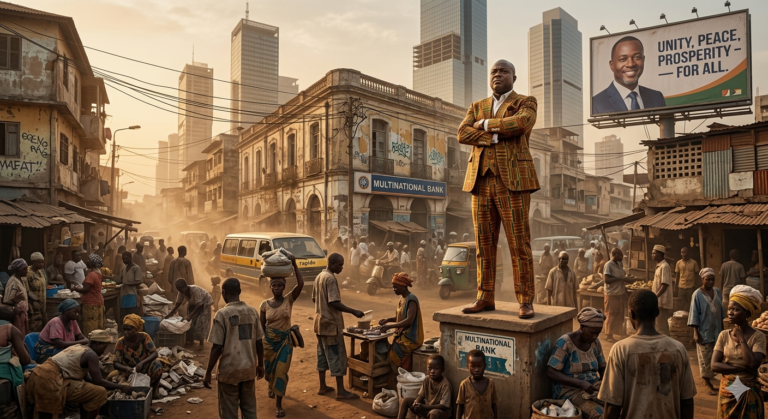
The fictional country of Aburiria is led by a Ruler, never named, whose megalomania has reached the stage where it requires international financing. The Ruler wants to build a tower, Marching to Heaven, that will reach the heavens and allow him to address God directly, or perhaps to become God, or perhaps to make the distinction between addressing God and being God irrelevant. The project requires a loan from the Global Bank, whose representatives arrive from Washington to assess Aburiria’s suitability for international financial assistance with the brisk condescension of people who have assessed dozens of countries like Aburiria and found them all similarly wanting.
This setup establishes the novel’s central triangle. The Ruler. His people. The international financial institutions. And the relationship between these three parties, the way the Ruler performs for the Global Bank, the way the people survive both, the way the Global Bank’s conditions of lending shape what the Ruler can do and cannot do and therefore shape the conditions of ordinary life in ways that are invisible to the people experiencing them, is the novel’s primary political subject.
It is the most accurate fictional account of the political economy of postcolonial African dictatorship that has ever been written, and it is written as comedy.
The Comic Register and Why It Is the Right One
The decision to write a novel about dictatorship as comedy is not an evasion of the horror. It is a recognition of something about the nature of dictatorship that purely tragic treatments miss.
Dictatorship is, among other things, absurd. Not in the philosophical sense of the term, though that too, but in the more ordinary sense that the institutions it produces, the rituals it requires, the logic it enforces, are, when examined from outside the framework of fear that makes them seem inevitable, profoundly and sometimes hilariously ridiculous.
The Ruler’s ministers compete for his favour through increasingly extreme performances of loyalty. They spy on each other. They denounce each other. They are consumed by the protocols of a court whose rules shift according to the Ruler’s moods, which are themselves unpredictable because power of sufficient absoluteness detaches from any stable relationship with reality. The machinery of the dictatorship is constantly breaking down, producing crisis after crisis that the ministers manage through improvisation and concealment and the elaborate manufacture of appearances.

Ngugi finds the comedy in this without losing the terror. The ministers are funny and they are frightening, because the comedy of their behaviour is inseparable from the violence it enables. They make you laugh and then they torture someone, and the transition is seamless, because in the world the novel is describing these two things are not in different registers. They exist on the same plane.
This is the achievement of the comic mode in political fiction at its greatest. It does not soften the horror. It reveals the horror’s actual texture, which includes the absurd, the petty, the self-serving, and the banal alongside the violent and the tragic.
Orwell understood this, which is why Animal Farm is funny. But Animal Farm is a fable, which means the comedy operates at a certain distance from the reality it represents. Wizard of the Crow is not a fable. It is a fully realised fictional world, and the comedy operates from inside that world, which means it has a density and a specificity and an intimacy that fable cannot achieve.
Kamiti and Nyawira: The Alternative Centre
At the centre of the novel’s human drama are two characters whose relationship constitutes the novel’s deepest argument about what resistance looks like and what it costs.
Kamiti is an educated young man who has been unable to find employment, whose degrees and qualifications have proved worthless in the economy of Aburiria, and who is reduced to queuing for non-existent jobs along with thousands of others in the same situation. He is brilliant and he is broke and he has been failed by every institution, the educational system, the economy, the state, that was supposed to provide the infrastructure for a life.
By accident and then by design, he becomes the Wizard of the Crow, a figure who dispenses wisdom and cures in a makeshift shrine, who attracts followers from among the desperate and dispossessed, and whose reputation grows until it reaches the Ruler himself.
Nyawira is his partner, a political organiser involved in the Movement for the Voice of the People, a woman of extraordinary courage and strategic intelligence who uses the cover of the Wizard’s shrine for her own political work and whose understanding of power is considerably more sophisticated than Kamiti’s more spiritual orientation.
Together they constitute a kind of composite hero, and their complementarity is one of the novel’s structural achievements. Kamiti’s spiritual and philosophical dimension and Nyawira’s political and organisational dimension are presented not as alternatives or opposites but as aspects of the same project of human resistance to the dehumanising effects of absolute power.
This is important because it means the novel does not endorse a single model of resistance. It does not say that spiritual withdrawal is the answer, and it does not say that political organisation is the answer. It holds both in tension and suggests that the fullest form of opposition to a system like Aburiria’s requires both, the capacity to imagine differently and the capacity to organise materially around that different imagination.
Nyawira is one of the great female characters in African literature, and the novel’s treatment of her is one of the clearest signals of Ngugi’s political seriousness. She is not defined by her relationship with Kamiti, though that relationship is central to the novel. She is defined by her own commitments, her own history, her own political analysis. She is a woman who has thought carefully about the intersection of gender oppression and class oppression and colonial history and who acts on the basis of that thinking with extraordinary courage.
The novel does not idealise her. She makes mistakes. She has fears. She is capable of doubt. But she is also capable of a clarity of moral and political vision that most of the novel’s male characters, including Kamiti, do not consistently achieve.
The Body Politic Made Literal
One of Wizard of the Crow’s most sustained and most brilliant conceits is its treatment of illness as political metaphor.
The Ruler develops a condition that the novel calls self-inflating, in which his body literally expands, filling with air, until he resembles a balloon. The condition is both physical and metaphysical, both a symptom of something wrong in his body and a literalisation of what his power has done to him, inflating his sense of himself until the self has expanded beyond any relationship with reality.
The ministers develop their own conditions. One develops a condition in which he cannot stop speaking, pouring out words in an unstoppable torrent that is both a parody of political rhetoric and a literalisation of what political rhetoric actually is, a flood of sound designed to fill space and prevent the silence in which truth might be heard.
The people of Aburiria develop a condition called white-ache, a longing for whiteness, for the validation of the Western gaze, for the approval of the international institutions whose money the Ruler needs and whose standards the country is required to perform compliance with.
These conditions are magical and they are also precisely accurate diagnoses of real political pathologies. The Ruler’s self-inflation is not a fantastical invention. It is a description of what absolute power actually does to the people who hold it, the way it disconnects them from any feedback mechanism that might correct their self-perception, the way it allows the self to expand indefinitely because nothing pushes back.
The use of illness as political metaphor is not new in African literature. But Ngugi’s deployment of it in Wizard of the Crow is more systematic, more inventive, and more precisely diagnostic than anything that precedes it. The illnesses are not decorative. They are the novel’s primary analytical tool, the means by which it makes visible the political pathologies that ordinary realist description would have to labour to convey.
Language and the Question of Translation
Ngugi wa Thiong’o made one of the most politically significant decisions in African literary history when he chose, in 1977, to stop writing in English and to write in Gikuyu instead.
The decision was not merely symbolic. It was a theoretical position about the relationship between language and liberation, a position he has articulated in essays and lectures over several decades but that is most fully embodied in Wizard of the Crow itself.
The argument is that writing in the colonial language, however brilliantly, is a form of accommodation with the colonial structure of knowledge production. The colonial language carries with it a hierarchy of value, a set of assumptions about what is worth saying and how it should be said, that shapes and constrains what the writer can think and express. To write in Gikuyu is not simply to address a different audience. It is to think from a different place, to organise experience and analysis through different categories, to access a different relationship between language and reality.
Wizard of the Crow was written in Gikuyu and translated into English by Ngugi himself, which means the English text is not a translation in the ordinary sense but a second original, shaped by the same intelligence that produced the first but operating in a different linguistic register.

This matters for how the novel reads. The English text has a quality that is not quite like any other English novel, a rhythm and an approach to metaphor and a relationship between the literal and the figurative that reflects the Gikuyu original’s different orientation to these things. It is a novel that feels translated even in its most fluent passages, not because the translation is imperfect but because the novel is making a point about the relationship between languages that the translation embodies rather than merely illustrates.
The comedy of the novel, much of which depends on wordplay and the specific tones of political rhetoric in East African English, survives the translation with remarkable vitality, which is itself a demonstration of Ngugi’s mastery of both his languages and of the political registers they make available.
Why It Is the Greatest
The argument for Wizard of the Crow as the greatest African political novel is an argument about scope, ambition, achievement, and honesty.
It is the most comprehensive fictional account of how postcolonial African dictatorship actually operates, in its relationship to international financial institutions, in its internal dynamics of loyalty and terror, in its effects on ordinary people trying to live ordinary lives inside extraordinary conditions. No other African novel covers this ground with this breadth or this precision.
It is the most formally ambitious African novel, using magic realism not as a decorative device but as an analytical tool, finding in the literalisation of metaphor a way of making political pathology visible that realism cannot achieve.
It is the most politically honest African novel about power, because it does not exempt any of its characters from scrutiny, not the resisters, not the ordinary people, not the international institutions. Everyone is implicated in the system the novel describes. Everyone is shaped by it in ways they do not fully understand. The novel does not offer a clean opposition between good and evil. It offers a complex account of how power works on everyone it touches.
And it is the funniest serious novel in the African tradition, which is not a minor achievement. The comedy is not relief from the political argument. It is the means by which the political argument is made. The laughter the novel produces is the laughter of recognition, of seeing accurately described something that you knew was true but had not seen named so precisely, and recognition of that kind is one of the things that literature at its greatest is for.
Achebe gave African literature its foundational text. Soyinka gave it its most complex theatrical intelligence. Armah gave it its most searingly honest account of postcolonial disillusionment.
Ngugi, in Wizard of the Crow, gave it its most complete political novel, the one that sees the whole system, names all its parts, finds the comedy inside the tragedy and the tragedy inside the comedy, and does all of this in a voice that is entirely and unmistakably his own.
That is what the greatest means, when the word is used carefully.
It means this novel, and no other.