
Vox and the Trouble With Dystopian Premises That Cannot Survive Their Own Logic
Christina Dalcher’s Vox begins with one of the most immediately gripping premises in modern dystopian fiction.
Women in America are limited to speaking only one hundred words per day. A counter attached to the wrist tracks every spoken word, and punishment follows anyone who exceeds the limit.
It is an idea designed to provoke instant emotional reaction because the symbolism is obvious. Silence becomes political control. Language becomes power. Speech itself becomes survival.
For the first hundred pages, the novel moves with genuine urgency. The premise feels sharp, frightening, and emotionally effective.
Then something more complicated happens.
The deeper the novel explores its own world, the harder it becomes to believe that world could actually function.
And that reveals one of the central problems of many modern dystopian novels: powerful symbolic concepts that collapse under sustained logical pressure.

The Premise Is Emotionally Powerful Before It Is Politically Coherent
The core idea behind Vox works immediately because readers understand the metaphor instinctively.
Silencing women represents:
- suppression
- erasure
- social control
- intellectual domination
- patriarchal power
The emotional clarity of the concept gives the novel strong initial momentum. Readers do not need lengthy exposition to understand why the world feels horrifying.
But dystopian fiction faces a difficult balancing act. Symbolism alone is rarely enough. The imagined society must also survive practical scrutiny long enough for readers to emotionally inhabit it.
This is where Vox begins struggling.
The more readers think about the mechanics of the world, the less stable the premise becomes.
How does an advanced society function when half the population can barely communicate?
How do families operate?
Schools?
Hospitals?
Workplaces?
Legal systems?
Emergency situations?
The novel gestures toward answers, but the infrastructure beneath the premise never fully solidifies.
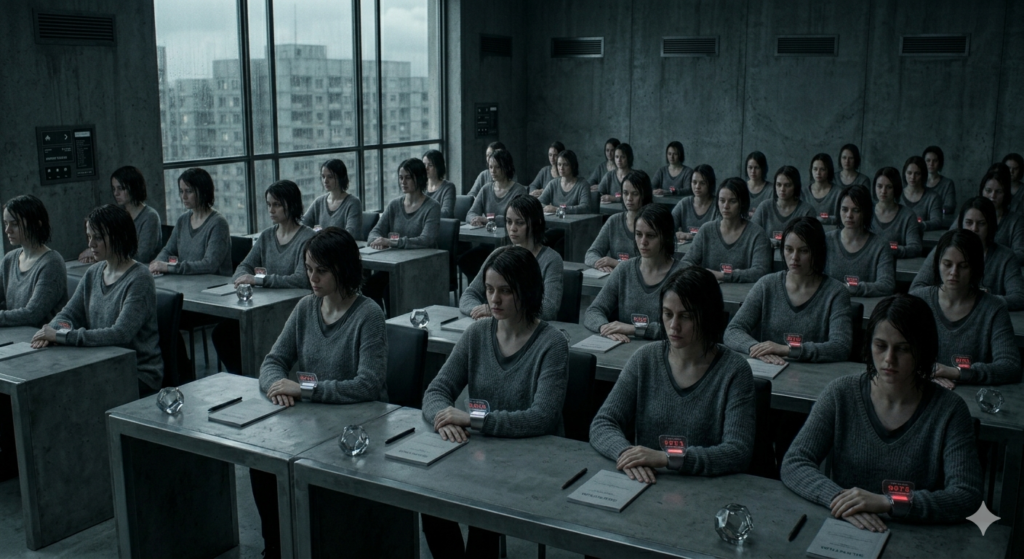
Good Dystopias Build Systems, Not Just Metaphors
The greatest dystopian novels succeed because their symbolic ideas are reinforced by believable systems.
George Orwell’s Nineteen Eighty-Four works because surveillance, language control, propaganda, and state violence reinforce each other structurally.
Margaret Atwood’s The Handmaid’s Tale works because Gilead feels socially organized. Its laws, rituals, religious ideology, gender hierarchy, and political logic interconnect convincingly even when horrifying.
In Vox, the premise often feels isolated from larger institutional realism.
The word limit remains emotionally provocative, but the surrounding world sometimes appears constructed mainly to sustain the metaphor rather than functioning as a believable society.
This matters because dystopian fiction depends heavily on immersion. Readers need to feel not only that a system is cruel, but that it could continue operating.
Once the mechanics begin collapsing, the emotional tension weakens too.
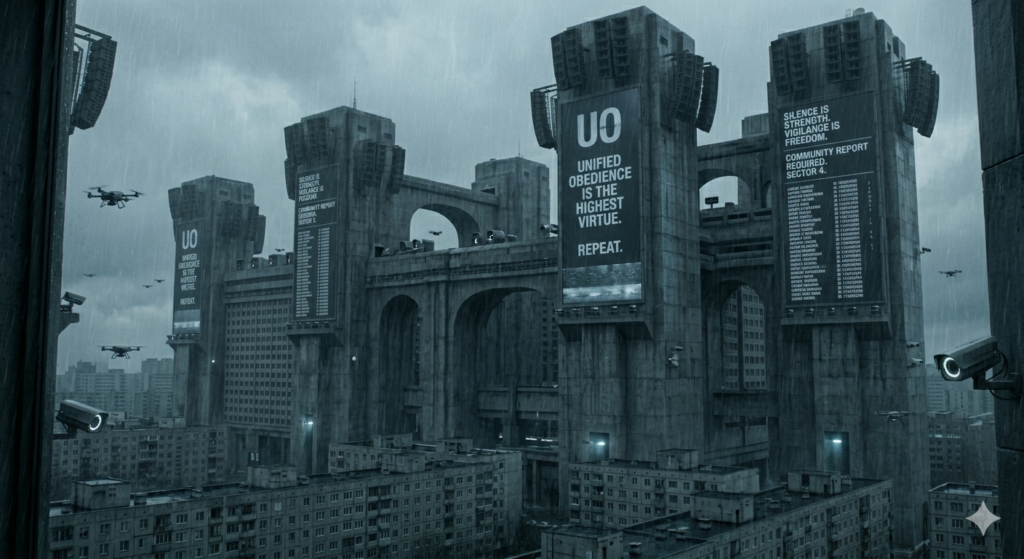
The Novel Wants Allegory and Realism Simultaneously
Part of the difficulty comes from the novel attempting two different modes at once.
At times Vox behaves like political allegory where symbolic exaggeration matters more than practical realism. In allegory, emotional truth often outweighs logistical detail.
But the novel also presents itself as grounded near-future dystopian fiction. It asks readers to take the political transformation seriously as a plausible social development.
These two goals create tension.
The stricter the realism becomes, the more readers question how the system functions materially. The more symbolic the story becomes, the harder it is to emotionally believe the world as lived reality.
The best dystopian fiction usually resolves this tension carefully. Vox never entirely does.
That does not make the novel ineffective. It remains emotionally readable and politically urgent in many places.
But it creates the sensation that the premise arrived before the worldbuilding fully caught up to it.
Language Control Is More Complex Than Word Counts
One reason the premise eventually feels strained is because language itself is more flexible than the novel sometimes allows.
Human communication extends far beyond spoken words:
- gestures
- writing
- facial expression
- touch
- symbols
- technology
- silence itself
Historically, oppressed groups develop alternative communication systems remarkably quickly. Entire underground cultures emerge around restricted speech.
The novel occasionally acknowledges this reality, but not deeply enough to fully convince. The society’s control over language often feels technologically absolute while psychologically underexplored.
Ironically, this weakens the novel’s strongest theme.
The real horror of language repression is not merely numerical limitation. It is the reshaping of consciousness, education, emotional expression, and collective identity over time.
Some dystopian novels understand this with terrifying precision. Vox sometimes reduces the complexity of language into a single controlling image.
That image remains striking.
But it narrows the psychological depth the novel could have explored further.
Why the Premise Still Resonated With Readers
Despite these weaknesses, Vox connected strongly with many readers because the emotional fear beneath the premise feels recognizable.
The novel emerged during intense political anxiety surrounding gender, authoritarian rhetoric, and cultural backlash. Readers were already primed to fear systems attempting to reduce women’s autonomy and public voice.
The wrist counter became an emotionally immediate symbol for broader experiences:
- being interrupted
- dismissed
- ignored
- silenced
- politically erased
The simplicity of the concept gave it viral power.
Many dystopian novels succeed not because every detail withstands scrutiny, but because they crystallize emotional anxieties already present in society.
Vox absolutely accomplishes that.

The Difference Between Concept and World
One useful way to understand Vox is to separate concept from execution.
The concept is excellent.
Few modern dystopian hooks communicate thematic stakes so quickly and clearly. Readers instantly understand both the political symbolism and emotional terror.
The execution becomes less stable when the novel attempts to sustain that concept across an entire functioning society.
This distinction matters because modern dystopian fiction increasingly operates through high-concept premises designed for immediate cultural impact. Social media, marketing, and rapid political discourse reward instantly understandable metaphors.
But great dystopian fiction usually requires more than conceptual sharpness.
It requires systems.
Psychology.
Institutional texture.
Economic logic.
Cultural adaptation.
Without those layers, the world risks feeling emotionally persuasive but structurally fragile.
Why Logical Pressure Matters in Dystopian Fiction
Some readers argue that demanding realism from dystopian fiction misses the point. Symbolic truth matters more than logistical detail.
There is truth in that argument.
But dystopian fiction becomes most powerful when symbolic truth and systemic realism reinforce each other rather than compete.
Readers fear Orwell because Oceania feels sustainable.
Readers fear Atwood because Gilead feels socially functional.
Readers fear The Water Knife because its climate collapse feels materially plausible.
Logic matters because believable systems linger psychologically longer than isolated metaphors do.
Once readers stop believing the world, they begin observing the allegory from outside instead of emotionally living inside it.
Final Thoughts
Vox remains an interesting and emotionally effective dystopian novel because its central image is undeniably powerful: a society where women are literally measured, restricted, and punished through speech itself.
But the novel also reveals the limitations of dystopian premises built primarily around symbolic force without equally rigorous systemic logic.
Christina Dalcher created a metaphor readers instantly understood.
The difficulty is that sustaining a metaphor across an entire believable civilization requires more than emotional urgency. It requires social, psychological, and institutional depth strong enough to survive scrutiny.
That tension between concept and coherence may explain why Vox remains memorable even as its world becomes increasingly difficult to fully believe.