1984 Has Been Filmed Five Times. None of Them Has Understood the Last Scene.
George Orwell’s Nineteen Eighty-Four has been adapted repeatedly because filmmakers are drawn to its atmosphere. The surveillance. The gray architecture. The omnipresent fear. The giant face of Big Brother staring down from walls and screens. Visually, 1984 almost seems built for cinema.
Yet despite multiple adaptations across decades, something essential keeps getting lost.
The final scene.
Most film versions understand the politics of 1984. Some even capture the suffocating mood. But almost none fully understand what Orwell was actually doing at the end of the novel. The mistake is subtle but important.
The ending is not simply about defeat.
It is about emotional annihilation.
That difference changes everything.
Why the Ending Is So Difficult to Adapt
The final pages of 1984 are psychologically devastating because very little happens externally.
There is no dramatic execution.
No final rebellion.
No explosive confrontation.
Instead, Orwell shows something quieter and more horrifying: the destruction of inner reality itself.
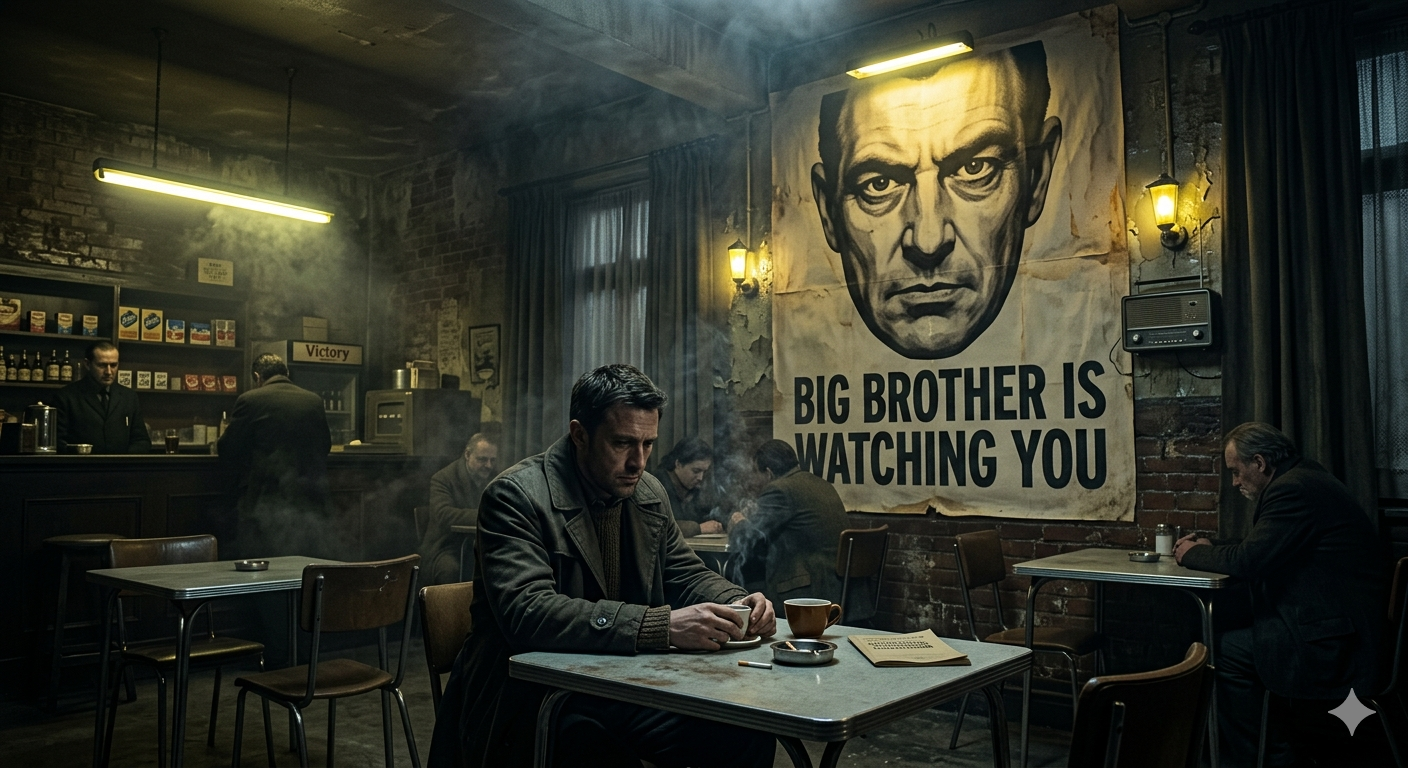
Winston sits in the Chestnut Tree Café. He drinks gin. He remembers fragments of the past. He watches propaganda. And eventually he realizes he loves Big Brother.
Many film adaptations treat this as tragic irony or political surrender. But Orwell’s point goes deeper than forced obedience.
Winston no longer merely pretends to believe.
His internal self has been rewritten.
That is the true horror of the novel.
The Novel’s Final Scene Is About Love
This sounds strange at first because 1984 is rarely discussed as a novel about love. Yet the ending only works because Orwell understood that totalitarianism ultimately seeks emotional control, not just political control.
The Party does not simply want citizens who obey.
It wants citizens who genuinely love power.
That is why torture alone is not enough. O’Brien repeatedly explains that the Party seeks conversion, not compliance. Physical domination means nothing if private thought survives underneath.
Most film adaptations miss this emotional dimension. They focus heavily on brutality and surveillance while treating the ending as Winston’s collapse under pressure.
But Orwell is describing something far more terrifying than broken resistance.
He is describing the corruption of love itself.
Winston’s love for Julia disappears.
His loyalty to truth disappears.
His private emotional world disappears.
The Party replaces all of it with manufactured devotion.
That transformation is the real climax of the novel.
The Famous Last Line Is Usually Misunderstood
“He loved Big Brother.”
The line is famous because it sounds simple. But simplicity is what makes it horrifying.
Many readers initially interpret the sentence as cynical sarcasm, as though Orwell is winking at the audience. But the emotional power of the ending depends on the opposite.
The sentence must be real.
Winston truly loves Big Brother by the end because the Party has destroyed the psychological structures that once allowed him to resist.
This is what many adaptations fail to communicate visually. Cinema naturally gravitates toward visible suffering, dramatic emotion, and physical rebellion. Orwell’s ending is terrifying precisely because Winston appears calm.
The violence has already finished.
The inner self has already collapsed.
What remains is emptiness filled by ideology.
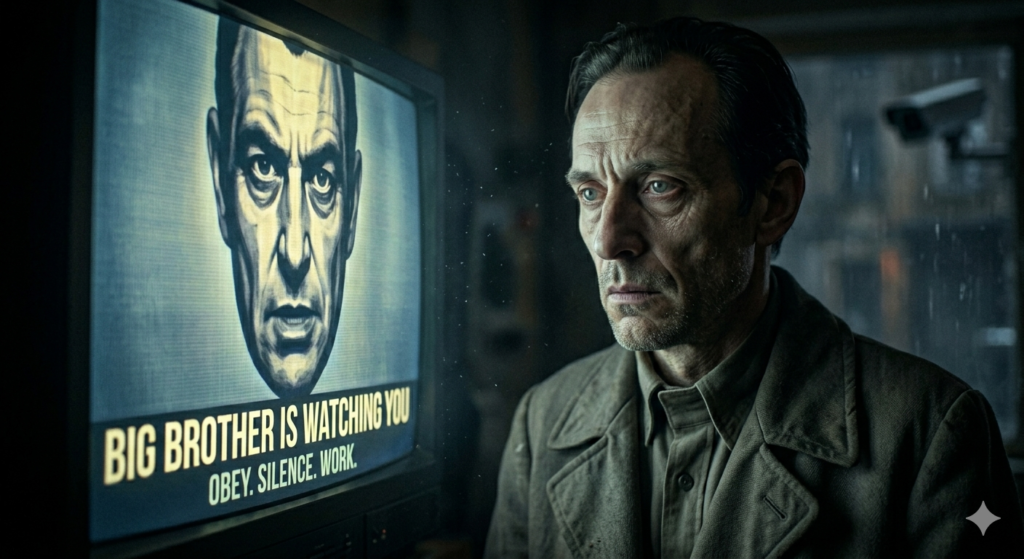
Orwell Understood That Power Wants More Than Fear
One of Orwell’s greatest insights is that authoritarian systems are never satisfied with outward obedience alone.
Fear is unstable.
People secretly resent what they fear.
The Party wants something deeper and more permanent: emotional dependence.
This idea appears throughout the novel. Citizens are not only watched. They are psychologically conditioned. Language itself is reshaped through Newspeak. Memory is manipulated. Relationships are weakened. Independent emotional bonds become dangerous because they compete with loyalty to the Party.
By the final scene, Winston has lost the ability to emotionally exist outside state ideology.
That is why the ending feels spiritually empty rather than dramatically tragic.
Orwell is showing the death of the private self.
Why Film Adaptations Keep Missing It
Most adaptations of 1984 succeed visually but struggle psychologically.
The aesthetics are easy to reproduce:
- concrete architecture
- telescreens
- uniforms
- interrogation rooms
- propaganda posters
- surveillance technology
But Orwell’s real subject is internal consciousness.
That is far harder to film.
The novel spends enormous time inside Winston’s fragile inner life. Readers experience:
- his secret hopes
- his erotic desires
- his memories
- his uncertainty
- his longing for truth
- his fear of psychological collapse
Cinema often externalizes these emotions into visible drama. But the ending of 1984 depends on something nearly invisible: the erasure of interior resistance.
A filmmaker can show torture.
A filmmaker can show despair.
Showing the precise moment someone emotionally accepts their own domination is much more difficult.
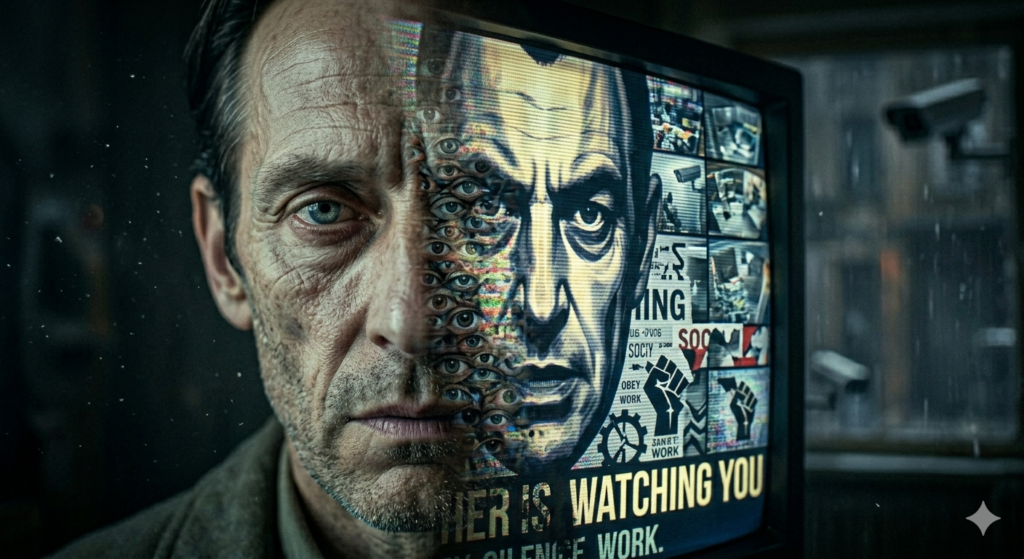
The Ending Is More Religious Than Political
Another reason the final scene is misunderstood is because Orwell structures it almost like a dark religious conversion.
Winston passes through suffering, confession, betrayal, and finally surrender. But instead of spiritual liberation, he reaches ideological absorption.
The Party functions like a corrupted religion:
- Big Brother replaces God
- orthodoxy replaces truth
- confession becomes torture
- salvation becomes obedience
The final line resembles a twisted moment of revelation.
Winston does not merely submit physically. He experiences emotional conversion.
That religious dimension gives the ending its haunting power. Orwell was not only warning about political dictatorship. He was warning about systems capable of replacing human reality itself.
Why the Ending Still Feels Modern
The final scene of 1984 remains powerful because Orwell understood something deeply unsettling: people can eventually learn to love systems that destroy them if those systems fully control memory, fear, language, and emotional life.
That idea feels disturbingly relevant in modern culture where information, identity, and emotional perception are constantly shaped by media systems, algorithms, and ideological environments.
The ending forces readers to ask an uncomfortable question:
What happens when manipulation becomes emotionally internalized rather than externally imposed?
That question matters far beyond Orwell’s fictional world.
Final Thoughts
The greatest challenge of adapting 1984 has never been recreating its dystopian setting. It has been understanding the emotional meaning of the final scene.
George Orwell did not end the novel with rebellion crushed.
He ended it with consciousness rewritten.
Winston’s tragedy is not merely that he suffers.
It is that he loses the ability to meaningfully distinguish truth from power, love from fear, selfhood from ideology.
The last scene matters because Orwell understood the ultimate ambition of totalitarianism.
Not simply to control what people do.
But to control what they are capable of loving.


