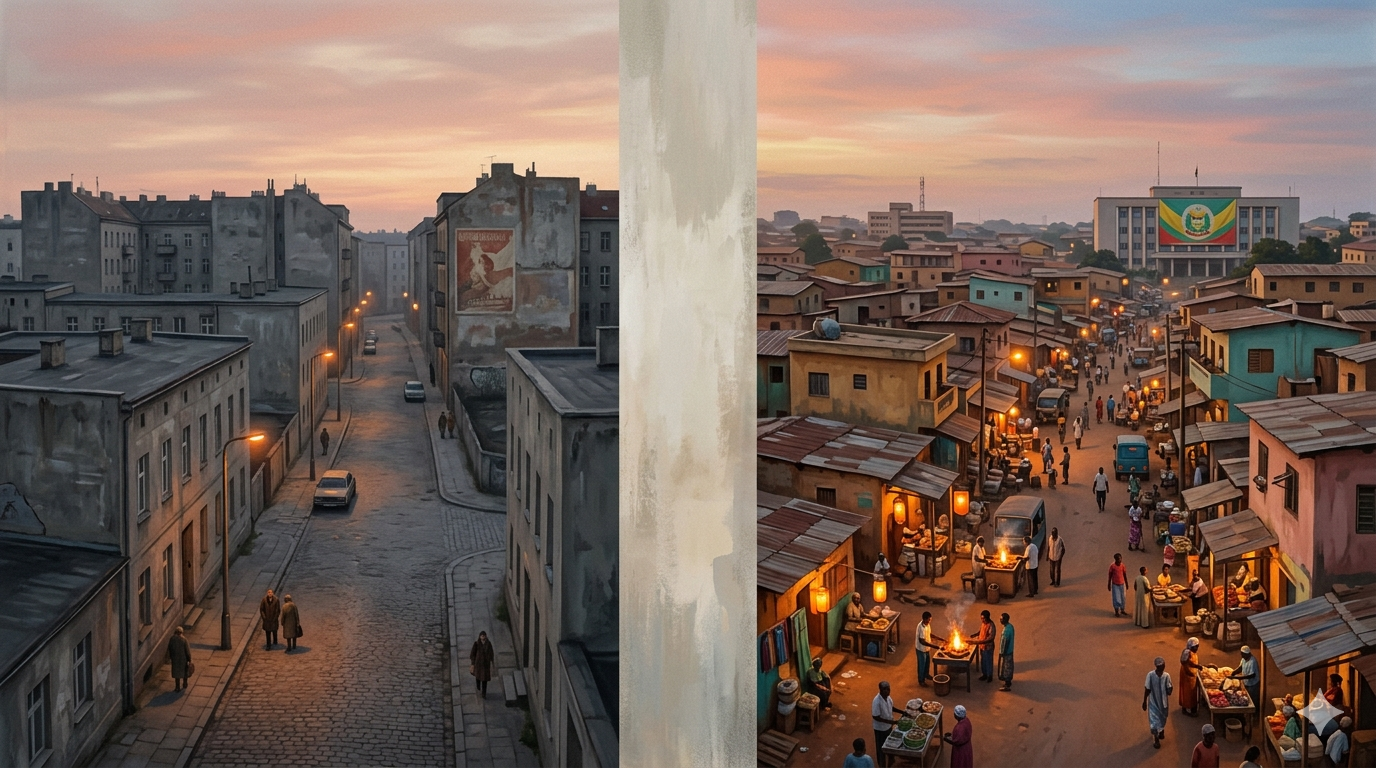
Reading 1984 and Wizard of the Crow Together, in Detail, for the First Time
There is a comparative analysis the canon has been quietly refusing to perform for nearly twenty years.
George Orwell’s 1984, published in 1949, is the most influential dystopian novel ever written. Ngũgĩ wa Thiong’o’s Wizard of the Crow, published in 2006, is one of the most ambitious dystopian novels of the twenty-first century. Both depict totalitarian regimes. Both follow a protagonist whose interior life is gradually shaped by the regime’s pressure. Both have been recognised, by their respective publics, as major political works.
The two novels have almost never been read next to each other. Orwell is taught in secondary schools. Ngũgĩ is taught in postcolonial literature courses. Orwell appears on every list of canonical dystopias. Ngũgĩ appears on lists of African literature, African satire, magical realism, or world literature in translation. The shelves the canon maintains have kept the two books apart, even though the case for reading them together is, on inspection, overwhelming.
I want to perform that reading here. This is not an argument that Ngũgĩ is better than Orwell. That is not a useful claim. The two novels are doing different things, and the work of comparison is to understand what each is doing and what each is failing to do, not to rank them. The argument is that putting them next to each other reveals features of both that neither one discloses on its own. The comparison is the analysis. The analysis is overdue.
The Two Regimes Side by Side
Orwell’s Oceania and Ngũgĩ’s Aburĩria are both single-party authoritarian states with personalist leaders, total information control, and a population trained into compliance through a combination of fear, surveillance, and engineered language. Held at this level of abstraction, the two regimes look nearly identical.
The differences begin to appear the moment you ask what the regimes are actually doing on the page.
Oceania is mechanical. Aburĩria is bodily.
Orwell’s regime operates through institutions. The Ministry of Truth produces propaganda. The Ministry of Love conducts torture. The Thought Police enforce compliance. The Party meets in defined hierarchies. Big Brother is a face on a poster. The regime has a structure that can be diagrammed.
Ngũgĩ’s regime operates through bodies. The Ruler’s actual physical body inflates with the swelling of his self-regard. His ministers have had themselves surgically modified to please him. One has had his eyes enlarged so he can see corruption everywhere. One has had his ears enlarged so he can hear conspiracies. One has had his tongue lengthened so he can lick the Ruler’s boots more efficiently. These are not metaphors in the novel’s world. They are described as actual surgical procedures, performed by complicit doctors.
The difference is not a matter of literary mode. The difference is a matter of where the two writers locate the centre of authoritarian power. Orwell locates it in the institutions, which is to say in the structure. Ngũgĩ locates it in the bodies, which is to say in the flesh. The structure can be overthrown by reorganising the institutions. The flesh cannot be overthrown, because the flesh is the regime. The Ruler’s body is not a symptom of Aburĩria’s politics. The Ruler’s body is Aburĩria’s politics.
This is one of the central insights the comparison reveals. Orwell’s regime is, in the deep sense, abstractable. The Party is an idea that has been instantiated in a particular country at a particular time. The idea could be moved, with adjustments, to another country at another time. Ngũgĩ’s regime is not abstractable in this way. Aburĩria is the specific psychology of a specific kind of personalist dictator, rendered through his specific body. It cannot be moved without losing what makes it work.
This matters because the two novels are making different claims about the nature of authoritarian power. Orwell is making a structural claim. Authoritarianism is a system that can be analysed, criticised, and resisted by attending to its institutions. Ngũgĩ is making an embodied claim. Authoritarianism is, in its deepest form, the body of the leader, and you cannot understand it without understanding the specific psychology and the specific flesh that produces it.
Both claims are partly correct. The comparison shows that neither novel alone is sufficient. Orwell catches what structural authoritarianism looks like. Ngũgĩ catches what personalist authoritarianism looks like. The world contains both. The reader who has only one of these novels has only half of the analysis.
Oceania is grey. Aburĩria is loud.
The texture of the two regimes is utterly different on the page.
Orwell’s London is described in monochrome. The buildings are grey. The food is grey. The skies are grey. The Victory Mansions where Winston lives are dilapidated. The Victory gin tastes like cleaning fluid. The chocolate is rationed and inadequate. The novel’s sensory palette is austere, depressed, and consistent. The regime has drained colour out of life.
Ngũgĩ’s Aburĩria is a riot of colour, sound, and movement. The regime stages enormous public ceremonies. The Ruler’s birthday is a national event with parades and dancing. The ministers compete for visibility through ever more elaborate displays of loyalty. The market sequences in the novel are alive with shouting vendors, gossiping shoppers, hawkers selling state-approved commemorative items. The regime is not draining colour out of life. The regime is flooding life with colour, sound, and ceremony.
This is the saturation versus scarcity distinction I have written about in earlier posts on this blog. Orwell’s regime works through deprivation. Ngũgĩ’s regime works through overproduction. Both are techniques of control. Both can produce compliant populations. The two novels show what each technique looks like when fully developed, and the comparison reveals that the techniques are nearly opposites.

The cultural implication is significant. A reader who has only read Orwell will be trained to recognise authoritarianism by its scarcity. The dim light, the bad food, the empty shelves, the cold buildings. A reader who has only read Ngũgĩ will be trained to recognise it by its excess. The constant noise, the engineered spectacle, the saturation of public space with state-aligned production. Real authoritarianisms use both techniques, often simultaneously, often in different forms for different populations within the same country. Neither novel alone prepares the reader to recognise the full range. Together they do.
Winston is alone. The Wizard is in a community.
The protagonists of the two novels occupy very different social positions, and the difference shapes almost everything else about the books.
Winston Smith is, throughout 1984, structurally alone. He has no real friends. His marriage has been destroyed by the regime. His mother and sister are lost to the past. The few people he interacts with regularly, like his colleague Parsons, are caricatures rather than relationships. When he finally enters into a relationship with Julia, it is conducted in secret, in a room above an antique shop, in a city where every other interaction is monitored. His resistance is the resistance of an isolated individual against a total system.
The Wizard of the Crow, by contrast, is embedded in a community from the first pages of the novel. He has a partner, Nyawira, who is herself a political activist. He has clients. He has neighbours. He has connections to a women’s resistance movement that has existed for years. He is part of a network of people who, in various ways, are doing the slow work of curing the population of its fear. His resistance is the resistance of a person within a community against a regime that the community as a whole is gradually learning to refuse.
This is one of the most important structural differences between the two novels, and it reflects a deep difference in how the two writers understand political agency. Orwell, working in the European liberal tradition, treats the individual as the primary unit of political analysis. Winston’s rebellion is meaningful because Winston is a person with an interior life. The novel’s tragedy is the destruction of that interior life. The political claim is that totalitarianism is, at its deepest level, the destruction of individual selfhood.
Ngũgĩ, working in a tradition that places more weight on collective life, treats the community as the primary unit. The Wizard’s rebellion is meaningful because it is connected to other rebellions, performed by other people, supported by networks the regime cannot fully see. The novel’s hopefulness, such as it is, comes from the slow accumulation of these collective actions. The political claim is that totalitarianism is, at its deepest level, the regime’s attempt to prevent communities from acting collectively, and the resistance is the work of building or rebuilding the collective.
Neither claim is wrong. Both are partial. The comparison shows that the canonical Western dystopian tradition has been operating with only half of the analysis, because it has been working with only one of the two protagonist structures. Winston is the figure the Western tradition expects. The Wizard is the figure the Western tradition has not yet learned to take seriously.
The Two Endings Side by Side
The endings of the two novels are perhaps the place where the comparison is most revealing.
Orwell’s ending is one of the most famous in twentieth-century literature. Winston, after his torture in the Ministry of Love, is released back into the world. He sits in the Chestnut Tree Cafe. He drinks Victory gin. He looks up at the screen and sees the announcement of a great Oceanian victory. The closing lines describe him weeping with gratitude, finally loving Big Brother. The regime has won completely. The protagonist’s interior life has been replaced by the regime’s preferred contents.
This is the tragic ending I have written about in earlier posts. It is structurally clean. The regime has produced a citizen who is fully compliant. The reader is meant to grieve.
Ngũgĩ’s ending is structurally different. The Wizard of the Crow has not been broken. The dictator is weakened but not deposed. The opposition has not won. The regime is not complete. The Wizard’s work continues, one cured citizen at a time. The novel closes in the middle of an ongoing process, with no resolution of the larger political situation.
The two endings are doing fundamentally different political work.
Orwell’s ending claims that the regime is, in principle, total. The novel needs Winston’s complete breaking to demonstrate this. The reader is meant to walk away from the book convinced that totalitarianism is a system that can produce, in its victims, the appearance of consent. The warning is severe. The grief is meant to mobilise the reader against the possibility of such a regime in their own future.
Ngũgĩ’s ending claims that the regime, even at its worst, is not total. The novel needs the Wizard’s work to continue past the closing page to demonstrate this. The reader is meant to walk away from the book convinced that resistance is possible even under the most repressive conditions, because resistance does not require the overthrow of the regime. Resistance can be the slow work of curing the population of its fear, one person at a time, in ways the regime cannot fully prevent.

Which ending is correct? Both. Different regimes produce different conditions. Some regimes do break their citizens completely. Others do not. Orwell’s analysis is accurate to certain situations. Ngũgĩ’s analysis is accurate to others. The reader who has only one of these novels has only one of the two analyses, and is unprepared for the situation that requires the other.
This is the deepest reason the canon’s separation of the two writers has been costly. By teaching Orwell as the model dystopian novel and filing Ngũgĩ elsewhere, the canon has been training generations of readers to expect one specific shape of regime and one specific kind of ending. The training is partial. The world is not.
Where the Two Novels Are Closest
The comparison has been emphasising the differences. It is worth pausing to note where the novels are closest, because the closeness is a useful reminder that the differences are not absolute.
Both novels treat language as a primary site of political struggle. Orwell’s Newspeak is the most famous example in dystopian fiction. Ngũgĩ has been writing about language and political control for his entire career, including in his decision to write Wizard of the Crow originally in Gikuyu rather than in English. The two writers are doing the same work, with different specifics. Orwell traces a regime that simplifies language to make certain thoughts impossible. Ngũgĩ traces a regime that floods language with state speech until meaning drains away. Both are accurate to different real situations. The two together are more complete than either one alone.
Both novels treat history as a site of struggle. Orwell’s regime is constantly rewriting the past, sending inconvenient facts down the memory hole. Ngũgĩ’s regime is constantly producing new official histories to support whatever the Ruler currently believes. The mechanisms are different. The principle is the same. Both writers understand that a regime that controls the past controls the present.
Both novels treat the body as an object of regime concern, though in different ways. Orwell’s Party tortures Winston’s body in order to break his mind. Ngũgĩ’s regime works through the bodies of its ministers and its leader as the regime’s primary medium. Both writers understand that political control cannot be separated from the body. The difference is which direction the control runs. Orwell shows the body as the regime’s target. Ngũgĩ shows the body as the regime’s tool.
These three convergences, on language, history, and the body, are the genuine common ground between the two novels. The convergences make the comparison possible. Without them, the two books would be doing such different work that comparison would not yield much. With them, the comparison becomes productive, because the two writers can be seen as working on the same core problems with different but complementary tools.
What the Comparison Produces
I want to be specific about what this comparison delivers, because the general claim that the two books should be read together is less useful than the specific claim that doing so reveals certain insights neither book alone can produce.
The comparison produces, first, a richer picture of what authoritarianism looks like. Orwell shows the structural face. Ngũgĩ shows the embodied face. Real regimes have both. A reader who has both novels in mind is better equipped to recognise authoritarianism in unfamiliar forms.
The comparison produces, second, a richer picture of what resistance looks like. Orwell shows the isolated individual who is finally broken. Ngũgĩ shows the embedded community whose work continues past the closing page. Real resistance takes both forms. A reader who has both novels in mind is better equipped to think about what resistance might require in their own situation.
The comparison produces, third, a richer picture of what the dystopian novel itself can do. Orwell’s novel works through the tragic compression of a single life under total pressure. Ngũgĩ’s novel works through the comic and tragic distribution of pressure across an entire society, rendered at scale. Both forms are legitimate. The genre is larger than either one alone.
The comparison produces, fourth, a more honest picture of the canon. The canon has been keeping these two novels apart for reasons that have more to do with the geography and ethnicity of the writers than with the literary content of the books. The honest comparison reveals that the separation has not been earned. Both books are major dystopian novels. They should be read together as a matter of course.
Reading Between the Lines
The argument across many of this blog’s posts has been that the canonical organisation of dystopian fiction is wrong in specific, demonstrable ways. The Huxley-Zamyatin comparison demonstrated one kind of wrongness, in which a popular novel had been celebrated above its more rigorous source. The Orwell-Ngũgĩ comparison demonstrates a different kind of wrongness, in which two novels of comparable seriousness have been kept on different shelves because of the writers’ backgrounds rather than because of the books’ literary content.
The remedy is the same in both cases. Read across the canon’s boundaries. Hold the books next to each other. Look at what each one does and what each one fails to do. The work of comparison is the work of restoring the conversation the canon has been quietly preventing.
In the case of Orwell and Ngũgĩ, the conversation has been prevented for nearly two decades. Wizard of the Crow was published in 2006. The comparative analysis I have just performed could have been performed at any point in the last nineteen years. It has been performed, in fragments, by individual scholars. It has not been performed in the general culture, where Orwell continues to be cited every week and Ngũgĩ continues to be filed under African literature.
The conversation is overdue. The novels are available. The work is not difficult. The reader who has read this post and not yet read Wizard of the Crow is in a position to perform the comparison directly, with the two books in hand, over a week of careful reading. The reader who does this will discover, by themselves, most of what this post has been arguing. The discovery will be more lasting than the post. The post is scaffolding. The novels are the work.
Read them next to each other. The canon has been keeping them apart. You do not have to.