The Five Most Misread Endings in Dystopian Fiction
Endings are where novels make their final argument.
Everything that precedes the last pages, the characters, the plot, the accumulating weight of the world the novel has constructed, converges in the ending and is given its final shape. The ending does not simply conclude the story. It tells you what the story was for, what it was trying to say, what it understood about the world it was describing and the people who inhabit it.
This is why misreading an ending is not a minor error. It is a misreading of the novel’s central argument. And dystopian fiction, more than almost any other genre, produces endings that are systematically misread, endings whose meaning is routinely flattened, sentimentalised, or inverted by readers who bring to them expectations the novels are specifically designed to frustrate.
The five endings examined here are among the most discussed in the tradition. They are also among the most consistently misunderstood. In each case, the misreading is not accidental. It is produced by something the novel is doing, a deliberate difficulty, a formal choice, a refusal to deliver the comfort the reader has been prepared to want. Understanding why the misreading happens is part of understanding what the novel is actually saying.
1. 1984: He Loved Big Brother
The standard misreading of 1984’s ending is that it is a portrait of total defeat, of a human being so thoroughly broken by the regime that nothing remains, and that this defeat is the novel’s final, despairing word on the possibility of resistance under totalitarianism.
This reading is correct about the defeat. It is wrong about what the defeat means.
The final image of Winston Smith sitting in the Chestnut Tree Cafe, gin-soaked, vacant, watching the telescreen announce a military victory, with tears running down his face as he finally and genuinely loves Big Brother, is not simply a portrait of a broken man. It is the completion of a philosophical argument that the novel has been making since its first pages, and the argument is considerably more specific than the general proposition that totalitarianism destroys people.
The argument is about the nature of the self. O’Brien claims throughout the interrogation sequences that there is no stable self, that the self is a product of experience and can therefore be remade by experience, that the Winston who hates Big Brother and the Winston who loves Big Brother are not two different people but two different configurations of the same material, both equally real, neither more essentially Winston than the other.
The ending vindicates O’Brien’s claim. This is what most readers resist. They want the ending to be a portrait of Winston’s destruction, of the annihilation of a self that was real and valuable, because that framing preserves the implicit argument that there was something essential in Winston that the Party destroyed. But the novel will not give you that framing. It gives you instead a Winston who genuinely loves Big Brother, not a Winston who performs love while secretly retaining his rebellion in some protected interior.
The self has not been destroyed. It has been remade. The remake is the point. And the horror of the ending is not that Winston is gone but that Winston is there, feeling what the Party requires him to feel, and that this is what the Party’s philosophical claim about the self, taken seriously, actually looks like when it is proved correct.
The reader who finds this ending merely depressing has not yet confronted what it is actually arguing.
2. The Handmaid’s Tale: The Historical Notes
The most common misreading of The Handmaid’s Tale’s ending focuses on the moment before the Historical Notes, the moment when Offred steps into the black van and the novel says it may be the end or it may be a new chapter and leaves the question unresolved.
Readers treat this as the ending. They debate whether Offred escapes or is captured. They find the ambiguity frustrating or liberating depending on their tolerance for unresolved narrative questions. They treat the Historical Notes that follow as supplementary material, an academic appendix, something that contextualises the main text without being fully part of it.
This is precisely the wrong way to read the structure.
The Historical Notes are the ending. The van scene is a penultimate scene. Atwood is not being coy about whether Offred escapes. She is doing something far more interesting, which is demonstrating what happens to a woman’s testimony when it passes through the hands of scholars who are more interested in the political system it illuminates than in the person who produced it.
Professor Pieixoto’s lecture, which constitutes the Historical Notes, is a masterpiece of tone. He is scrupulously academic. He is careful about sources. He is appropriately sceptical about authenticity. He makes a joke at the beginning of his lecture, a pun on Gilead and the phrase gilded cage, that the assembled scholars find amusing, and the joke is the most damning thing in the novel.
He is discussing a woman’s account of systematic sexual enslavement, torture, and psychological destruction, and he is making puns. He is two hundred years from Gilead and he can afford to be witty.

The ending of The Handmaid’s Tale is not about whether Offred escapes. It is about what happens to women’s testimony over time, about who gets to interpret it and for what purposes, about how the academic framework that surrounds a document shapes what can be understood from it and what is occluded. Pieixoto is not a villain. He is something more unsettling, a good scholar whose scholarly apparatus is inadequate to the moral weight of what he is studying, and who does not notice that it is inadequate.
Atwood’s real ending is the question of whether the reader, having encountered Pieixoto’s reading of Offred’s account, can do better than he does. Can you see what he misses. Can you hold the moral dimension that his scholarly distance makes him incapable of holding. The ending is a test of the reader, not a resolution of the plot.
3. Never Let Me Go: The Reconciliation
The standard reading of Never Let Me Go’s ending treats it as quietly tragic, a meditation on mortality and acceptance, a story about people who come to terms with their fate with a grace that implicitly endorses the value of acceptance over futile resistance.
Kathy H.’s final pages, in which she stands in a field in Norfolk watching debris accumulate against a fence and imagines Tommy there with her, and in which her narration achieves a kind of sorrowful peace, are read as the novel’s emotional resolution. She has accepted. She is at peace. The novel is sad but not despairing.
This reading is wrong in the most consequential way possible.
It accepts the novel’s narrator’s evaluation of her own situation, and the entire novel has been constructed to demonstrate that Kathy H. is not capable of accurately evaluating her own situation. She is not at peace. She is a person so thoroughly formed by a system that has treated her as a means rather than an end that she cannot perceive her own condition with the moral clarity it demands. What reads as acceptance is the final demonstration of the novel’s central horror, which is that the system has done its work so completely that the person inside it cannot see the work being done.
The ending is not tragic in the genre sense of a noble person brought low by fate or flaw. It is tragic in a more specific and more disturbing sense. It is the ending of a person who has been so thoroughly shaped by an atrocity that she cannot experience the atrocity as an atrocity. Her equanimity is not wisdom. It is the most complete evidence of the damage.
Ishiguro makes this visible through what the ending does not contain. Kathy does not rage. She does not grieve in a way that acknowledges the full injustice of what has been done to her. She does not name the system that has produced her as a system that should not exist. The absence of these things is not serenity. It is amputation.
The reader who finds the ending quietly beautiful has been moved by the wrong thing, or rather, has been moved by the right thing without understanding what they are being moved by, which is the sight of a person who has been so thoroughly deprived of the language and the framework to understand her own situation that she cannot mourn it properly.
That is not acceptance. That is the thing that should be mourned.
4. Brave New World: John’s Suicide
The standard reading of John the Savage’s suicide at the end of Brave New World treats it as a tragic but inevitable conclusion to the story of a man who cannot find a place in either of the two worlds available to him, the World State or the Reservation, and who chooses death rather than the compromise that continued life would require.
In this reading, John is a sympathetic figure brought low by his own inability to adapt, a man too attached to his Shakespearean conception of human dignity to survive in a world that has abolished the conditions that dignity requires. His death is a defeat but a comprehensible one, and the novel’s final image of his body hanging in the lighthouse is read as a straightforwardly elegiac image of a human possibility that the World State has made unviable.
This reading is too sympathetic to John and not sufficiently attentive to what Huxley is arguing through him.
John is not a straightforwardly heroic figure whose values the novel endorses. He is a deeply compromised figure whose critique of the World State, while not wrong, is inseparable from a set of attitudes that are themselves part of the problem. His conception of human dignity is bound up with ideas about suffering, punishment, and the relationship between pain and authenticity that are themselves forms of damage, the damage inflicted by a childhood spent on the Reservation, by a mother whose own damage was profound, by an education conducted entirely through Shakespeare’s plays.
When John whips himself in the novel’s final pages, when he performs a public ritual of self-punishment that the World State’s citizens find sexually exciting and flock to participate in, he is not making a dignified stand against the World State’s values. He is demonstrating that his own values are not a clean alternative. The cruelty he performs on himself, the punishment he believes is necessary for authentic human experience, is not the opposite of what the World State offers. It is a different form of the same dehumanisation.
His suicide is not the noble refusal of compromise. It is the final confusion of a person who has no access to a coherent alternative to the world he is trying to reject. He cannot live in the World State and he cannot construct, from the materials available to him, a genuine alternative. His death is not the World State’s indictment. It is the indictment of a situation in which the only available opposition to a dehumanising system is a set of values that are themselves dehumanising in different ways.
Huxley’s ending is darker than the elegiac reading allows. It is not a tragedy of a good man destroyed by a bad world. It is a tragedy of a world in which the bad system and its apparent opposition are both inadequate to human possibility, and in which the person who falls between them has nowhere to fall except into death.
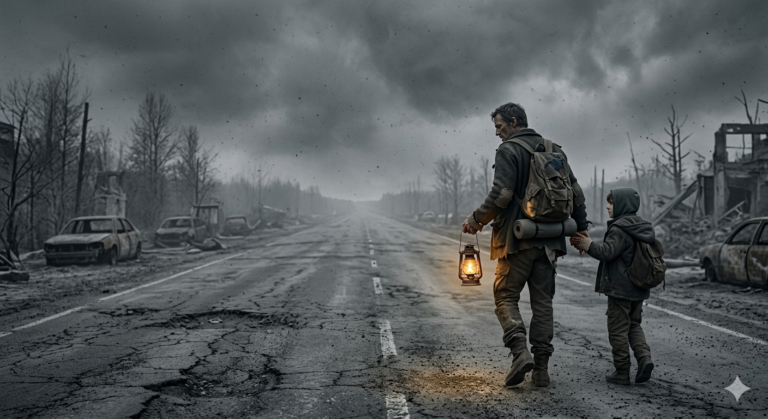
5. The Road: The Boy and the New Family
The ending of The Road is the most sentimentalised ending in the contemporary dystopian tradition, and the sentimentalisation is the most understandable of the five, because the novel has been so relentlessly brutal in everything that precedes it that the reader’s desire for comfort in the final pages is not merely understandable but almost physiologically urgent.
The man dies. The boy, alone on the road, is found by a family, a man and a woman and children, people who carry the fire the man has been invoking throughout the novel as the symbol of human goodness and continuity. The woman speaks to the boy about God and the boy is able to think about his dead father without the thought being too hard to bear. The novel ends with a lyrical passage about trout in mountain streams, their patterns like maps of the world in its becoming.
The standard reading treats this as a qualified but genuine hope. The boy survives. Good people still exist. The fire is still being carried. Life continues. McCarthy is offering, after four hundred pages of unrelenting devastation, a small and carefully hedged affirmation.
This reading is not exactly wrong. The boy does survive, and the survival is not meaningless. The new family are, as far as the novel allows us to determine, genuinely good people. The fire is being carried.

But the ending is more ambiguous than the hopeful reading allows, and the ambiguity is located in a specific formal choice McCarthy makes that is almost always overlooked.
We do not know these people. The family that takes in the boy appears on the last pages of the novel with almost no prior establishment. We have spent the entire novel learning, through the most harrowing possible education, that in the world the novel depicts appearances of goodness are unreliable, that trust is dangerous, that the road is full of people who appear safe and are not. The man has spent the entire novel teaching the boy exactly this lesson.
And then the man dies, and the boy, alone, meets a family who tell him they are good people and take him in.
McCarthy does not tell us whether they are good people. He tells us the boy goes with them. Whether the boy’s trust is vindicated or whether the novel’s ending is the cruelest irony of all, the boy surviving the road only to be taken by the kind of people the road is full of, is a question the final pages do not settle.
The lyrical passage about the trout is not an answer to this question. It is written in a register that is outside the novel’s main narrative, a kind of coda or envoi that speaks about the world before the catastrophe with an elegiac distance. It is beautiful and it is also, in the context of the ambiguity the ending has established, deliberately unresolved.
McCarthy is not offering comfort. He is offering the possibility of comfort, which is not the same thing. The boy may be safe. The fire may continue. The world may produce something worth having from the devastation the novel has depicted. But the novel will not promise you this. It will only show you a boy walking off the road with strangers, into a future the novel refuses to describe.
The most honest response to the ending of The Road is not relief. It is the suspension of certainty, the willingness to hold open a question that the novel has spent four hundred pages demonstrating cannot be answered by wishing it were otherwise.
The five endings examined here share a single feature. They refuse to deliver what the reader, by the final pages, most wants.
They refuse comfort, or they offer comfort in a form that is inseparable from the discomfort of examining it carefully. They refuse resolution, or they offer resolution that opens into further questions. They refuse the clean emotional payoff that the accumulated weight of what precedes them seems to promise.
This refusal is not cruelty. It is honesty. Dystopian fiction at its greatest understands that the world it is describing is a world in which the clean emotional payoff is not available, in which hope and despair are not cleanly separable, in which the ending of one story is always the beginning of a question that the story cannot answer.
The misreadings of these endings are misreadings of that honesty. They are attempts to find, in novels that deliberately withhold it, the comfort that the novels have decided not to give.
The novels are right to withhold it.
The world they are describing has not earned the comfort either.