The Road Is Not the Novel You Think You Read
There is a small but consistent pattern in how people talk about Cormac McCarthy’s The Road.
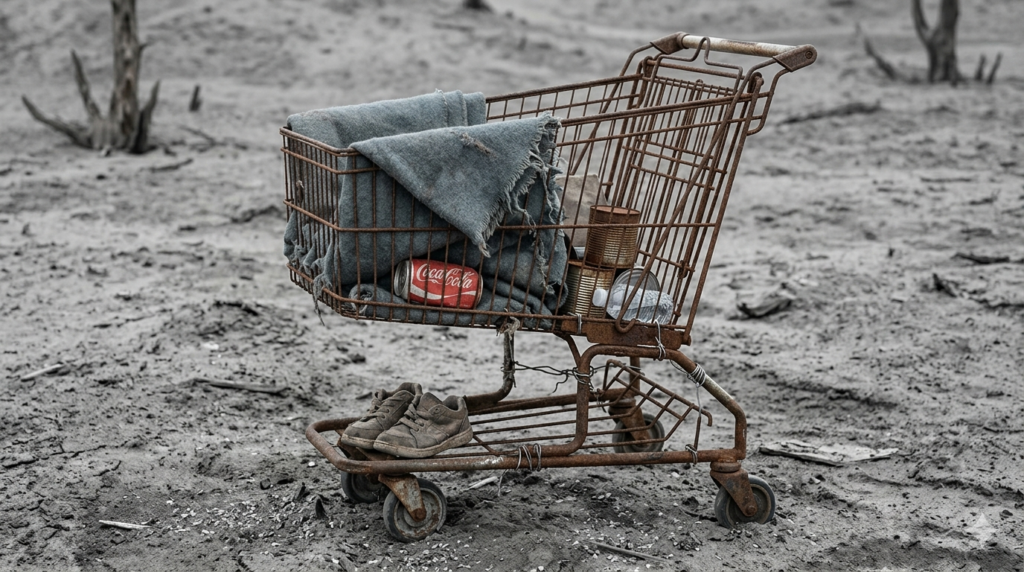
They remember it as bleak. They remember it as a father and a son walking through a destroyed world. They remember the ash, the cold, the cannibals, the cart, the can of Coke, the ending. They remember it as a love story between a parent and a child. They remember it as a book that made them cry. They remember it as a book they could not finish, or could only finish once, or finished and never wanted to return to.
What they rarely remember is the language.
This is strange, because the language is the entire novel. The Road is a book in which almost nothing happens at the level of plot. A man and a boy walk south. They scavenge for food. They hide from other people. They lose almost everything. The boy, at the end, loses his father. This summary fits on a postcard, and the postcard is, in its way, accurate. But the summary captures none of what is actually on the page. The novel is doing its work somewhere the summary cannot reach, which is sentence by sentence, in a prose so specifically engineered that almost any other prose would have produced a different book entirely.
I want to read the novel here at the level it actually operates. The work is the kind of close reading the blog has performed on other foundational dystopias, attending to what is on the page rather than what the cultural memory has retained. The argument is that The Road has been read, by most of its readers, at the level of plot summary, and that the novel itself is doing something quite different from what the summary captures. The misreading is not a failure of attention by individual readers. It is a structural feature of how the book has been received. Recovering the novel requires recovering the prose. The prose is where the novel lives.
The First Paragraph
Let me start where the novel starts, because the first paragraph contains, in compressed form, almost everything the book is going to do for the next three hundred pages.
The opening paragraph describes the man waking in the woods, in darkness, reaching out to touch the child sleeping beside him. The breathing of the child. The cold. The night. The sound of nothing in the distance. The man’s small ritual of checking that the child is still alive.
The paragraph is roughly a hundred words long. It does several things at once that are worth naming.
It establishes the rhythm of the prose. McCarthy’s sentences are short, often fragmentary, with conjunctions doing the work of connection. There are almost no commas. There are no quotation marks for dialogue. The sentences sit next to each other on the page in a way that resembles spoken thought rather than constructed argument. This rhythm is going to continue, unbroken, for the entire novel. It is not a stylistic choice in the conventional sense. It is the form the novel needs in order to perform what it is performing.
It establishes the central relationship. The man’s first conscious act in the book is to check that the child is alive. This action will recur, in various forms, throughout the novel. The man’s central work is the maintenance of the child’s life. Everything else in the novel is secondary to this single ongoing task.
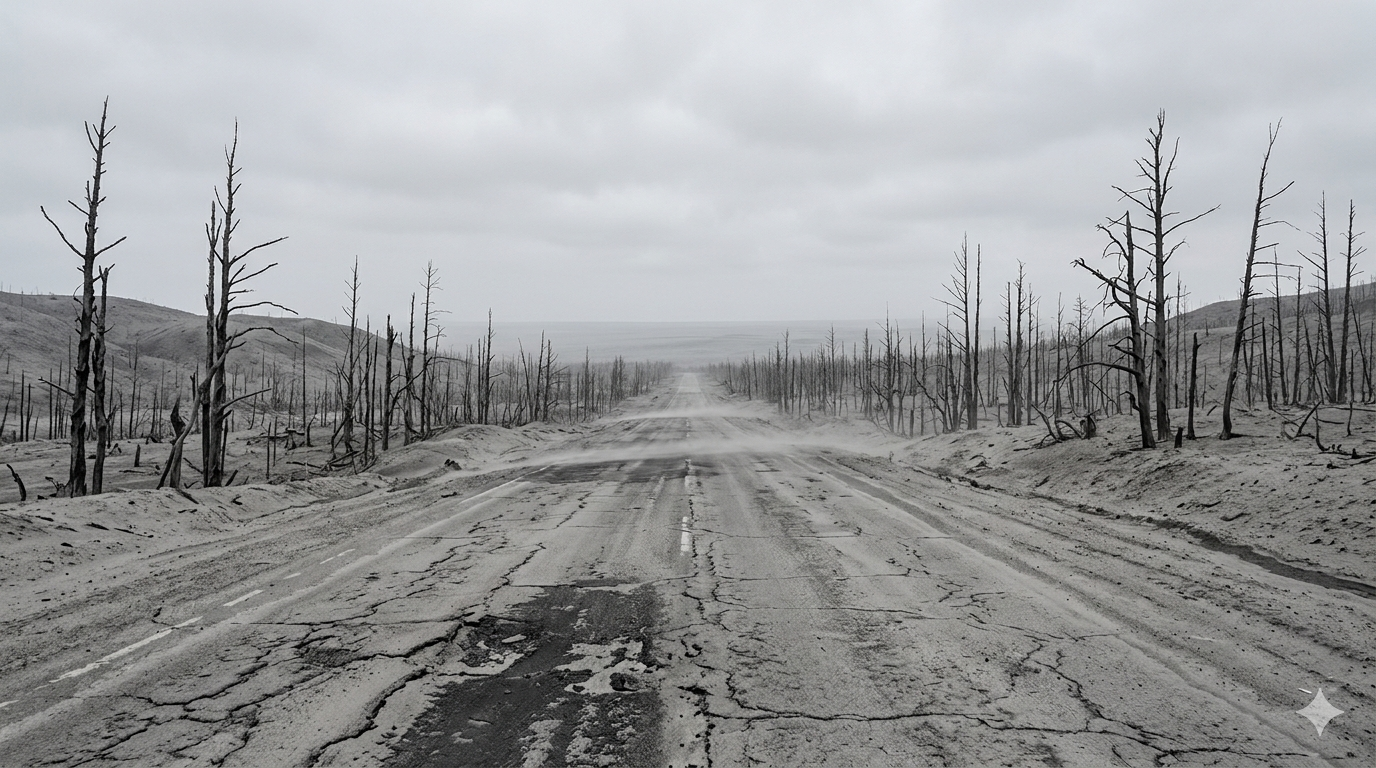
It establishes the world. The world is dark, cold, silent, and dangerous. The man’s careful checking of the child is necessary because the conditions of the world require it. The paragraph does not explain what has happened to the world. It does not need to. The careful checking tells the reader everything they need to know about the situation in which the novel is set.
It establishes the prose’s relationship to information. McCarthy does not explain. He describes. The world is rendered through observed detail rather than through summary or backstory. The reader is given the experience of the world rather than the explanation of it. This will be the novel’s method throughout. The reader will learn what has happened to the world only by inference, only gradually, only through what the characters notice as they move through it.
A hundred words. Five things. This is what the prose is doing on the first page. It will continue to do five things at once, in roughly a hundred words at a time, for the rest of the book.
The Refusal of Backstory
One of the most consistent features of the novel is its refusal to explain what has happened to the world.
The reader knows, by the end of the book, that some sort of catastrophe has occurred. The sun is blocked. The trees are dead. The animals are gone. Ash falls. Most of humanity is gone, and the surviving humans are starving. But the reader does not know what caused this. McCarthy never says. There are a few oblique references to flashes of light, to clocks stopping at a particular moment, to the sky changing colour. These references are scattered, fragmentary, and never assembled into an explanation.

This refusal is not laziness. It is one of the novel’s most deliberate strategies. McCarthy has thought carefully about what kind of catastrophe to leave unexplained, and he has chosen the kind that would, in a survivor’s actual experience, be unexplained. The survivors of a catastrophe of this magnitude would not have access to authoritative information about what had happened. They would have rumours, fragments, theories. They would not have the comfort of a known cause.
The novel performs this epistemological condition. The reader is placed in the same position as the man, which is to say, in the position of someone who knows the world has ended and does not know why. The unknowability is the point. The novel refuses to give the reader the consolation of explanation because the characters do not have that consolation.
This is what distinguishes The Road from most other post-apocalyptic novels. Most of them explain. They give the reader the plague, the nuclear war, the alien invasion, the climate collapse, the engineered virus. The explanation reassures the reader that the world is comprehensible. The Road refuses this reassurance. The world is what the characters can see and touch. What caused it is not within the novel’s purview, because it is not within the characters’ purview either.
This is one of the most rigorous things the novel does, and it is one of the things the popular summary erases entirely. The summary says, it is a post-apocalyptic novel about a father and son. The summary supplies a category. The novel itself refuses the category. The novel is doing something specifically harder, which is to render the experience of catastrophe without giving the reader the apparatus to step back from it.
The Naming Problem
The two central characters in the novel do not have names.
The man is the man. The boy is the boy. They are referred to as such throughout. They occasionally call each other other things. The boy calls the man Papa. The man calls the boy a number of small endearments. But neither character is given a proper name in the narration, even in the closest interior moments.
This is, again, a deliberate choice. McCarthy has thought about what it would mean to name them and has decided that the cost of naming them would be greater than the cost of not naming them.
Naming would have placed them in the world the novel has erased. Names belong to a system of records, families, civic registration, social existence. The man and the boy live in a world where this system no longer functions. Naming them would have implied that the system was still operating somewhere, that the names had meaning beyond the immediate context of the relationship between the two of them. McCarthy does not want this implication. He wants the characters to be radically reduced to their relationship and to the world they are moving through. Names would have undone the reduction.
The unnaming also performs something at the level of the reader’s experience. A named character is a character with a history that exists prior to the novel. The reader has someone to refer to. The reader can imagine the character outside the events of the book. The man and the boy have no such existence. They are only what they do in the novel. The reader cannot imagine them before the events. The reader cannot imagine them after the events. They exist in the present tense of the walking, and the unnaming enforces this.
This is one of the most important formal decisions in the novel, and it is the kind of decision the popular summary cannot register. The summary refers to the characters as the father and the son, which is reasonable but slightly wrong. The characters are not the father and the son. They are the man and the boy. The difference is small in vocabulary and large in implication. The father and the son are members of a family that the world might still recognise. The man and the boy are creatures who have been reduced to their relationship, with the relationship being all that remains of the world that produced them.
The Conversations
The two characters speak to each other throughout the novel. The conversations are short. They are written without quotation marks, with each speaker’s lines on a new line. The conversations are one of the most distinctive features of the prose.
A typical conversation might go something like this in summary. The boy asks the man whether they are still the good guys. The man says yes. The boy asks whether they would ever eat anyone. The man says no. The boy asks whether they are carrying the fire. The man says yes. The boy is reassured, briefly. The conversation ends.
The conversations have a particular structure. They are almost always initiated by the boy. The boy asks a question. The man answers it, often with a single word. The boy presses the question, sometimes in a slightly different form. The man answers again. The exchange ends when the boy is reassured, or when the man’s answer has reached the limit of what he is willing to say.
This structure is doing several things at once. It is performing the relationship between the two characters, which is one of a child who depends on his father for reassurance and a father who is running out of ways to provide it. It is also performing the gradual narrowing of what can be said between them. As the novel progresses, the boy’s questions become harder, and the man’s answers become more careful. The man cannot lie to the boy without breaking the moral framework they are both trying to maintain. He also cannot tell the boy the truth without breaking the boy. The conversations are the working out of this impossible position, exchange by exchange, page by page.
The phrase carrying the fire recurs throughout the conversations. The boy returns to it repeatedly. The man uses it to reassure him. The phrase is never explained. It is a private vocabulary the two characters have developed for what they are doing, which is something to do with maintaining moral coherence in a world that no longer rewards it. The fire is not a literal fire. The fire is not exactly a metaphor either. It is a word the characters use among themselves, with a meaning that exists only inside the relationship.
The reader who reads the novel attentively comes to understand what carrying the fire means by inference, through repetition, through the contexts in which it is invoked. The reader who reads quickly may miss it entirely, or may register it only as a vague gesture toward moral resolve. The novel is doing something specific with the phrase. It is showing the reader how moral language survives in a context where the social structures that gave moral language its weight have collapsed. The phrase is private because it has to be. Public moral language has been emptied. The characters have built, between themselves, a tiny vocabulary that still does the work.
The Ending
The ending of the novel has been widely discussed and widely misunderstood. Let me try to describe it carefully.
The man dies. The boy is alone. Within hours, possibly a day, a stranger appears. The stranger is a man with a wife and two children. The stranger asks the boy whether he wants to come with them. The boy, after some hesitation, agrees. The novel ends with a coda about brook trout in mountain streams.
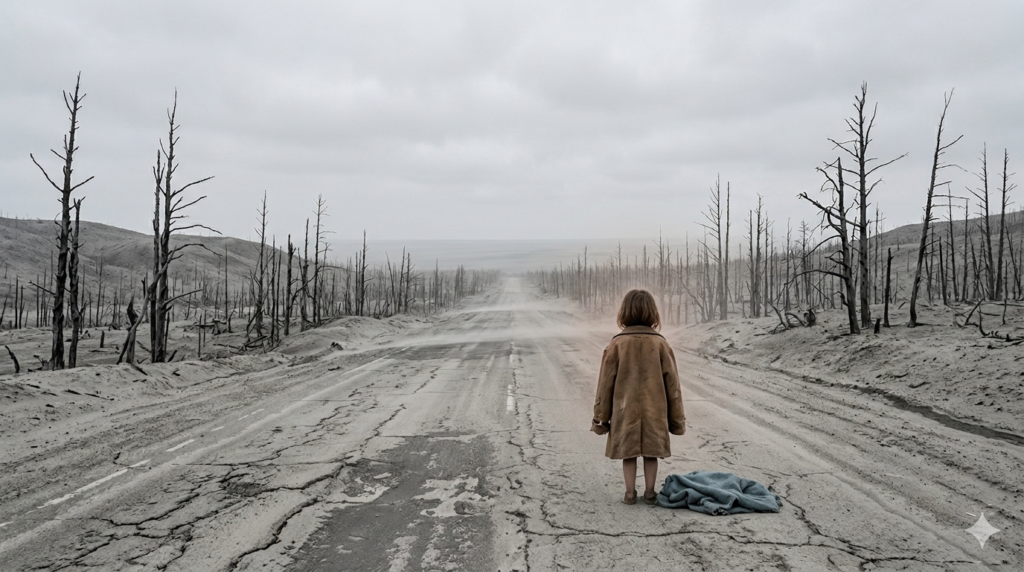
The popular reading of this ending is that it is hopeful. The boy has been saved. The good people have appeared. The world will continue. The brook trout coda is sometimes read as ambiguous, sometimes as elegiac, but the ending as a whole is generally received as a kind of redemption.
This reading is not exactly wrong, but it is, on a careful reading of the novel, not exactly right either.
The novel has spent three hundred pages establishing that strangers cannot be trusted. The man’s entire pedagogical project with the boy has been to teach him this. Most of the other humans they encounter want to kill them, eat them, enslave them. The few who do not want to harm them are also in such desperate circumstances that they cannot help. The novel has been, in its way, an extended argument for the moral isolation of the man and the boy.
The ending then reverses this. A stranger appears. The boy goes with him. The stranger is presented as one of the good guys. The boy is presented as having found, at the last possible moment, a community that will take him in.
This reversal can be read as the novel’s redemption, but it can equally be read as the novel’s most unstable moment. The reader does not know whether the stranger is actually one of the good guys. The reader does not know whether the boy will be safe. The novel ends before the verification is possible. The boy has made a choice. The reader is left holding the choice without being told whether it was the right one.
The brook trout coda makes this instability worse, not better. The coda describes a world that no longer exists. It mourns the lost beauty of a creation that the catastrophe has destroyed. The coda is, in tone, elegiac rather than hopeful. It does not suggest that the world is recovering. It suggests that the world is mostly gone and that what is gone cannot be replaced.
So the ending is doing two things at once. It is offering the boy a chance at survival, and it is mourning the world that the survival will not be able to recover. The ending is, on a careful reading, more honest than the popular summary allows. It is neither hopeful nor hopeless. It is the precise rendering of the small kind of hope that is possible at the end of a catastrophe, which is the hope of one child going with one family into a world that is still, in almost every way, ending.
This is what the prose has been preparing the reader for the whole time. The prose has been refusing easy emotions throughout. It has refused the easy despair of pure bleakness and the easy hope of straightforward redemption. The ending continues this refusal. The reader who has been trained, by the prose, to refuse easy emotions can absorb the ending in the spirit it is offered. The reader who has been reading at the level of plot summary cannot, because plot summary does not have the texture to register what the ending is doing.
What the Novel Is About
I have been avoiding the question of what the novel is about, because the popular readings of the novel have answered this question in ways the novel itself does not quite support.
The popular reading is that the novel is about love. The father loves the son. The son loves the father. The love survives even the worst possible conditions. This is a reasonable thing to say about the novel, but it is not exactly what the novel is doing.
The novel is, more precisely, about the maintenance of a particular kind of moral coherence under conditions designed to destroy it. The man’s project, throughout the novel, is to raise the boy as a person who can recognise himself as one of the good guys. The conditions of the world make this project nearly impossible. The man has to commit small acts of moral compromise himself in order to keep the boy alive. He has to teach the boy lessons that are at odds with the framework he is trying to instil. He has to lie to the boy about what is happening. He has to lie to himself.
The novel tracks this project through to its end. The man dies before he can know whether the project has succeeded. The boy, at the end, encounters a stranger and must apply, on his own, the framework his father has been trying to give him. The reader does not know whether the framework will hold. The novel ends in this uncertainty.
This is, on a careful reading, a much more rigorous argument than the popular summary attributes to the novel. The novel is not making the easy claim that love survives. It is making the harder claim that moral coherence can be transmitted from one person to another through small consistent acts performed over time, and that the transmission is fragile, and that the only test of whether it has succeeded is whether the receiving person can act on the framework when the transmitting person is no longer there to enforce it.
This is what The Road is doing. The prose is the means by which it does it. The reader who attends to the prose can see the argument being made, sentence by sentence, over the course of the novel. The reader who reads only the plot can see only the summary, and the summary, however accurate at its own level, is doing something different from what the book itself is doing.
Reading Between the Lines
The argument of this post is one I have made in different forms across many of the blog’s recent essays. The books that have entered popular reception have often been read at a level that does not engage with what the books are actually doing. The summaries that circulate are accurate at the level of plot but inaccurate at the level of literary work. The recovery of the actual book requires close reading, sentence by sentence, with attention to what the prose is performing.
In the case of The Road, the close reading recovers a novel that is more rigorous than the popular reception has allowed. The novel is not a meditation on love. It is a meditation on the transmission of moral coherence under conditions that resist it. The prose is engineered to perform this transmission for the reader, who is asked to absorb the moral framework alongside the boy, through the same small consistent acts of attention that the man is performing. The novel is, in a sense, training the reader to be the boy. The training works only if the reader attends.
This is what the book is for. It is one of the few novels published in the last twenty-five years that genuinely rewards repeated rereading. The first reading absorbs the plot. The second reading begins to register the prose. The third reading discloses the argument. The argument has been there all along. The reading practice required to see it has been less common than the book’s popularity might suggest.
Read the book again. Read it slowly. Read it sentence by sentence. The novel is short. It can be reread in two evenings.
The book has been on the shelf the whole time.
The careful reading is still available.
Read it as if you have never read it.
You probably have not.